



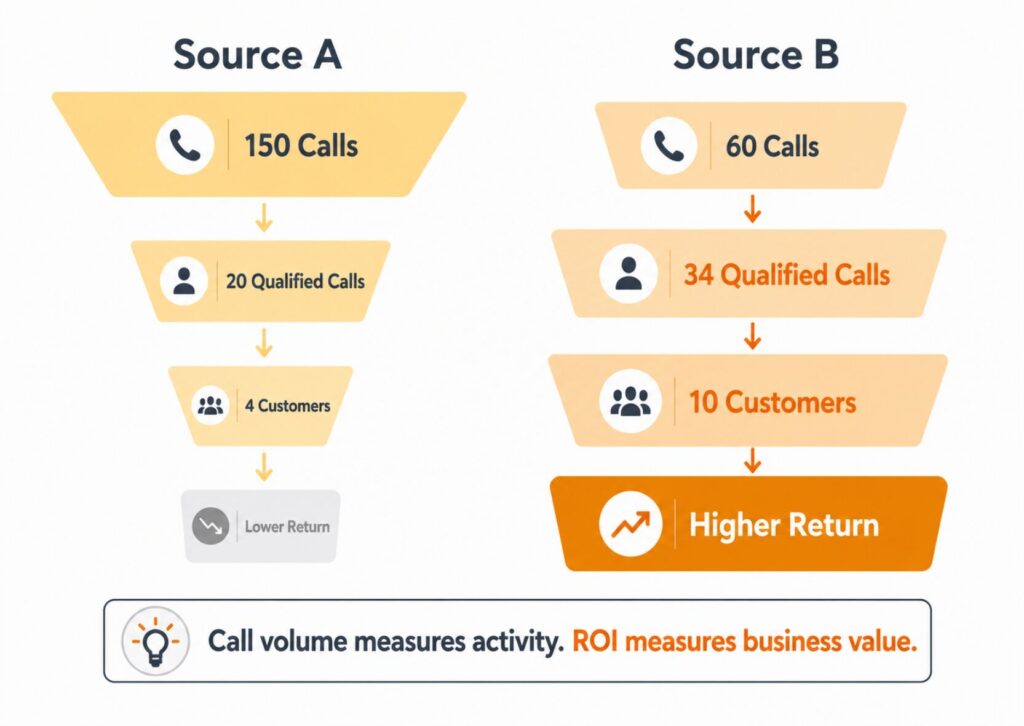
Call tracking ROI measures whether phone leads generated by campaigns and marketing channels produce enough qualified opportunities, customers, and revenue to justify the investment.
Call volume alone does not show business value. A campaign may generate many low-quality calls, while another source produces fewer calls but more appointments, sales opportunities, or revenue. Accurate ROI analysis, therefore, requires businesses to connect call sources to lead quality and downstream outcomes.
This guide explains how to calculate call-tracking ROI, compare source quality, identify the metrics that matter, avoid common measurement errors, and connect phone leads to business outcomes.
 What Is Call Tracking ROI?
 What Is Call Tracking ROI?
Call tracking ROI measures the financial return associated with phone leads generated by marketing campaigns, channels, keywords, landing pages, or other tracked sources. A useful ROI analysis connects the original call source with lead quality, business outcomes, revenue, and the costs required to generate those calls.
A basic call report may answer:
- How many calls came from Google Ads?
- Which landing page generated a call?
- Which campaign received the most calls?
An ROI-focused report goes further:
- Which source generated the most qualified calls?
- Which campaign produced the lowest cost per qualified call?
- Which callers booked appointments?
- Which phone leads became customers?
- Which source produced the most attributed revenue?
- Which campaigns generated calls but little business value?
Call Tracking ROI Formula
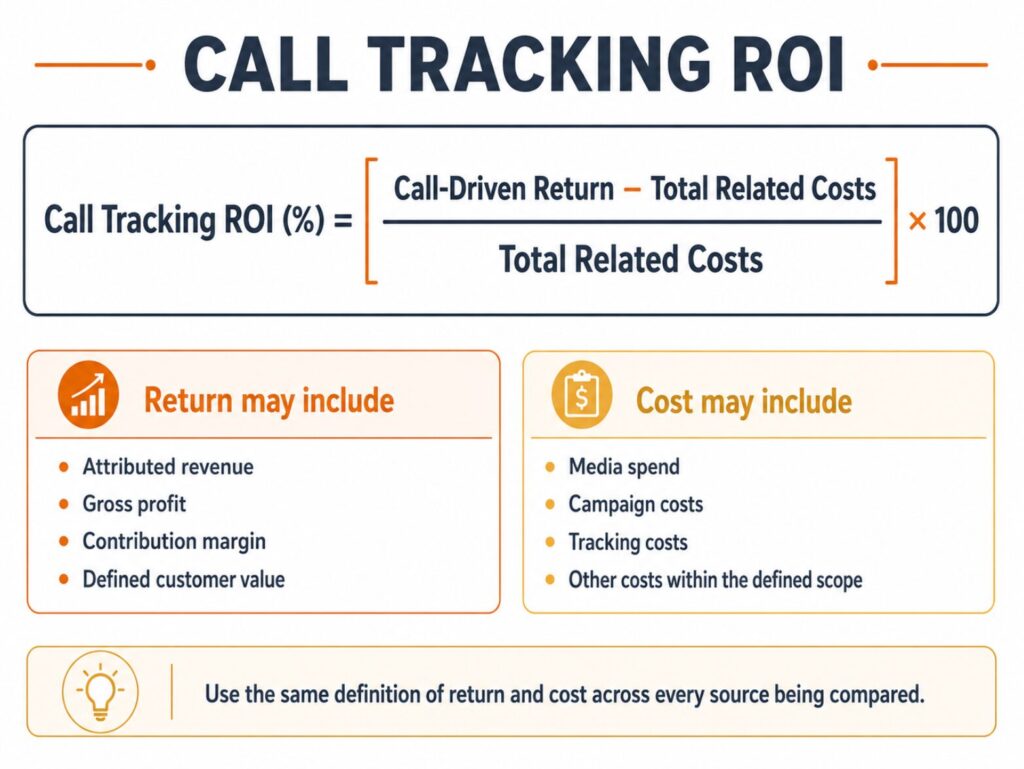 A business can use the following general formula:
Call Tracking ROI (%) = [(Return From Call-Driven Conversions − Total Related Costs) ÷ Total Related Costs] × 100
The definition of “return” should remain consistent across the analysis. Depending on available data and the reporting objective, a business may use:
- attributed revenue,
- gross profit,
- contribution margin,
- customer value,
- or another clearly defined financial outcome.
The same principle applies to cost. A campaign-level analysis may include media spend and directly related tracking costs, while a broader acquisition analysis may include other costs within a clearly stated scope.
Call Volume, Cost per Call, and ROI Are Not the Same
| Metric | What It Measures | Main Limitation |
| Call volume | The total number of calls | It does not show lead quality |
| Cost per call | The average spend required to generate a call | It treats valuable and irrelevant calls equally |
| Qualified call rate | The percentage of calls that meet defined lead criteria | It does not show the final financial outcome |
| Cost per qualified call | The spend required to generate a relevant phone lead | It does not show whether the lead became a customer |
| Revenue by source | The revenue associated with a campaign or channel | It may not reflect profit or total acquisition cost |
| Call tracking ROI | The financial return relative to defined costs | It requires reliable source, outcome, and cost data |
For that reason, the highest call volume does not automatically indicate the strongest marketing return.
How Do You Measure Call Tracking ROI?
An accurate call tracking ROI analysis follows the phone lead from the original marketing source to the final business outcome.
A useful process moves through seven connected stages:
Source → Qualification → Outcome → Revenue → Cost → ROI → Lead-Handling Leakage.
 1. Track Every Call Back to a Marketing Source
 1. Track Every Call Back to a Marketing Source
The first step is to identify where the call originated.
Depending on the campaign, a business may need to track calls from:
- Google Ads,
- organic search,
- social campaigns,
- email,
- local listings,
- landing pages,
- direct mail,
- print advertising,
- radio,
- billboards,
- partner campaigns,
- or other offline and online sources.
AvidTrak can assign tracking numbers to specific marketing sources and use dynamic number insertion to connect website calls with visitor and campaign context.
For a website visitor, the available attribution data may include details such as:
- the marketing channel,
- the campaign,
- the landing page,
- the referring source,
- and, where the setup supports it, keyword-level context.
Marketers working with paid search can also review AvidTrak’s guide to call tracking software for Google Ads for a closer look at campaign and keyword attribution.
Without reliable source tracking, the later ROI calculation starts with incomplete data.
2. Define What Counts as a Qualified Call
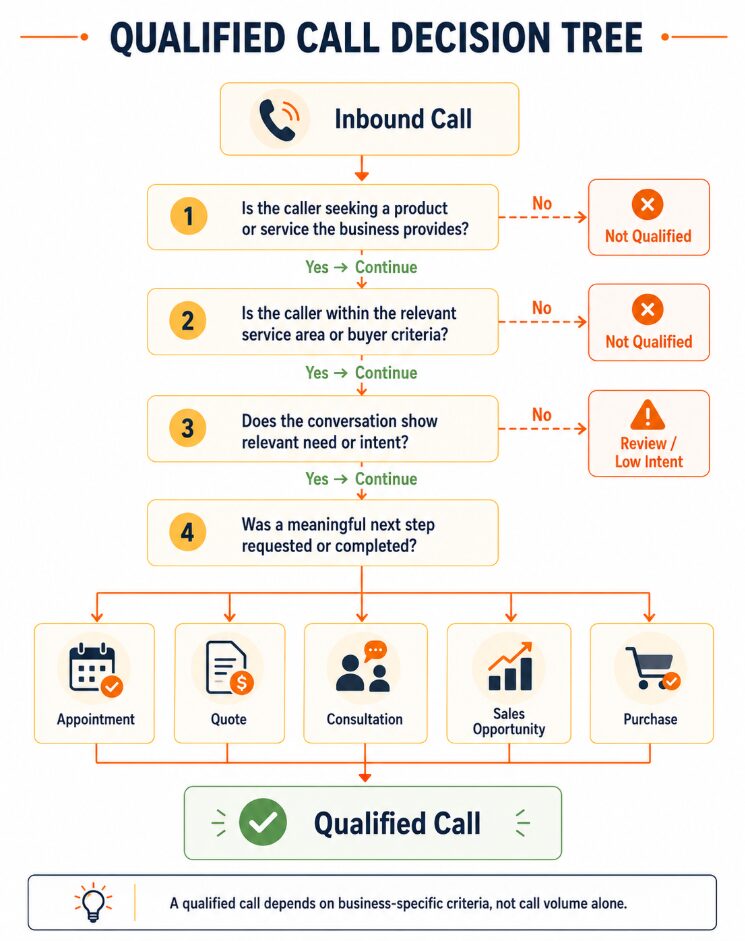 A qualified call is a phone conversation that meets the business criteria for a potentially valuable lead or outcome.
The definition should reflect the business model rather than a generic call-duration threshold.
A qualified call may involve a caller who:
- needs a service the business provides,
- lives within the service area,
- asks about pricing or availability,
- requests an appointment,
- discusses a relevant product,
- meets the company’s buyer criteria,
- or shows another clear sign of purchase intent.
For a dental practice, a new patient asking to book an appointment may qualify.
For an HVAC company, a homeowner requesting an air conditioning repair within the service area may qualify.
For a B2B software company, a decision-maker asking about pricing or a product demonstration may qualify.
By contrast, the following calls may not qualify as new opportunities:
- wrong numbers,
- spam calls,
- vendor calls,
- existing-customer support requests,
- job inquiries,
- out-of-area callers,
- or inquiries for services the business does not provide.
A useful ROI report should not assign equal value to all of these calls.
3. Track the Outcome of Each Valuable Call
Once the business identifies a qualified caller, the next step is to track what happened after or during the conversation.
Useful outcomes may include:
- an appointment booked,
- a quote requested,
- a consultation scheduled,
- a sales opportunity created,
- a purchase completed,
- a customer won,
- a follow-up required,
- a caller disqualified,
- or no action taken.
The correct outcome categories depend on the business.
For example, an appointment may be a meaningful conversion for a dental practice, while a sales-qualified opportunity may be more useful for a B2B company.
AvidTrak supports call recording where legally permitted and properly configured, along with AI-powered transcription and conversation analysis capabilities that can help teams review caller intent and call outcomes.
Rather than stopping at “a call happened,” a marketing team can ask, “What business result followed the call?”
4. Connect Call Outcomes With CRM or Revenue Data
A qualified call is valuable, but a qualified call is not always a customer.
For a stronger ROI analysis, the business should connect phone leads with downstream records such as:
- CRM contacts,
- opportunities,
- deal stages,
- appointments,
- closed sales,
- customer records,
- or revenue data.
AvidTrak can support connected reporting workflows with CRM and analytics systems, including platforms such as Salesforce, HubSpot, Zoho, Google Ads, and GA4, depending on the business setup.
This connection allows the team to compare:
- the original call source,
- the lead qualification,
- the conversation outcome,
- the later sales result,
- and the associated revenue.
Without downstream data, a campaign can appear successful because it produces many qualified calls even when few of those callers become customers.
5. Add the Full Cost of Generating Those Calls
An ROI calculation needs both a return and a cost.
Depending on the scope of the analysis, relevant costs may include:
- media spend,
- paid search spend,
- campaign costs,
- agency fees included within the chosen reporting scope,
- creative or placement costs,
- call tracking costs,
- and other defined acquisition expenses.
The key is consistency.
For example, comparing one channel using only media spend against another channel using media spend plus agency fees would produce a misleading result.
A business should define the cost basis before comparing ROI across campaigns or channels.
6. Calculate ROI by Campaign, Channel, or Source
Once source, outcome, revenue, and cost data are available, marketers can calculate ROI at the level most useful for the decision.
Examples include:
- ROI by channel,
- ROI by campaign,
- ROI by paid search campaign,
- ROI by keyword,
- ROI by landing page,
- ROI by location,
- ROI by offline placement,
- or ROI by client account for an agency.
A campaign-level calculation may look like this:
Campaign ROI (%) = [(Attributed Return − Campaign Cost) ÷ Campaign Cost] × 100
The result is more useful when the underlying attribution rules are clearly defined.
For a broader view of measurement, marketers can review AvidTrak’s guide to 126 call tracking metrics and KPIs.
7. Compare Financial Return With Lead-Handling Leakage
A strong marketing source can still produce a weak business result when incoming calls are not handled effectively.
Important leakage points include:
- missed calls,
- slow follow-up,
- poor routing,
- calls sent to the wrong location,
- long hold times,
- weak qualification,
- and inconsistent sales follow-up.
Suppose a paid campaign generates 40 high-intent calls but the business misses 12 of them. A weak revenue result does not necessarily mean the campaign generated poor demand.
The problem may sit between lead generation and lead handling.
A useful call tracking ROI analysis therefore asks two separate questions:
- Did the source generate valuable demand?
- Did the business convert that demand effectively?
AvidTrak can help teams review missed-call patterns, call routing performance, conversation outcomes, and source data together, giving marketers more context before they reduce or increase campaign spend.
Call Tracking ROI Example: Why More Calls Can Produce Less Revenue
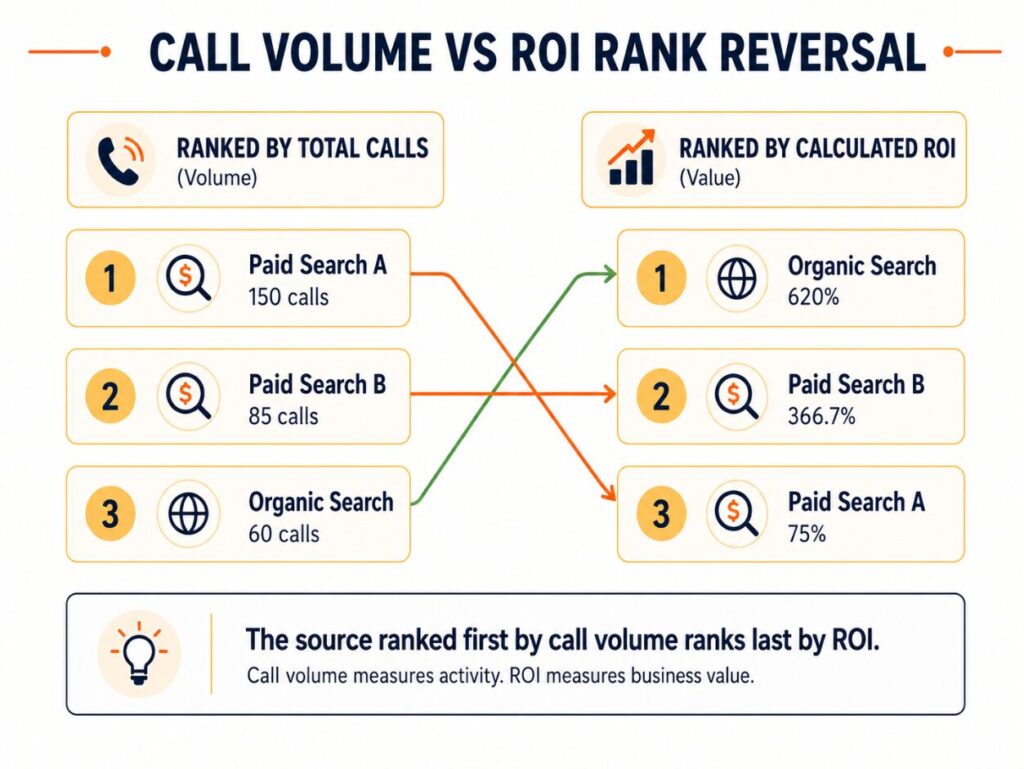 Consider a business comparing three marketing sources during the same reporting period.
| Source | Defined Cost | Total Calls | Qualified Calls | Customers | Attributed Revenue |
| Paid Search A | $4,000 | 150 | 20 | 4 | $7,000 |
| Paid Search B | $3,000 | 85 | 31 | 8 | $14,000 |
| Organic Search | $2,500 | 60 | 34 | 10 | $18,000 |
Based on call volume, Paid Search A appears to be the strongest source. The campaign generated 150 calls, almost three times the organic search volume.
The outcome data tells a different story.
Paid Search A
- 150 total calls
- 20 qualified calls
- 4 customers
- $7,000 in attributed revenue
Qualified call rate = 20 ÷ 150 × 100 = 13.3%
Using attributed revenue as the defined return for this simplified example:
ROI = ($7,000 − $4,000) ÷ $4,000 × 100 = 75%
Paid Search B
- 85 total calls
- 31 qualified calls
- 8 customers
- $14,000 in attributed revenue
Qualified call rate = 31 ÷ 85 × 100 = 36.5%
ROI = ($14,000 − $3,000) ÷ $3,000 × 100 = 366.7%
Organic Search
- 60 total calls
- 34 qualified calls
- 10 customers
- $18,000 in attributed revenue
Qualified call rate = 34 ÷ 60 × 100 = 56.7%
ROI = ($18,000 − $2,500) ÷ $2,500 × 100 = 620%
In this simplified example:
- Paid Search A wins on call volume.
- Paid Search B produces stronger qualified-call efficiency.
- Organic search generates the fewest calls but the highest qualified-call rate, the most customers, and the strongest calculated return.
The example shows why a marketer should not shift more budget toward a source merely because the phone rings more often.
A higher call count can coexist with weaker lead quality and a lower financial return.
Why Can Call Volume Misrepresent Marketing ROI?
Call volume is useful for measuring activity, but it can hide major differences in caller value.
| A High Call Count May Hide | Why It Matters |
| Unqualified inquiries | More calls do not necessarily mean more sales opportunities |
| Repeat callers | One person may generate several calls |
| Wrong-location leads | The business may be unable to serve the caller |
| Existing-customer support calls | Support demand can inflate acquisition reports |
| Job or vendor inquiries | The calls may have no lead value |
| Missed high-intent calls | Valuable demand may never reach a conversion |
| Low-value outcomes | Calls may not become appointments, opportunities, or customers |
| Weak campaign targeting | A campaign may generate interest from the wrong audience |
Consider two campaigns:
- Campaign A generates 120 calls and 15 qualified opportunities.
- Campaign B generates 70 calls and 28 qualified opportunities.
Campaign A wins on volume.
Campaign B wins on qualified opportunities.
Once customer and revenue data are added, the difference may become even greater.
The better question is therefore not:
- Which source generated the most calls?
The better questions are:
- Which source generated the most valuable calls?
- Which source produced those calls at an acceptable cost?
- Which source created the strongest business return?
Which Metrics Matter Most for Call Tracking ROI?
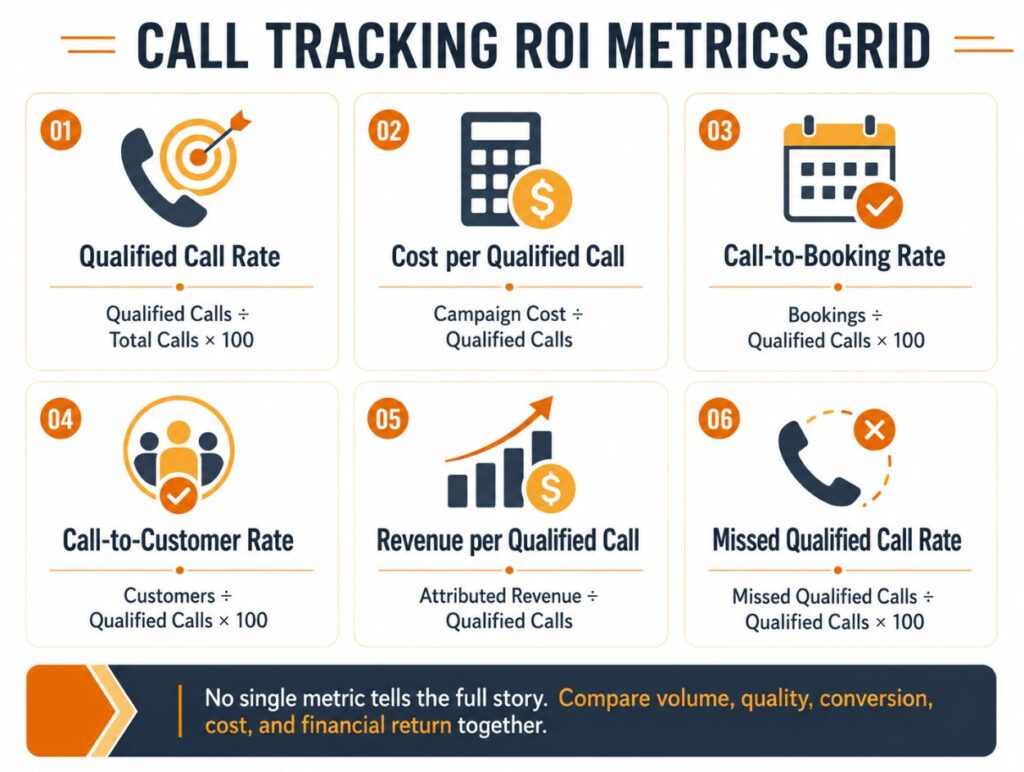 A call tracking ROI report should focus on metrics that help a business compare costs, quality, conversion rates, and financial outcomes.
Qualified Call Rate
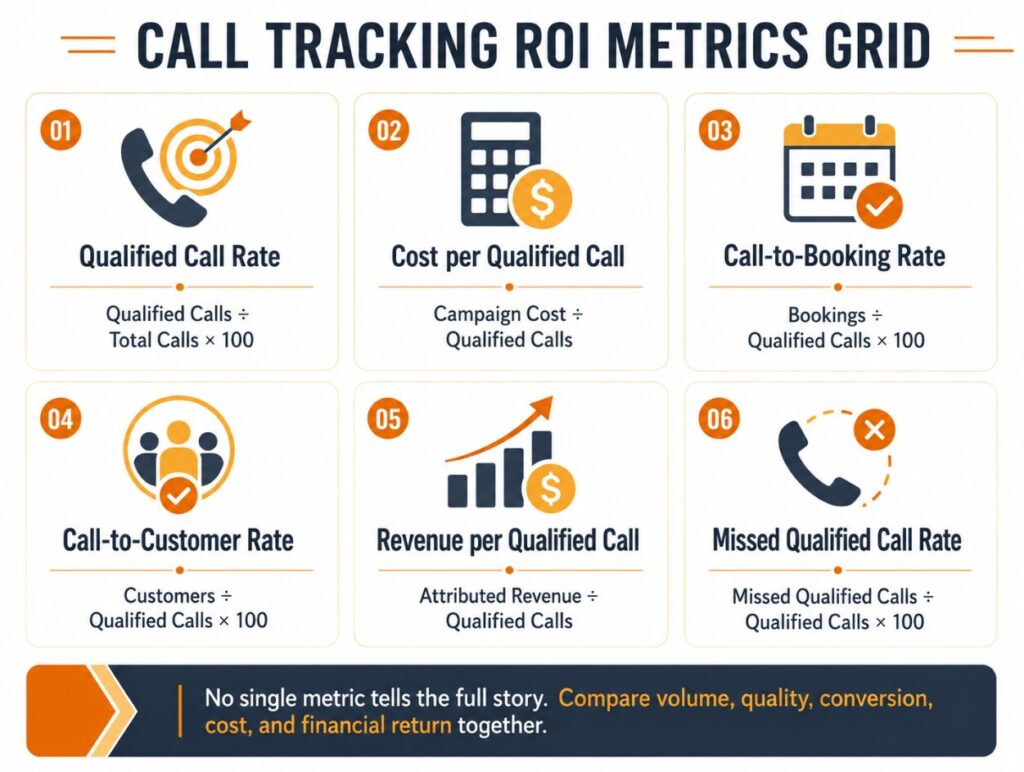
Qualified Call Rate = Qualified Calls ÷ Total Calls × 100
The qualified call rate shows what percentage of calls meet the business criteria for a valuable lead.
A campaign with 200 calls and 20 qualified calls has a 10% qualified call rate.
A campaign with 80 calls and 32 qualified calls has a 40% qualified call rate.
The second campaign produces fewer calls but a much stronger concentration of relevant opportunities.
Cost per Qualified Call
Cost per Qualified Call = Defined Campaign Cost ÷ Qualified Calls
Suppose:
- Campaign A costs $4,000 and produces 20 qualified calls.
- Campaign B costs $3,000 and produces 30 qualified calls.
The cost per qualified call would be:
- Campaign A: $200
- Campaign B: $100
A standard cost-per-call metric could miss that difference if Campaign A generates many low-value calls.
Call-to-Booking Rate
Call-to-Booking Rate = Bookings ÷ Qualified Calls × 100
This metric helps businesses such as:
- dental practices,
- home service companies,
- legal firms,
- automotive businesses,
- healthcare providers,
- and appointment-based companies.
The metric shows whether qualified demand progresses into a meaningful next step.
Call-to-Customer Rate
Call-to-Customer Rate = Customers From Tracked Calls ÷ Qualified Calls × 100
The call-to-customer rate connects lead quality with final conversion.
A campaign may produce many qualified calls but still perform poorly if few callers become customers.
Revenue per Qualified Call
Revenue per Qualified Call = Attributed Call Revenue ÷ Qualified Calls
This metric helps compare the average financial value generated from qualified phone leads.
For example:
- Source A generates 40 qualified calls and $20,000 in attributed revenue.
- Source B generates 25 qualified calls and $22,500 in attributed revenue.
Revenue per qualified call would be:
- Source A: $500
- Source B: $900
Source B produces fewer qualified calls but more revenue per qualified opportunity.
Missed Qualified Call Rate
Missed Qualified Call Rate = Missed Qualified Calls ÷ Qualified Calls × 100
A high missed qualified call rate may indicate that a business is losing valuable demand after paying to generate it.
This metric can be particularly important for businesses where callers often contact several providers before making a decision.
Revenue by Source
Revenue by source shows how much attributed revenue is associated with each:
- campaign,
- channel,
- keyword,
- landing page,
- location,
- or other tracked source.
The metric helps marketers compare business outcomes rather than activity alone.
ROI by Source
ROI by source compares the defined return from a source with the defined cost of that source.
The analysis can help answer:
- Which campaigns deserve more budget?
- Which campaigns need better targeting?
- Which sources produce cheap calls but expensive customers?
- Which low-volume channels generate high-value opportunities?
- Which campaigns look weak because valuable calls are being missed?
For a wider list of phone performance measures, AvidTrak’s call tracking metrics and KPIs guide covers attribution, lead quality, response, revenue, and reporting metrics in greater depth.
What Can Distort Call Tracking ROI?
Even a well-designed report can produce weak conclusions when the underlying measurement rules are inconsistent.
Treating Every Call as a Lead
Not every inbound call represents a new sales opportunity.
A total call count may include:
- spam,
- support calls,
- repeat callers,
- wrong numbers,
- vendor inquiries,
- job seekers,
- and out-of-area prospects.
When every call receives equal value, weak campaigns can look stronger than they are.
Comparing Cost per Call Without Lead Quality
A low cost per call may appear efficient.
However, consider:
- Campaign A: $20 per call and a 10% qualified call rate.
- Campaign B: $35 per call and a 50% qualified call rate.
Campaign B looks more expensive at the call level but may produce qualified opportunities at a much lower cost.
A cost-per-call metric should therefore be reviewed with qualification and outcome data.
Counting Repeat Callers as New Opportunities
A single person may call several times before:
- making a purchase,
- confirming an appointment,
- requesting an update,
- or speaking with a different team member.
Counting each call as a separate new lead can inflate performance.
Caller identity, repeat-call behavior, CRM records, and outcome tracking can provide a more accurate picture.
Ignoring Missed Calls
A campaign may generate valuable demand that the business fails to answer.
For example:
- Campaign A generates 30 qualified calls and answers 28.
- Campaign B generates 35 qualified calls but misses 15.
A weak customer result from Campaign B may reflect a handling problem rather than a source-quality problem.
Before cutting the campaign, the team should review both marketing performance and call response.
Stopping Measurement at the Booking Stage
A booking is a meaningful outcome for many businesses, but it may not be the final financial result.
Some booked appointments:
- cancel,
- fail to attend,
- do not purchase,
- or generate different customer values.
Where possible, a business should connect the tracked phone lead with later customer and revenue outcomes.
Using Inconsistent Attribution Rules
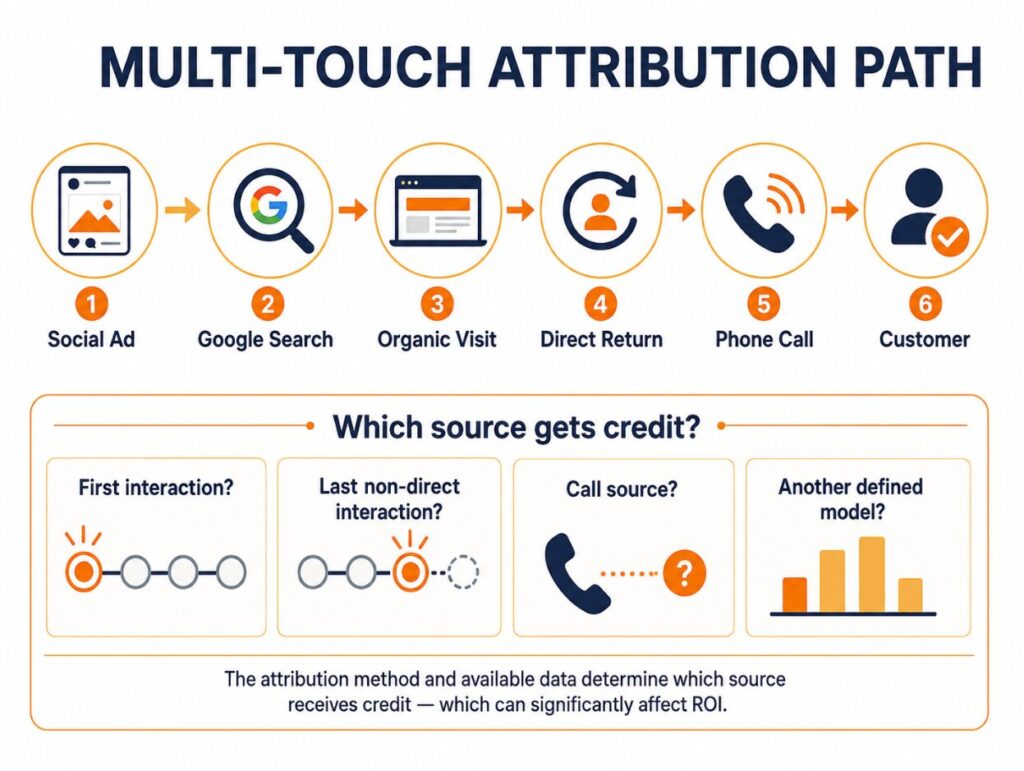 A caller may interact with several marketing touchpoints before making a phone call.
For example, a person may:
- click a social ad,
- later search on Google,
- visit an organic result,
- return directly,
- then call.
The source credited with the conversion depends on the attribution method and available data.
A business should use clear, consistent attribution rules rather than changing the model from one campaign comparison to another.
Comparing Revenue Without Comparing Cost
A source that generates $50,000 in attributed revenue is not automatically better than a source generating $35,000.
The result depends on the cost required to generate that return.
For example:
- Source A generates $50,000 from $40,000 in defined costs.
- Source B generates $35,000 from $10,000 in defined costs.
Revenue alone does not answer the ROI question.
How Should Marketers Compare ROI Across Different Call Sources?
Different marketing channels produce different caller behaviors. The same quality signals should not always receive equal weight across every source.
| Source | What to Track | Main ROI Risk |
| Paid search | Campaign, keyword context, cost, qualified-call rate, customer outcome | High call volume can hide expensive low-quality calls |
| Organic search | Landing page, source context, qualified outcomes, revenue | Phone revenue may remain disconnected from the original visit |
| Local listings | Listing source, location, call reason, outcome | Support and direction calls may inflate acquisition totals |
| Social campaigns | Campaign, audience, caller intent, downstream conversion | Casual interest may look like purchase demand |
| Campaign, customer status, call outcome | Existing customers may be mixed with new leads | |
| Offline media | Source-specific number, placement, outcome, revenue | Weak source tracking can hide placement performance |
| Direct traffic | Caller status, visit context, outcome | The original acquisition source may remain unclear |
Paid Search
For paid search, call tracking ROI should compare more than total calls and cost per call.
Useful questions include:
- Which campaigns produce qualified calls?
- Which keywords produce sales-ready conversations?
- Which campaigns create appointments or customers?
- What is the cost per qualified call?
- What revenue is connected with each campaign?
AvidTrak’s Google Ads call tracking software guide provides a closer comparison of platforms for paid-search attribution, lead quality, and reporting.
Organic Search
For organic search, marketers may need to connect calls with:
- landing pages,
- content topics,
- visitor paths,
- qualified outcomes,
- and downstream revenue.
A page with modest traffic can generate a strong return if the visitors who call have high purchase intent.
Local Listings
For local listings, total call volume can be particularly misleading.
Calls may include:
- new prospects,
- existing customers,
- requests for directions,
- opening-hour questions,
- service inquiries,
- or support issues.
Outcome classification helps separate acquisition value from general call activity.
Offline Campaigns
Offline sources such as direct mail, print, radio, and billboards can use source-specific tracking numbers to connect calls with individual placements.
Without that source separation, the business may know that calls increased but not which placement generated the response.
How AvidTrak Connects Call Sources With ROI Outcomes
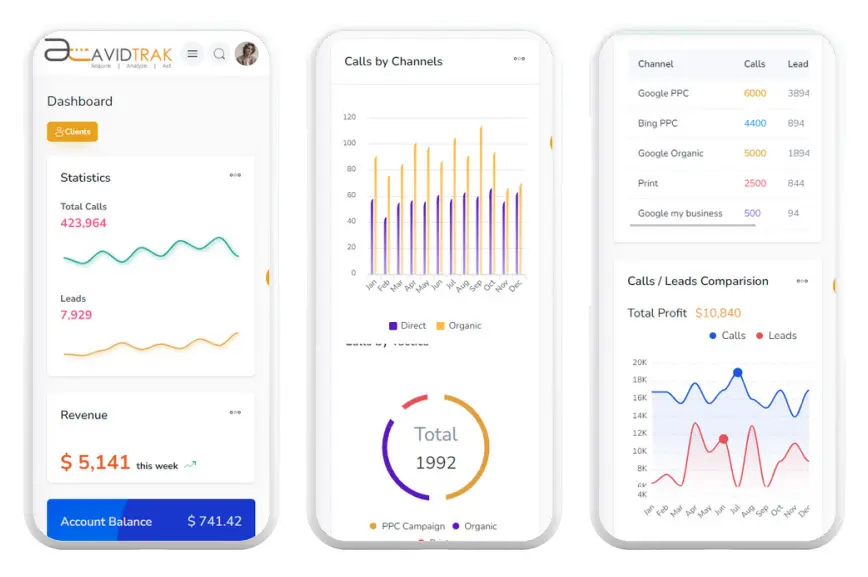 AvidTrak is a call tracking and attribution platform that helps businesses connect inbound phone calls with marketing sources, conversation data, lead outcomes, and downstream reporting.
Rather than judging performance by call volume alone, marketing and revenue teams can use connected data to examine the value behind the calls.
Connect Calls With Campaigns and Keywords
AvidTrak helps businesses identify which marketing sources generate inbound calls.
Depending on the tracking setup, teams can connect calls with:
- campaigns,
- channels,
- landing pages,
- online sources,
- offline placements,
- and keyword-level context.
Dynamic number insertion can show different tracking numbers based on visitor and source conditions, helping the business connect a website call with relevant marketing context.
The source data forms the first layer of an ROI analysis.
Identify Qualified Calls and Buyer Intent
A source report shows where a call came from. Conversation data helps explain what happened next.
With call recording where legally permitted and properly configured, along with transcription and conversation analysis capabilities, AvidTrak can help teams review signals such as:
- the caller’s reason for contacting the business,
- product or service interest,
- qualification,
- appointment intent,
- pricing questions,
- sales intent,
- and call outcomes.
This context helps separate a valuable opportunity from a low-value or irrelevant call.
Connect Phone Leads With CRM Outcomes
A phone lead may continue through several later stages before producing revenue.
AvidTrak can support connected workflows with CRM and reporting systems so teams can compare call-source data with later outcomes.
Depending on the setup, that process may involve platforms such as:
- Salesforce,
- HubSpot,
- Zoho,
- Google Ads,
- and GA4.
The resulting view can help a business connect:
Marketing Source → Phone Call → Qualification → Sales Outcome → Revenue
For marketers comparing software options around this use case, AvidTrak also maintains a guide to call attribution software for marketing ROI.
Find Missed Calls and Lead-Handling Gaps
A marketing campaign can generate valuable phone demand without producing the expected revenue when the business fails to handle those calls effectively.
AvidTrak can help teams examine:
- missed calls,
- call routing,
- call outcomes,
- response patterns,
- and source data.
This context matters when a campaign appears to underperform.
Before reducing spend, a marketing team can ask:
- Did the campaign generate qualified calls?
- Were those calls answered?
- Did the calls reach the right team?
- Was follow-up required?
- Did valuable opportunities stop progressing after the call?
The answers help separate a marketing problem from an operational problem.
Compare Source Performance Beyond Call Counts
By connecting call-source data with qualification, outcomes, and downstream information, AvidTrak helps marketers compare sources using business value rather than call totals alone.
A team can examine questions such as:
- Which campaign generates the highest qualified call rate?
- Which source produces the lowest cost per qualified call?
- Which landing pages create valuable phone leads?
- Which campaigns generate appointments?
- Which channels produce customers?
- Where are valuable calls being missed?
- Which sources deserve further investment?
For businesses comparing broader platform options, AvidTrak’s guide to the best call tracking software reviews platforms for attribution, call recording, dynamic number insertion, analytics, routing, and related requirements.
When Is Call Tracking ROI Most Useful?
Call tracking ROI can support any business that relies on phone conversations as part of lead generation, sales, bookings, or customer acquisition.
The approach becomes particularly useful in the following situations.
Businesses Running Multiple Paid Campaigns
When a business runs several paid campaigns at once, total conversions may not show which campaigns generate valuable phone leads.
An ROI framework can compare:
- spend,
- qualified calls,
- bookings,
- customers,
- and attributed return.
Agencies Reporting Marketing Value to Clients
An agency may report:
- clicks,
- impressions,
- form submissions,
- and total calls.
Clients may still ask which marketing activity produced genuine opportunities.
By connecting calls with qualification and outcomes, an agency can report beyond call quantity.
Multi-Location Businesses
A multi-location business may need to compare:
- location-level demand,
- campaign performance,
- call handling,
- qualified callers,
- and business outcomes.
A high-performing campaign can still lose value if calls are routed incorrectly or missed at a specific location.
Call-Heavy Service Businesses
Phone leads are particularly important for businesses such as:
- HVAC companies,
- plumbers,
- roofing companies,
- legal firms,
- dental practices,
- automotive businesses,
- healthcare providers,
- and other service companies.
For these businesses, a large portion of valuable demand may move through phone conversations rather than forms alone.
Marketing and Sales Teams Connecting Lead Sources With Revenue
Marketing teams often know which campaigns generate leads.
Sales teams often know which opportunities become customers.
Call tracking ROI becomes more useful when those two views are connected.
AvidTrak can help teams connect the original inbound call source with later qualification and outcome data so marketing performance can be reviewed against business results.
Stop Optimizing for More Calls When Better Calls Drive More Revenue
A campaign should not earn more budget merely because it generates the most phone calls.
A stronger decision considers:
- where the calls came from,
- whether the callers were qualified,
- what happened during or after the conversation,
- which callers became customers,
- how much return the source generated,
- and whether missed calls or weak follow-up reduced the final result.
AvidTrak helps marketing and revenue teams connect inbound calls with campaigns, keywords, conversation outcomes, CRM data, and source-level performance.
Instead of stopping at call volume, AvidTrak gives teams the context needed to compare phone lead quality and marketing value.
Frequently Asked Questions
1. What is call tracking ROI?
Call tracking ROI measures the financial return associated with phone leads generated by marketing sources. It compares defined call-driven returns with the costs required to produce those outcomes.
2. How do you calculate call tracking ROI?
A common formula is: [(Return from call-driven conversions − total related costs) ÷ total related costs] × 100. The business should clearly define both return and cost.
3. What is a good ROI for call tracking?
A good call tracking ROI depends on margins, customer value, acquisition costs, sales cycles, and business goals. The most useful comparison is often against the company’s required return and alternative marketing investments.
4. How do you calculate cost per qualified call?
Divide the defined campaign cost by the number of qualified calls. For example, a $3,000 campaign generating 30 qualified calls has a cost per qualified call of $100.
5. Why can a high call volume produce a low ROI?
A high call volume may include unqualified inquiries, repeat callers, support calls, wrong-location leads, or low-value outcomes. Source quality and customer results matter more than volume alone.
6. Can call tracking connect phone calls with revenue?
Yes. When call-source data is connected with CRM, sales, booking, or customer records, a business can associate tracked calls with downstream outcomes and attributed revenue.
7. How do missed calls affect marketing ROI?
Missed calls can reduce the return from otherwise strong campaigns because the business pays to generate demand but fails to convert some valuable callers into appointments, opportunities, or customers.
8. How does AvidTrak measure source and call quality?
AvidTrak connects inbound calls with marketing-source data and supports call recording, transcription, outcome analysis, integrations, and reporting workflows that help teams compare source performance beyond raw call counts.


