


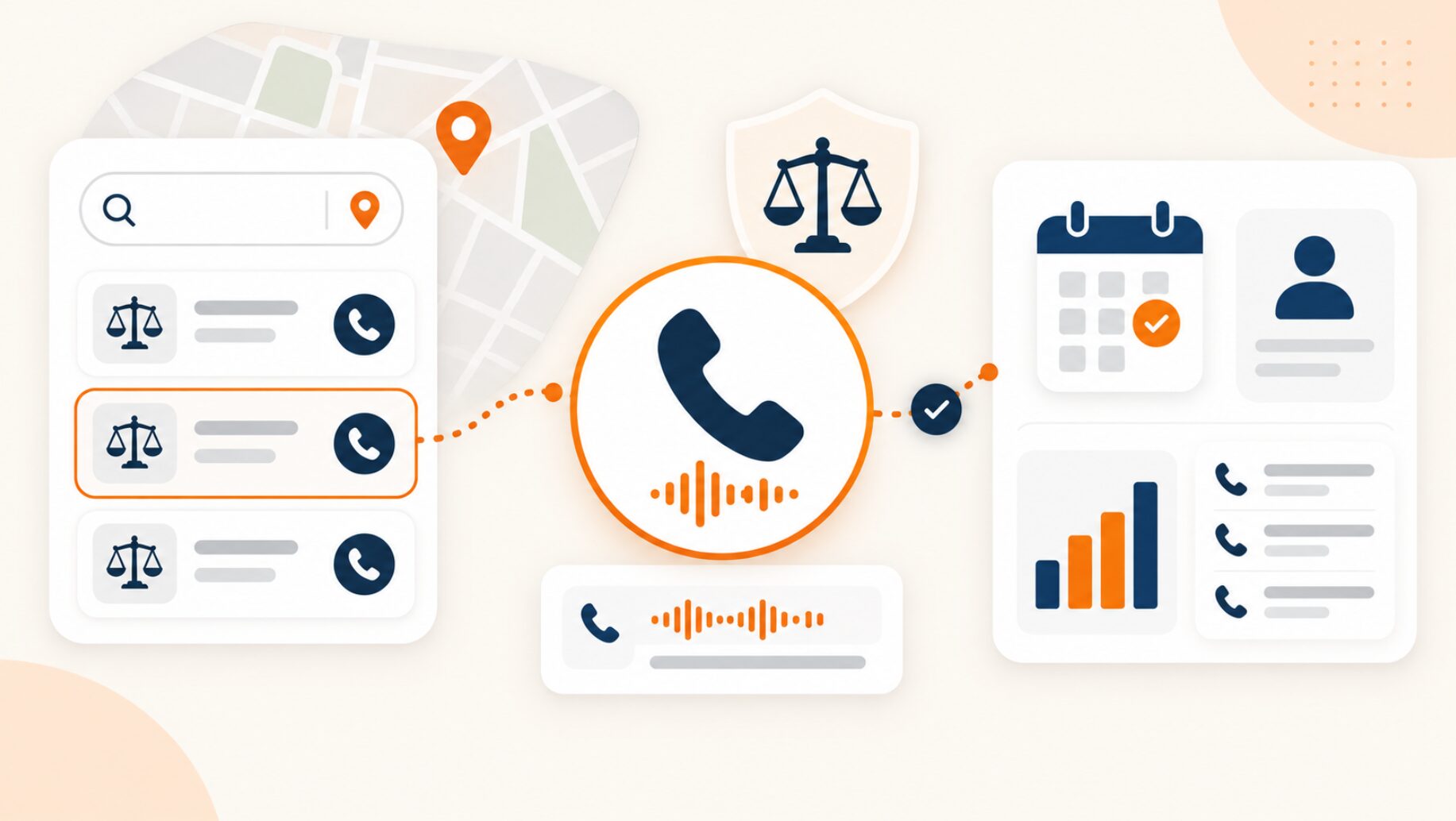
Local Services Ads call tracking for law firms means measuring what happens after Google generates an LSA phone lead, from the initial conversation through legal intake, consultation, and the final client outcome.
Suppose Google reports that a Local Services Ad generated a call. The law firm knows that an inquiry occurred, but the lead record alone does not show whether the caller had a relevant legal matter, qualified for a consultation, completed the consultation, or became a retained client.
A practical measurement process connects these stages:
Google LSA lead → Phone conversation → Legal intake → CRM/client record → Consultation → Retained client
The goal is not simply to count LSA phone leads. The goal is to determine which inquiries become valuable legal opportunities.
What is Local Services Ads call tracking for law firms?
Local Services Ads call tracking for law firms is the process of measuring an LSA phone inquiry and connecting that inquiry with the intake and client data needed to evaluate lead quality and eventual business outcomes.
Google already handles the initial LSA phone connection through a Google forwarding number. When a prospective client calls the number displayed in the ad, Google forwards the call to the law firm’s business phone number.
The larger measurement challenge begins after that call reaches the firm.
At that point, the law firm still needs to determine whether the caller is a new prospect, whether the legal matter fits the firm’s services, whether a consultation is scheduled, and whether the prospect eventually becomes a client.
That downstream measurement is narrower than general law firm call tracking, which can cover calls from Google Ads, websites, landing pages, offline marketing, and other phone-driven channels.
What Google already tracks for Local Services Ads phone leads
Google already provides the first measurement layer for Local Services Ads calls. A law firm does not need another platform simply to establish that an LSA phone lead occurred.
Google’s forwarding number
The phone number displayed in a Local Services Ad is a Google forwarding number. Google states that the displayed number is dynamic, may change as people search and interact with the ad, and cannot be selected by the advertiser.
Google forwards the call to the firm’s business number. Google may also announce the incoming call as a call from Google when the phone connection reaches the business.
That model differs from website call tracking, where a marketer may control the tracking number displayed on a website or use Dynamic Number Insertion to associate calls with visitor sources.
Lead records and call recordings
Google also records LSA phone activity inside the lead-management environment.
For advertisers in the United States and Canada, Google states that inbound calls received through the Google forwarding number are recorded and that callers are notified before the call connects.
Google can therefore establish that a phone lead occurred and provide a record of the conversation.
However, the Google lead record does not by itself answer the questions that matter most to a legal intake team.
The law firm still needs to determine:
- Whether the caller is a new prospect or an existing client.
- Whether the matter fits the correct practice area.
- Whether the caller meets the firm’s geographic and intake criteria.
- Whether a consultation was scheduled and completed.
- Whether the prospect became a retained client.
Those downstream outcomes require data beyond the initial Google lead record.
Can law firms use a third-party tracking number with Local Services Ads?
A law firm should not assume that a third-party tracking number can simply replace the business phone number used by a legacy Local Services Ads account.
Google controls the forwarding number displayed in the ad. Google’s legacy LSA documentation also states that the business phone number to which calls are routed must not be a tracking number.
That rule creates an important difference between LSA call measurement and ordinary campaign tracking.
Legacy LSA accounts
For a law firm operating through the legacy Local Services Ads environment, Google’s documented call path is effectively:
Google forwarding number → Law firm’s business phone number
Google controls the number shown to the prospective client, while the business number receives the forwarded call.
Because Google’s documentation says that the destination business phone number must not be a tracking number, a law firm should verify any proposed third-party routing setup before changing that number.
Ordinary website tracking-number or DNI practices should therefore not be treated as an approved LSA implementation method.
Accounts migrating into Google Ads
Google is moving Local Services Ads into specialized Performance Max campaigns with pay-per-lead goals in phases.
The first phase began in August 2026 for selected U.S. home and storefront service advertisers. Google’s documentation places professional services in later migration phases, so a law firm should rely on its account notification rather than assume that its account has already moved.
After migration, advertisers manage their campaigns and leads inside Google Ads. Google also states that migrated advertisers can edit the phone number to which call and message leads are routed.
However, an editable routing number does not by itself establish that every external tracking-number configuration is permitted.
The practical rule is straightforward: the law firm should check its actual account state and Google’s applicable routing requirements before changing the phone setup.
Is LSA call tracking the same as Google Ads call tracking?
No. Local Services Ads and standard Google Ads use different call-attribution models.
Google describes Local Services Ads and the newer pay-per-lead Performance Max campaigns as keywordless. The campaigns rely on service categories, service areas, business information, and related contextual signals rather than advertiser-managed keyword lists.
Standard Google Ads call tracking can use a different attribution structure. Depending on the campaign and implementation, standard Google Ads calls may be associated with campaigns, ad groups, keywords, landing pages, and website sessions.
For that reason, a law firm running both Local Services Ads and PPC for lawyers should not treat the two channels as if they provide identical phone-lead data.
A law firm should not create keyword-level attribution for an LSA call when Google has not supplied that information.
What LSA reporting does not tell a law firm about lead quality
An LSA lead confirms that a potential customer contacted the firm through Google’s advertising system. The lead record does not automatically mean that the inquiry is a valuable legal opportunity.
For example, an LSA call may involve:
- A strong potential client.
- An existing client.
- A caller outside the firm’s accepted geography.
- A matter from the wrong practice area.
- A caller who does not meet the firm’s intake criteria.
- A qualified prospect who schedules a consultation.
- A qualified prospect who never completes the next step.
A useful measurement process therefore separates three different outcomes:
A phone lead occurred.
The phone lead qualified as a legal opportunity.
The qualified opportunity became a client.
Those outcomes should not be treated as interchangeable.
This distinction allows the marketing team to measure lead generation while the intake team records whether the inquiry was relevant to the law firm.
How to track an LSA phone lead from call to retained client
A law firm can evaluate LSA performance more accurately when the original source remains connected with the stages that follow the phone call.
The core process is:
LSA lead → Phone conversation → Legal intake → CRM/client record → Consultation → Retained client
1. Keep Local Services Ads as the acquisition source
The first step is to preserve Google Local Services Ads as the source of the inquiry.
Where the firm’s systems allow it, the downstream record should retain enough information to distinguish the LSA inquiry from calls generated by standard Google Ads, organic search, the firm’s website, referrals, offline campaigns, or other phone-lead sources.
The firm should preserve the information Google actually provides rather than create attribution fields that are unavailable from LSA.
2. Record what happened during the conversation
The next stage answers a more useful question than whether the phone rang:
What did the prospective client need?
Relevant information can include whether the call was answered, the call duration, the legal matter discussed, the likely practice area, whether the caller was a new prospect, and the next step agreed during the conversation.
When a call is available within a supported AvidTrak workflow, AI call analytics can convert recorded conversations into searchable transcripts and identify signals such as caller intent, sentiment, important phrases, and conversation outcomes. AvidTrak documents these capabilities for supported recorded calls.
That capability does not mean that every LSA call automatically enters AvidTrak. The phone-routing or integration path must support the call before AvidTrak can analyze the conversation.
3. Qualify the legal inquiry during intake
Legal intake determines whether the conversation represents a viable opportunity.
A law firm may need to establish whether the caller is a new prospect, whether the matter fits the firm’s practice area, whether the caller is in the correct geography, and whether the prospect meets the firm’s criteria for a consultation.
The firm should then assign a clear result, such as a qualified inquiry, an unqualified inquiry, or another intake outcome used by the firm.
The important requirement is that the phone lead receives a meaningful business status rather than remaining only a call record.
4. Connect the inquiry with the CRM or client record
A CRM, a legal intake platform, or a case-management system can provide continuity after the initial conversation.
Useful downstream information may include the prospect’s identity, the responsible intake representative, the practice area, the consultation status, the follow-up status, and the current lead or client stage.
For calls tracked through a supported AvidTrak setup, CRM call tracking can connect call data with Salesforce, HubSpot, and Zoho workflows. AvidTrak also documents call attribution, recordings, transcription, and CRM synchronization across these supported workflows.
The exact CRM matching and record-creation behavior depends on the implementation and should not be assumed.
5. Record the consultation and retained-client outcome
The strongest measurement process continues beyond the qualified inquiry.
A law firm should record whether the prospect scheduled a consultation, completed the consultation, progressed through case evaluation, and eventually became a retained client.
When the firm’s systems also contain reliable case or client value data, that information can support deeper marketing measurement.
This broader relationship forms part of closed-loop attribution, where the original acquisition source remains associated with the downstream business outcome.
The main principle is straightforward: a retained-client outcome tells the law firm more about marketing value than raw call volume alone.
What data should a law firm record for each LSA phone lead?
A useful LSA lead record should preserve enough information to connect the original Google inquiry with later intake and client outcomes.
| Data field | Why the law firm needs it |
| Acquisition source | The field identifies Local Services Ads as the origin of the inquiry. |
| Google lead reference | The reference can help connect the downstream record with the original Google lead where the information is available. |
| Call date and time | The timestamp helps the law firm match the lead with intake activity. |
| Answered or missed status | The status separates lead generation from call-handling performance. |
| Caller identity | The available caller information can help connect the inquiry with an intake or CRM record. |
| Practice area | The field shows whether the legal matter fits the firm’s services. |
| Geographic fit | The field shows whether the prospect is within the firm’s accepted service area. |
| New prospect or existing client | The distinction prevents existing-client conversations from being counted as new-client opportunities. |
| Qualification status | The field separates raw inquiries from viable legal opportunities. |
| Consultation status | The field shows whether the inquiry progresses beyond the initial phone call. |
| CRM or client record | The record maintains continuity between intake and later activity. |
| Retained-client status | The status establishes whether the inquiry became new business. |
| Case or client value where appropriate | Reliable downstream value supports later financial analysis. |
No single platform needs to own every field. The important requirement is that the firm’s systems can preserve the relationship among the source, the conversation, the intake result, and the client outcome.
Google LSA reporting vs. call analysis vs. legal intake and CRM
Different systems answer different questions about the same LSA phone inquiry.
| Measurement layer | Main question | Example information | What the layer does not establish |
| Google LSA reporting | Did Google generate a phone lead? | Google records the lead, the phone activity, and the call recording where applicable. | The record does not establish that the caller was a viable legal prospect. |
| Call analysis | What happened during the conversation? | The analysis can show the caller’s need, transcript, intent, outcome, and answered or missed status where supported. | The analysis does not establish that the prospect became a client. |
| Legal intake or CRM | Did the inquiry qualify and progress? | The intake record can include the practice area, geographic fit, consultation, and lead or client stage. | The system may not contain the final case value. |
| Client or case system | Did the law firm retain the client? | The system can record retained-client status, the signed matter, and appropriate client or case value. | The outcome needs a reliable connection back to the original acquisition source. |
Google’s LSA reporting and downstream call measurement are therefore complementary rather than interchangeable.
Google establishes the initial lead. The law firm’s intake and client systems establish what that lead became.
How missed calls and intake quality affect LSA measurement
A missed LSA call is not automatically evidence of poor advertising.
A campaign may have generated a relevant prospective client while the firm’s intake process failed to answer or follow up on the call.
Google states that responsiveness to customer inquiries is one factor used in Local Services Ads ranking and that missed calls may negatively affect responsiveness.
For measurement purposes, the firm should distinguish a low-quality inquiry from a qualified lead that was missed, a call that received a successful callback, or a call that never received follow-up.
That separation helps the firm identify whether a weak result came from lead quality or intake handling.
For supported phone sources, AvidTrak’s law firm call tracking includes call routing, AI transcription, outcome extraction, and legal-intake-oriented call measurement.
How AvidTrak fits into a law firm’s LSA measurement workflow
AvidTrak’s verified role in this workflow is call analysis, legal lead attribution, routing, and CRM-connected measurement for calls that enter an AvidTrak-supported setup.
AvidTrak’s law-firm capabilities include call attribution, routing by office or practice area, AI-powered transcription, conversation outcome extraction, and CRM workflows.
These capabilities can help a legal marketing or intake team determine what callers discussed, classify stronger and weaker inquiries, review how supported calls were routed and handled, and connect call activity with downstream CRM workflows.
The implementation boundary remains important.
AvidTrak should not be assumed to replace Google’s forwarding number or to function automatically as the routing number for a legacy LSA account. A law firm should first confirm that its Google account state and call-routing configuration support the intended workflow.
Frequently asked questions
1. How should a law firm classify a wrong-practice-area LSA call?
The law firm should preserve Local Services Ads as the acquisition source but classify the inquiry separately as an unqualified or wrong-practice-area lead. This treatment preserves the marketing data without making the call appear to be a successful new-case opportunity.
2. How should a law firm treat an LSA call from an existing client?
The firm should retain the LSA source where relevant but classify the conversation as an existing-client interaction rather than a new-client lead. Separating the two prevents existing-client calls from inflating new-business lead and consultation metrics.
3. Can an LSA phone lead be connected with a CRM without changing Google’s displayed number?
Potentially, yes. The law firm can connect downstream intake and CRM information with the original LSA lead when its systems have a reliable identifier or matching process. This process does not require the law firm to control the forwarding number that Google displays in the ad.
The exact method depends on the firm’s account and technology setup.
4. Can a law firm compare LSA performance by practice area?
Yes, if the law firm records the relevant practice area during intake or downstream lead management. That information can help the firm compare the quality of inquiries across legal services even when Google does not provide standard Google Ads keyword-level call attribution for LSA.
5. Should a law firm measure cost per LSA lead or cost per retained client?
Both metrics answer different questions. Cost per lead measures how efficiently the advertising generates inquiries, while cost per retained client measures whether those inquiries become actual business.
A law firm evaluating commercial performance should therefore look beyond lead volume when reliable retained-client data is available.
Measure LSA leads by client outcomes, not call volume alone
Google Local Services Ads provides the starting point by identifying and recording the initial phone lead.
A law firm’s measurement process should continue after that point:
Google LSA lead → Phone conversation → Legal intake → CRM/client record → Consultation → Retained client
The law firm should preserve the LSA source, determine what happened during the conversation, classify the inquiry during intake, connect the prospect with the appropriate downstream record, and record the final client outcome.
That process helps a law firm distinguish advertising that generates phone activity from advertising that generates viable new-client opportunities.
For law firms that need deeper call analysis, routing, attribution, and CRM-connected phone-lead measurement, AvidTrak call tracking for law firms provides the appropriate product-level next step.


