


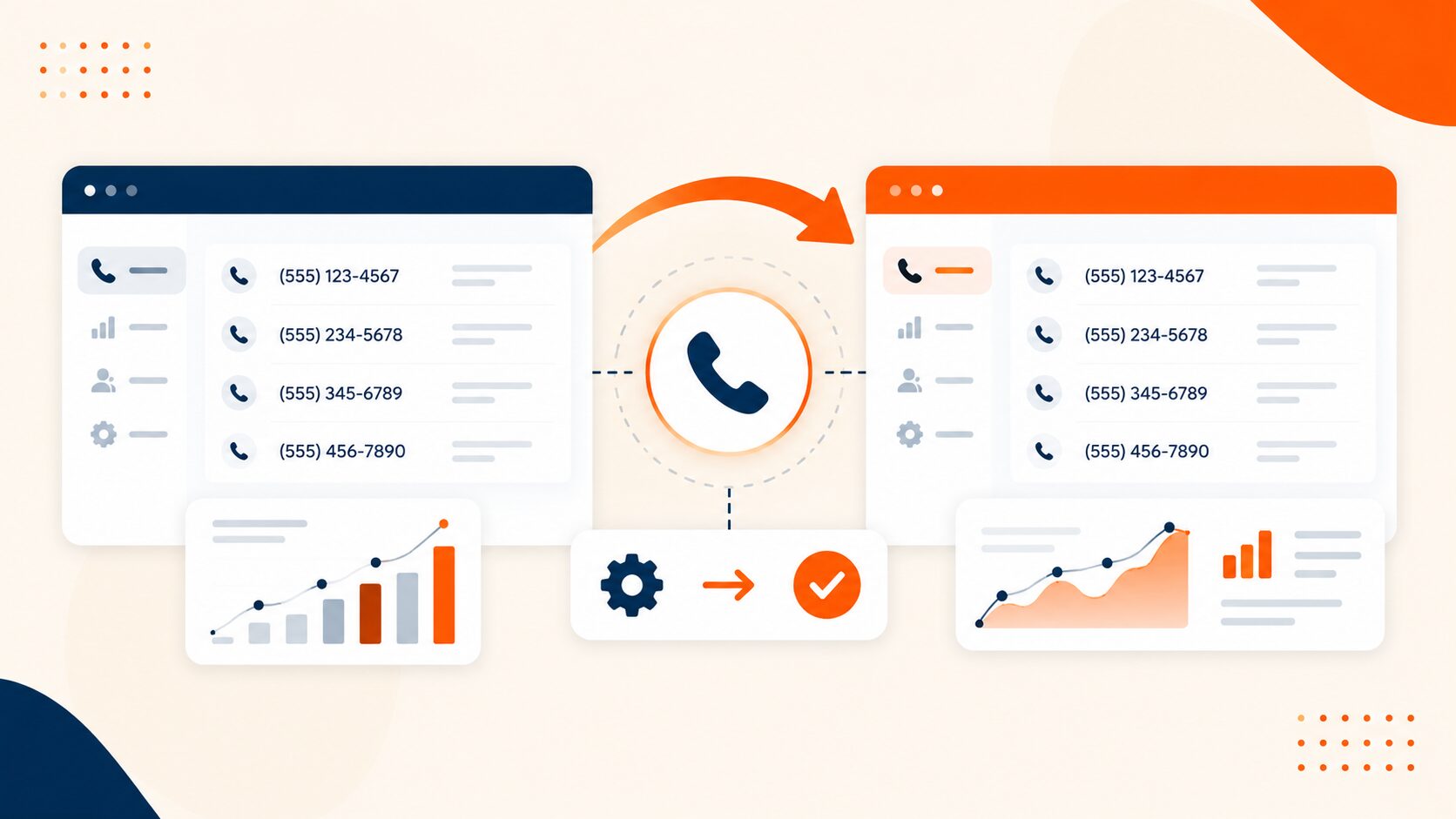
Call tracking links incoming phone calls with marketing sources, such as an advertisement, website visit, business listing, or printed campaign. A typical setup uses tracking phone numbers, source-assignment rules, and call records to show which marketing activities are associated with phone inquiries.
A basic phone log might show who called, when, and for how long. Call tracking adds marketing context: was the inquiry associated with paid search, organic search, a postcard, or another tracked source?
The customer usually makes an ordinary phone call. Behind the scenes, the tracking system connects that call to the business and attaches the available source information to its record.
How does call tracking work?
A typical number-based setup follows five stages. Three terms make the process easier to understand:
| Part | What it means | Simple example |
| Tracking number | The number the customer dials | A number displayed in a particular advertisement |
| Destination | The phone or team that receives the call | The business’s booking line |
| Attribution record | The source information associated with the call | The advertisement assigned to that tracking number |
The tracking number and destination can be different. Several campaign numbers can connect callers to the same office.
1. Assign numbers to the sources you want to measure
The business obtains tracking numbers from its provider and defines what each assignment represents.
For a simple offline campaign, one number might belong to a postcard and another to a radio advertisement. On a website, number assignment can depend on the visitor’s traffic source or session.
The reporting question determines the setup. Comparing two placements requires less detail than connecting individual website calls with available campaign information.
2. Record the source connection
With a fixed campaign number, the source comes from its configured assignment.
For website calls, a tracking script can read available visit information and display an appropriate number. Depending on the implementation, that may use campaign parameters, referring-site information, landing-page conditions, or session rules.
The system stores the relationship between the number and the source or visit. The phone number itself does not contain the campaign information.
3. Forward the incoming call to the business
When the customer dials the tracking number, the provider follows the configured call flow.
The call may reach an office, department, branch, queue, or answering team. A flow can include an interactive voice response menu, known as IVR, or different destinations during and outside business hours.
Forwarding connects the caller with the intended destination while the tracking system retains the information needed for the call record.
4. Log the call and its available details
The platform creates a call record and associates it with the relevant source information.
Available details may include the call identifier, time, duration, dialed number, destination, and connection status.
A connected call can reach a person, an automated menu, or voicemail. The telephone status alone does not establish that a useful human conversation happened.
5. Add the result when the workflow supports it
A business can classify the interaction as a qualified inquiry, appointment request, support call, wrong number, or another meaningful category.
A later booking or sale requires a reliable connection to the system holding that result. With CRM call tracking, relevant call information can be associated with customer records and followed through the sales process.
Recording, transcription, and AI analysis can add conversation context. These are additional capabilities; identifying a call’s assigned source does not require every conversation to be recorded.
What is the difference between static and dynamic call tracking?
Static tracking uses a fixed number for a defined source or placement. Dynamic tracking changes the number shown on a website according to source or visitor rules.
| Method | Number assignment | Useful question | Main limit |
| Static tracking | One fixed number for a campaign or placement | Which placement’s number received the call? | The number’s assignment does not reveal the caller’s complete marketing history |
| Source-level dynamic swapping | A website number changes according to a source rule | Was the call associated with paid search, organic search, or another defined source? | Source-level assignment does not necessarily identify an individual visit |
| Visitor- or session-level tracking | A number is temporarily assigned to a visit, often from a pool | Which available campaign or visit details were associated with the call? | Detail depends on assignment rules, capacity, and available data |
A business can combine these methods. Fixed numbers can measure offline placements while dynamic number insertion, or DNI, supports website attribution.
A number pool is a group of tracking numbers available for temporary assignments. Numbers can return to the pool under the provider’s rules. The business does not necessarily need a permanently reserved number for every website visitor.
Two examples of call tracking in practice
These examples are illustrative, not customer results.
Example 1: A postcard and a radio advertisement
A home-services business uses Number A on a postcard and Number B in a radio advertisement. Both forward to the same office.
Calls to Number A are associated with the postcard assignment. Calls to Number B are associated with radio.
This shows which assigned numbers received calls. It does not prove which advertisement each person first encountered. If someone shares the postcard number with a friend, the call still uses the postcard’s number.
Example 2: A paid-search visitor calls from the website
A person clicks a paid-search ad and visits an emergency-repair page.
The website tracking setup recognizes supported campaign information, displays an appropriate number, and records the assignment. The visitor calls that number and reaches the booking team.
The call record may show the paid-search source, campaign, and landing page where the setup supplies those fields. If the caller requests an estimate, that outcome needs separate confirmation through staff classification or another supported process.
The source record answers which marketing information was associated with the call. The outcome record answers what the business established about the inquiry.
What information can call tracking show?
Available information depends on the tracking method, provider, configuration, and connected systems.
| Information | Evidence behind it | What it does not establish by itself |
| Tracking number and destination | Telephone configuration | The caller’s reason for contacting the business |
| Call time, duration, and status | Telephone activity | Lead quality or a sale |
| Calling number, where available | Caller ID information | The marketing campaign or a unique person’s identity |
| Source or campaign | Number assignment or website attribution | Every influence on the purchase |
| Landing page and visit details | Supported website measurement | Activity that was never observed or reliably connected |
| Paid-search keyword | Supported advertising data and attribution setup | Every search query or organic keyword |
| Lead classification | Staff review, rules, or supported analysis | A completed transaction |
| Booking or revenue | Booking, CRM, or sales records | That every call represents a separate new customer |
Call tracking reports can organize this information into views such as source performance, call timing, missed calls, and repeat activity.
Tracking identifies the associated source. Recording stores conversation audio. Analytics examines patterns and results. The relationship between tracking, recording, and analytics matters when the business needs more than attribution alone.
A phone click, a call, and a conversion are different events
A phone-number click does not prove that a call connected. A connected call does not prove that a qualified inquiry or sale occurred.
| Event | Evidence | Appropriate interpretation |
| Phone-number click | A website visitor selected a call link or button | Call intent |
| Logged call activity | The telephone system recorded the call and its status | A phone interaction occurred or was attempted |
| Qualified inquiry | The interaction met the business’s defined criteria | A relevant lead |
| Confirmed booking or sale | A reliable business record establishes the result | The specified business outcome |
This distinction matters in Google Analytics call tracking. If an event fires when someone clicks a phone link, it measures that click. Google explicitly distinguishes phone-number click measurement from tracking actual calls.
A conversion also has a configured definition. Some Google Ads call-conversion methods use a minimum duration; supported import workflows can report selected outcomes from another system. Neither should be interpreted without checking what the conversion action counts.
Duration can be a useful signal, but a long support call may have no sales value, while a brief conversation may book an appointment.
Why businesses use call tracking
Call tracking supports decisions about:
- Marketing spend: Compare the sources associated with phone inquiries.
- Lead quality: Add meaningful classifications to distinguish prospects from support requests and other calls.
- Staffing: Review when calls arrive and where inquiries go unanswered.
- Locations: Keep branch and campaign activity identifiable.
- Sales results: Connect eligible call records with later appointments, opportunities, or revenue.
The software provides evidence. Better results depend on the business’s campaigns, response process, follow-up, and measurement quality.
What are the limits of call tracking?
Missing information stays missing
A call to an untracked number may have no reliable campaign association. Website attribution may also lack detail when source data is unavailable, a script does not run, or a call cannot be matched to the intended assignment.
Treat insufficient evidence as unknown rather than assigning a source by guesswork.
Keyword detail is not universal
An organic-search call may be identifiable as organic without revealing the exact search phrase.
Paid-search keyword data also depends on the advertising setup and available fields. An advertising keyword and the exact words a person searched are different fields.
Attribution is not proof of causation
A person may encounter several campaigns, return to the website, and call later. The source shown reflects the configured tracking and attribution rules.
It does not automatically reveal every earlier interaction or prove that one campaign alone caused a sale.
Conversation predictions need appropriate confirmation
AI analysis may identify a quote request, a service topic, or apparent booking intent. It does not independently prove attendance, job completion, or payment.
Keep inferred conversation labels separate from confirmed business records.
What do you need before going live?
Start with a reporting question and a small, testable setup.
- Define the question. Decide whether the priority is comparing channels, campaigns, locations, or later outcomes.
- Map the sources and numbers. Identify the ads, listings, website pages, and offline placements to measure.
- Configure the destination. Set the intended receiving team, operating hours, and fallback call path.
- Agree on outcomes and access. Define a qualified inquiry and decide who can view records, recordings, and reports.
- Connect only the systems you need. Map the required fields into the CRM, analytics, advertising, or booking workflow.
Recording is optional. Review the applicable consent, recording, access, and retention requirements before using it or deploying website measurement.
Then place a controlled test call through each important path. Verify:
- The correct number appears, including the actual dial target behind a call button.
- The call reaches the intended destination.
- A call record appears with the expected source under the configured rules.
- Any required downstream record receives the correct information.
Test advertising-conversion reporting separately under the advertising platform’s requirements. A successful routing test does not establish that a paid conversion is eligible or correctly reported.
How AvidTrak supports call tracking
AvidTrak supports tracking numbers, DNI, source reporting, and configurable call routing. Its reporting includes source, timing, missed-call, and repeat-call views. Supported CRM connections include Salesforce, HubSpot, and Zoho. Available information depends on the account and integration configuration.
Begin with the source detail and call flow your business needs. Add conversation review or outcome reporting where it answers a specific question.
Bring a sample campaign and your reporting requirements to an AvidTrak demo. Ask to follow one call from its assigned source to the resulting record.
Frequently asked questions
Can I keep my existing business phone number?
Often, yes, depending on the provider, carrier, country, and existing setup. Options may include supported porting, forwarding, or retaining permanent business numbers alongside tracking numbers. Confirm number ownership, service continuity, and port-out arrangements before changing a live number.
Will customers need an app to call a tracking number?
For ordinary local or toll-free tracking numbers, customers dial normally without a special app. The greeting, recording notice, IVR, and receiving team depend on the configured call flow. Call charges depend on the number type, country, and the caller’s telephone plan.
What happens if someone saves a tracking number and calls later?
While the number remains active and correctly routed, the call can still reach the business. Source attribution depends on its assignment history and provider rules. Fixed campaign numbers generally retain their configured source; temporarily assigned numbers require attention to delayed-call and reuse behavior.
Does call tracking reveal the caller’s exact location?
Not ordinarily. Available location information may come from number geography, website context, or customer-provided details. A mobile number’s area code does not establish the caller’s current location. Marketing call tracking should not be treated as GPS-level location measurement.
How much does call tracking cost?
Costs depend on subscription fees, tracking numbers, usage, country, and optional services. Providers may bill by minutes, calls, accounts, or other activity. Compare proposals covering the same attribution, recording, analysis, integrations, and support requirements rather than subscription fees alone.


