


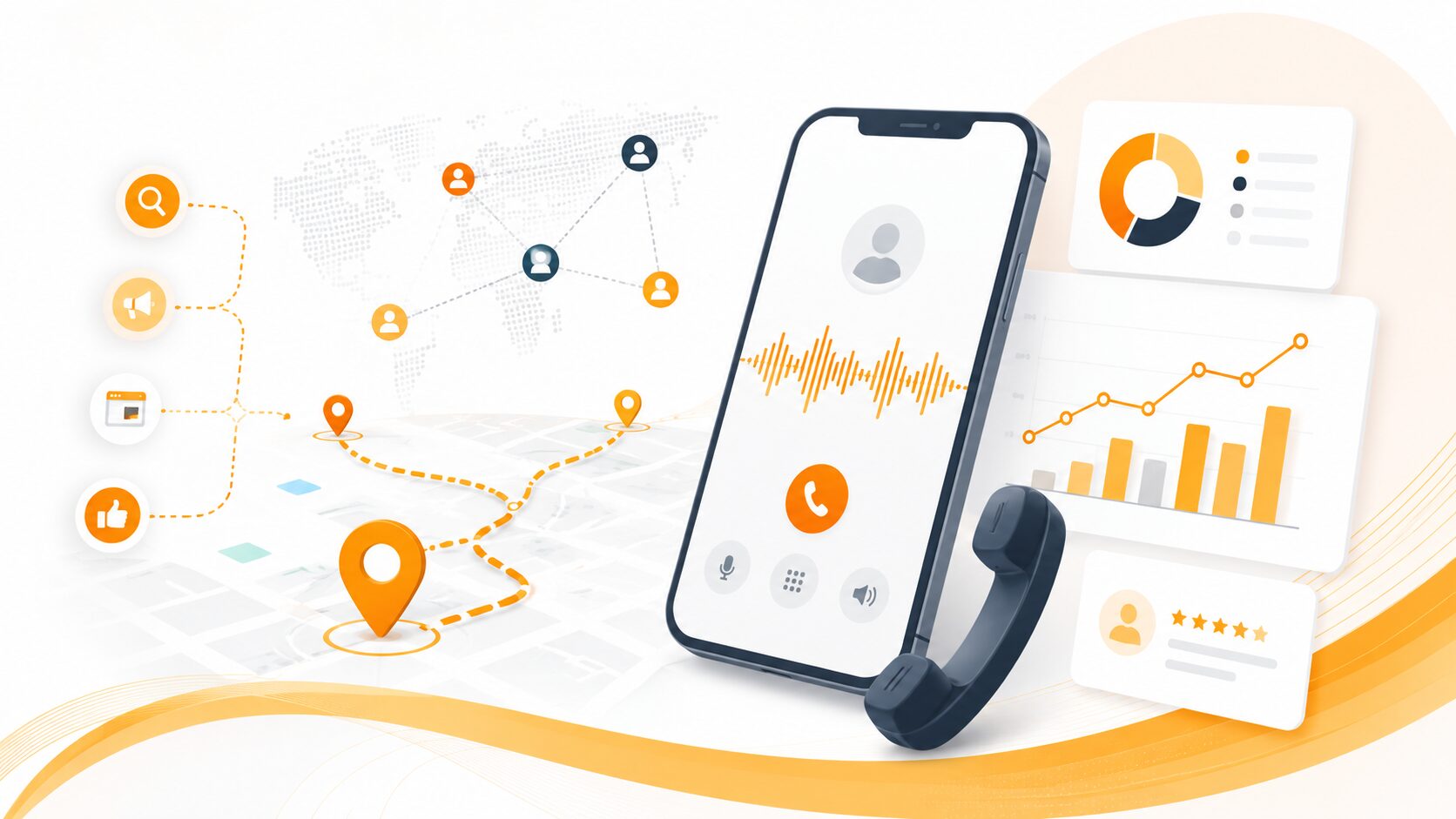
Call tracking, recording, and analytics are three connected layers of phone lead measurement: source attribution, conversation context, and performance analysis.
Imagine that a business receives 120 calls in one month from Google Ads, organic search, social media, and offline campaigns. The marketing team knows how many calls came in, but several questions remain unanswered.
Which calls came from genuine prospects? What did callers ask about? Which campaigns generated quote requests or appointments? How many valuable calls were missed? Which conversations later became sales opportunities?
A basic call log cannot answer all of these questions.
Call tracking identifies where calls come from. Call recording provides conversation context when recording is permitted and properly configured. Call analytics helps teams interpret call activity, lead quality, response performance, caller intent, and business outcomes.
The three capabilities become more useful when they work together. A connected measurement process can show which marketing activity generated a call, what happened during the interaction, and whether the call produced a meaningful result.
This guide explains how call tracking, call recording, and call analytics differ, how the capabilities work together, what businesses can learn from the combined data, and what to consider when selecting a platform.
Call Tracking vs Call Recording vs Call Analytics: What Is the Difference?
Call tracking, call recording, and call analytics answer different questions about the same phone interaction. Call tracking identifies the marketing source behind the call. Call recording preserves the conversation for authorized review. Call analytics uses call, attribution, and outcome data to show patterns in performance, lead quality, response, and results.
Consider a dental practice running three campaigns:
- A Google Ads campaign promotes emergency appointments.
- Organic search content targets people researching dental implants.
- A social media campaign promotes cosmetic consultations.
The practice receives 60 calls.
Call tracking can show which campaign generated each call. Call recording can provide context about what callers discussed. Call analytics can show that one campaign generated fewer calls but a higher proportion of consultation requests.
The same 60 calls now provide more than a volume count.
| Capability | Main question | Example |
| Call tracking | Where did the call come from? | A Google Ads campaign generated the call. |
| Call recording | What happened during the conversation? | The caller requested an estimate. |
| Call analytics | What does the call data show? | One campaign generates more qualified calls. |
| Conversation analytics | What does the conversation reveal? | The caller showed booking intent and discussed pricing. |
Where Does Conversation Analytics Fit?
The terminology varies between platforms, so call analytics and conversation analytics are not always defined in exactly the same way.
Call analytics can include operational and marketing data such as call volume, sources, campaigns, missed calls, answer rates, duration, lead quality, and outcomes.
Conversation analytics focuses more specifically on the content of the interaction. Depending on the platform, that analysis may include transcripts, caller intent, sentiment, keyword or topic mentions, objections, and conversation outcomes.
The distinction matters because a business may need marketing and operational call analytics without needing deeper analysis of every conversation.
Which Capability Does a Business Need?
The right combination depends on the question that the business needs to answer.
- A business should use call tracking when the main question is where calls originate.
- A business should use call recording when authorized teams need to review what happened during conversations.
- A business should use call analytics when teams need to compare call performance, lead quality, response patterns, and outcomes.
- A business should use conversation analytics when teams need deeper information about what callers said, wanted, or discussed.
A call tracking platform can connect several of these layers within the same measurement process, but the required setup should be based on actual reporting and business needs.
How Call Tracking, Recording, and Analytics Work Together
The relationship becomes easier to understand when one inbound lead is followed from the first marketing interaction to the final business action.
Imagine that a homeowner searches for emergency plumbing repair, clicks a paid search ad, visits a service page, and calls the displayed phone number.
1. The Marketing Interaction Is Tracked
The measurement process starts before the conversation.
A prospect may find a phone number through paid search, organic search, social media, email, direct mail, print advertising, a billboard, or a location page.
A business can assign dedicated tracking numbers to selected campaigns, sources, or locations.
For website traffic, dynamic number insertion can replace a default phone number with a tracking number according to defined traffic-source, visitor, or session rules.
Depending on the tracking setup, the business may identify the channel, source, campaign, ad, keyword where supported, landing page, referring source, or visitor session.
The appropriate attribution level depends on the question.
A marketing director may only need to compare paid search with organic search. A PPC manager may need campaign, ad group, landing-page, or keyword-level information.
More attribution detail does not automatically produce better decisions. The tracking structure should collect the information needed to answer a defined question.
2. The Call Is Routed and Logged
Attribution alone does not guarantee a successful business result.
Suppose that the plumbing prospect calls at 7:15 p.m. The campaign has generated a high-intent inquiry, but the standard office line is unattended.
Depending on the routing setup, the call may need to reach an emergency team, a department, a branch, an available representative, a call queue, or a series of forwarding destinations.
The call record can also contain information such as call time, call duration, answer status, missed-call status, call destination, and repeat-call activity.
These details can reveal problems that campaign reports alone may miss.
A marketing campaign may generate relevant prospects while weak routing, limited coverage, or missed calls reduce the number of inquiries that move forward.
3. The Conversation Adds Context
A call record can show that a conversation lasted six minutes. The call duration alone cannot show whether the caller requested a quote, asked for support, wanted a job, or reached the wrong company.
Where recording is permitted and properly configured, the conversation can provide that missing context.
Transcription can make conversation review easier by converting recorded speech into searchable text.
For example, a plumbing company may want to identify conversations involving emergency repair, same-day service, an estimate, water damage, or appointment availability.
Conversation information can then support lead qualification, follow-up, quality review, and outcome analysis.
4. The Call Is Classified by Outcome
The next question is what the interaction represented.
A business may classify a call as a qualified lead, quote request, appointment request, new customer inquiry, existing customer call, support request, vendor call, job-seeker inquiry, spam call, or wrong number.
The categories should reflect the business model.
A law firm may separate new case inquiries from existing-client calls. An HVAC company may distinguish emergency repairs, maintenance requests, and replacement estimates. A clinic may focus on new-patient appointments.
The goal is not to create the largest possible list of labels. The goal is to identify the outcomes that support useful decisions.
5. The Result Connects With Marketing and Sales Reporting
Call information becomes more useful when relevant data can connect with the systems used for marketing reporting, lead management, and sales.
Depending on the workflow, call data may connect with a CRM, Google Analytics 4, Google Ads, client reporting, or internal lead systems.
A prospect may follow this path:
- A prospect clicks a paid search ad.
- The prospect visits a service page.
- The prospect calls a tracking number.
- The call reaches the intended team.
- The caller requests a quote.
- The interaction is classified as a qualified inquiry.
- The lead is recorded in a CRM.
- The opportunity later becomes a sale.
The business can now compare marketing activities by more than the number of calls received.
The complete process can be summarized as:
Marketing source → Call → Conversation → Outcome → Business action
That connection is the central purpose of combining call tracking, recording, and analytics.
The Three Layers of Call Intelligence
Call tracking, recording, and analytics answer related but different questions. Each layer adds information that the previous layer cannot provide by itself.
Call Tracking: Connecting Calls With Marketing Sources
Call tracking associates inbound phone calls with marketing activity.
A business may use dedicated tracking numbers for campaigns, channels, locations, or offline promotions.
For website traffic, dynamic number insertion can display tracking numbers according to defined source or session conditions.
Imagine that a roofing company advertises through paid search, organic search, social media, and direct mail. If the same phone number appears across every campaign without another reliable attribution method, comparing phone leads by source becomes difficult.
A planned call tracking structure can show which marketing activities generate phone demand.
The available detail can range from broad source attribution to campaign, landing-page, and keyword-level attribution where the setup and platform support that information.
For PPC campaigns, keyword-level call tracking can help connect phone inquiries with the paid search terms, campaigns, and landing pages that generated the visits.
The reporting requirement should determine the setup.
The question:
Which channels generate calls?
requires less detail than:
Which paid search campaigns generate qualified estimate requests?
A business should collect enough attribution data to answer the required question without adding unnecessary complexity.
Call Recording: Understanding the Conversation
Call recording stores a conversation for later authorized review when recording is permitted and properly configured.
Consider two calls that both last eight minutes.
The first caller asks for a commercial cleaning quote.
The second caller is an existing customer asking about an invoice.
A duration report treats both interactions as eight-minute calls. The conversations reveal two very different business purposes.
Authorized teams may review recordings to understand what the caller wanted, which service was discussed, whether the inquiry matched the business, which questions or objections appeared, whether a next step was agreed, and why the conversation ended.
Call recordings can support lead qualification, quality review, sales coaching, and customer issue analysis.
Businesses should also distinguish call recording from call monitoring. Recording stores a conversation for later review, while monitoring refers more broadly to observing or reviewing call activity for supervision, quality, or operational purposes.
The legal and operational requirements for recording can vary by jurisdiction, industry, call type, and other circumstances. A business should review the applicable consent, notification, privacy, access, storage, and retention requirements before recording conversations.
Call Analytics: Turning Call Data Into Decisions
Call analytics examines patterns across call activity, attribution, response information, lead quality, and business outcomes.
Call activity data may include call volume, answer rates, missed calls, call duration, calls by hour, and calls by location.
Attribution data may include calls by source, campaign, keyword where available, and landing page.
Conversation-related data may include caller intent, topics, keyword mentions, questions, objections, and conversation outcomes.
Later-stage data may include qualified inquiries, bookings, opportunities, closed sales, cost per qualified call, and revenue by campaign.
Suppose that Campaign A generates 100 calls and Campaign B generates 60.
Campaign A produces 20 appointment requests.
Campaign B produces 30 appointment requests.
A volume-only report makes Campaign A appear more productive. An outcome-based comparison shows that Campaign B generated more appointment requests despite producing fewer calls.
That difference explains why call tracking and call analytics are related but not identical.
Call tracking provides the attribution layer. Call analytics helps a business interpret what the call data means across campaigns, response patterns, lead quality, and outcomes.
Businesses that need a deeper explanation can review AvidTrak’s call analytics guide, while teams evaluating a product that connects attribution with call outcomes can review AvidTrak’s analytic call tracking capabilities.
Where Conversation Analytics Goes Deeper
When conversation content itself needs to be analyzed, conversation analytics can add another layer.
Depending on the platform and configuration, conversation analysis may use transcripts, caller intent, sentiment, keyword or phrase mentions, topics, objections, and defined conversation outcomes.
AvidTrak’s AI call analytics connects these conversation signals with campaign source, keyword, landing-page, and call information where configured.
The distinction is useful because operational call analytics can still provide value without analyzing every recorded conversation.
What Can a Business Learn From Connected Call Data?
Connected call data can answer business questions that a basic phone log cannot.
A business may want to know which campaigns create phone demand, which sources generate relevant prospects, where valuable calls are being missed, what prospects repeatedly ask about, which campaigns generate appointments or quote requests, and which marketing activities later contribute to opportunities or revenue.
The right data depends on the question.
| Business question | Data to review |
| Which campaigns generate phone demand? | Calls by source and campaign |
| Which sources generate relevant prospects? | Qualified calls by source |
| Where are opportunities being lost? | Missed-call and answer-rate data |
| What do callers ask about? | Transcripts, topics, and intent where available |
| Which campaigns generate meaningful outcomes? | Bookings, opportunities, and revenue data |
Consider a multi-location clinic.
One location receives 200 calls while another receives 150. A call-volume report makes the first location appear more productive.
A connected review may show that the first location misses 30% of calls, while the second location misses 8%. The second location may also generate more new-patient appointments, while the first location receives more existing-patient inquiries.
The comparison changes because call volume represents only one part of performance.
A marketing team may focus on qualified calls by source, while an operations team may care more about missed calls and answer rates.
Useful reporting starts with the business question and then selects the appropriate call tracking metrics.
How Businesses Use the Combined Data
Connected call data can support marketing, lead management, conversation review, and reporting. The value comes from what a team does with the information.
Improve Marketing Attribution
Marketing teams need to know which activities generate valuable phone inquiries rather than measuring call totals alone.
Imagine that a home services company invests in Google Ads, SEO, social media, and direct mail.
A basic report shows call volume by source.
A deeper review may show that paid search generates the most calls, organic search produces a higher qualified-call rate, direct mail generates fewer calls but more estimate requests, and one social campaign mainly attracts existing customers.
The business can then reconsider budget allocation, keywords, campaign schedules, landing pages, offers, or audience targeting.
A campaign with a low cost per call may still perform poorly when most calls do not represent relevant prospects.
Prioritize Leads and Follow-Up
Not every caller requires the same follow-up priority.
Suppose that a roofing company receives five calls:
- A homeowner requests an urgent leak inspection.
- An existing customer asks about an invoice.
- A vendor offers building materials.
- A prospect requests a roof replacement estimate.
- A caller reaches the wrong number.
Treating all five calls as equivalent leads creates a weak follow-up process.
Outcome and conversation data can help teams distinguish high-intent prospects, general inquiries, existing customers, support requests, and irrelevant calls.
When a missed call requires follow-up, conversation or call context can also help the representative understand the source and purpose of the inquiry.
Review Sales and Customer Conversations
Recorded calls and transcripts can help authorized teams identify recurring patterns when the review has a defined purpose.
Managers may examine common objections, pricing questions, missed qualification questions, unclear next steps, transfer problems, or customer complaints.
For example, a dental practice may review calls from prospects who showed appointment intent but did not book.
The objective is not random call review. The objective is to identify whether a repeatable issue is preventing qualified callers from taking the next step.
Repeated questions may also reveal gaps outside the phone team, including unclear website information, missing pricing context, or weak expectation setting.
Report Results Across Clients or Locations
Agencies and multi-location businesses often need to understand where phone outcomes occur.
A client report that says:
The campaign generated 90 calls.
provides activity information.
A more useful report may say:
The campaign generated 90 calls, including 38 qualified inquiries and 16 estimate requests.
An agency can use client-level call tracking to separate attribution and reporting across accounts or campaigns.
A multi-location business can apply the same approach to compare demand, answer rates, lead quality, and outcomes across branches.
How to Set Up a Connected Call Measurement Process
A connected call tracking and analytics setup should begin with the business result rather than the phone number.
Step 1: Define Meaningful Outcomes
Start by deciding which call outcomes the business needs to identify.
Depending on the business model, the required outcomes may include a qualified lead, appointment request, quote request, sales opportunity, new customer, existing customer, support call, spam call, or wrong number.
A law firm may focus on new case inquiries. A home services company may separate emergency requests from estimates. A clinic may prioritize new-patient appointments.
Avoid shortcuts such as:
Any call over 60 seconds is a lead.
Call duration provides context, but duration alone does not prove intent or lead quality.
Step 2: Map the Sources That Generate Calls
List the places where prospects encounter phone numbers.
These sources may include Google Ads, organic search, social media, email, direct mail, print advertising, billboards, events, and individual business locations.
Then decide whether the business needs to compare channels, campaigns, keywords, landing pages, or locations.
A team running paid search may need campaign or keyword-level information, while an offline promotion may only require a dedicated tracking number.
Step 3: Choose the Tracking and Number Structure
The number structure should match the attribution requirement.
A business may use one tracking number for an offline campaign, one number for each location, separate numbers for selected marketing sources, or a number pool for website dynamic number insertion.
As the setup grows, document the structure.
A useful record may include the tracking number, source, campaign, destination, owner, and active dates.
A clear record reduces confusion when campaigns, numbers, or routing destinations change.
Step 4: Set Routing, Recording, and Privacy Rules
The call path should reflect the business process.
A business should determine which team receives each call, what happens outside business hours, what happens when nobody answers, whether several people should receive the call, and whether routing should differ by location.
When recording forms part of the approved process, the business should also define which calls are recorded, who can access the recordings, how long recordings remain available, and how the recordings will be reviewed.
Applicable legal and privacy requirements should be reviewed before recording is activated.
Step 5: Connect Analytics and CRM Systems
Decide where relevant call information needs to go.
Possible destinations include a CRM, Google Analytics 4, Google Ads, client reports, and internal lead systems.
A CRM call tracking connection can help marketing and sales teams use the same call source, lead, and outcome information rather than keeping phone activity in a separate reporting system.
For example, a business may report call events in GA4 while associating qualified call outcomes with CRM records.
The better question is not simply whether an integration exists.
The better question is:
Which call data needs to move, and what decision will that information support?
Step 6: Test and Review the Full Call Path
Testing should cover the complete process.
The business should confirm that the correct tracking number appears, the call reaches the intended destination, the source is associated correctly, recording works under the intended configuration, the transcript is available where expected, the correct outcome is recorded, the CRM receives the required information, and GA4 receives the expected event.
Testing should be repeated after major changes to website templates, campaigns, tracking numbers, routing, analytics tags, CRM workflows, or integrations.
A call measurement setup should be treated as an active system rather than a one-time installation.
Common Gaps That Weaken Call Data
Even a technically correct setup can lead to poor decisions when the information is interpreted incorrectly.
| Common gap | Better approach |
| Every call counts as a conversion | Separate calls from qualified outcomes |
| Call volume is treated as success | Compare lead quality and results |
| Missed calls are ignored | Review response gaps |
| Recordings are stored but never reviewed | Define a clear review purpose |
| Call data remains separate from CRM data | Connect the relevant systems |
| Tracking is never retested | Audit the call path after changes |
A common mistake is counting every call as a conversion.
Calls can come from existing customers, vendors, job seekers, spam callers, wrong numbers, or low-intent prospects. A business should define what a meaningful result looks like before evaluating campaigns.
Another problem is optimizing for volume alone.
A campaign that generates 100 calls and 10 qualified inquiries may be less valuable than a campaign that generates 60 calls and 25 qualified inquiries.
Missed calls also require attention. Marketing can generate relevant demand while limited response coverage reduces the final result.
Number structures, attribution errors, and broken tracking paths can also distort campaign reporting.
Call data should be tested, interpreted in context, and connected with a specific decision.
What to Look for in Call Tracking, Recording, and Analytics Software
A software evaluation becomes easier when requirements are grouped into three areas:
- Attribution capabilities.
- Conversation capabilities.
- Reporting and action capabilities.
This approach keeps the evaluation tied to the call workflow rather than starting with a long feature list.
Attribution Capabilities
The platform should support the attribution detail that the business actually needs.
Relevant capabilities may include tracking numbers, dynamic number insertion, channel attribution, campaign attribution, keyword attribution, landing-page attribution, and offline campaign tracking.
A local business may only need source and campaign reporting. An agency may need separate client accounts. A multi-location organization may need reporting by branch or location.
Conversation Capabilities
When recording forms part of the approved workflow, review whether the platform supports call recording, access controls, transcription, searchable conversation text, conversation analysis, and outcome classification.
The important question is whether the conversation data supports a defined use case, such as lead qualification, follow-up, coaching, or outcome analysis.
Reporting and Action Capabilities
The platform should help teams use the data after a call takes place.
Relevant capabilities may include call routing, reporting dashboards, CRM connections, analytics connections, advertising-platform connections, API access, data exports, multi-location reporting, and agency account management.
A practical checklist can include:
| Capability | Why it matters |
| Tracking numbers | Tracking numbers separate campaigns, sources, or locations. |
| Dynamic number insertion | DNI connects website calls with visitor sources. |
| Attribution reporting | Attribution reporting shows which marketing activity generated calls. |
| Call recording | Call recording preserves conversations for approved review workflows. |
| Transcription | Transcription converts recorded conversations into searchable text. |
| Outcome analysis | Outcome analysis separates different call purposes and results. |
| Call routing | Call routing sends callers to the intended destination. |
| Reporting | Reporting shows call-performance patterns. |
| CRM connections | CRM connections link calls with lead and customer records. |
| Analytics connections | Analytics connections add phone activity to wider measurement. |
| Agency or location support | Account structures separate clients, accounts, or locations. |
| Data access | Data access supports external reporting and connected workflows. |
A longer feature list does not automatically mean a better fit. The business should first define the questions the software must answer.
How AvidTrak Connects the Full Call Workflow
When marketing attribution sits in one system, call conversations sit in another, and later sales outcomes remain in a CRM, teams can struggle to connect a marketing campaign with the result of the phone interaction.
AvidTrak connects inbound call attribution, routing, recording, AI-powered transcription, conversation data, defined outcomes, reporting, and external systems within a call tracking workflow.
Attribute the Call
AvidTrak uses tracking numbers and dynamic number insertion to associate inbound calls with marketing activity.
Depending on the configuration, AvidTrak can connect calls with channels, campaigns, keywords, landing pages, and other tracked sources.
The purpose is to identify which marketing activity generated the phone interaction.
Add Conversation Context
Where recording is permitted and properly configured, AvidTrak can add conversation context beyond call duration and answer status.
AI-powered transcription converts recorded conversations into searchable text.
Instead of knowing only that a campaign generated a six-minute call, a marketing team can review conversation information showing that the caller discussed pricing or requested an appointment.
AvidTrak’s AI call analytics can also use conversation information such as sentiment, caller intent, keyword mentions, and defined outcomes where configured.
Identify Meaningful Outcomes
AvidTrak can connect conversation information with business-specific outcome categories.
Depending on the business, those categories may include a qualified lead, appointment request, quote request, existing customer, support request, or another defined outcome.
The categories should reflect the decisions the business needs to make rather than use one generic definition of a successful call.
Connect Calls With CRM and Reporting Workflows
AvidTrak can connect call information with external analytics, advertising, and CRM systems.
Depending on the workflow, a business may report phone interactions in GA4, associate calls with CRM records, compare paid campaign outcomes, review phone leads alongside other conversions, or connect later sales results with earlier marketing activity.
A campaign generates the call. The conversation provides context. The outcome indicates whether the interaction mattered. A CRM can then record later progress.
For businesses that need to connect marketing sources with downstream sales outcomes, closed-loop measurement can extend this process beyond the initial phone conversation.
A connected workflow helps answer questions such as:
- Which campaigns produce qualified calls?
- Which sources generate weak inquiries?
- Where are valuable calls being missed?
- Which conversations require follow-up?
- Which campaigns contribute to better business outcomes?
Businesses that want to connect inbound call attribution with conversation information, outcomes, and reporting can start a free trial with AvidTrak.
Frequently Asked Questions
1. What Is the Difference Between Call Tracking and Call Recording?
Call tracking identifies the marketing source associated with an inbound phone call. Call recording stores the conversation for later authorized review when recording is permitted and properly configured. A business can use tracking to identify the campaign behind an inquiry and recording to understand what happened during the conversation.
2. How Do Call Tracking and Call Analytics Work Together?
Call tracking provides the attribution data that identifies where an inbound call came from. Call analytics uses attribution, activity, response, lead-quality, and outcome information to help a business understand how those calls performed. Together, the two capabilities can show not only which campaign generated a call but whether the call represented a useful business result.
3. What Call Analytics Metrics Should Marketing Teams Review?
The right metrics depend on the business objective. Marketing teams may review call volume, calls by source or campaign, qualified-call rate, missed calls, answer rates, conversation outcomes, cost per qualified call, appointments, opportunities, and later revenue where the required systems are connected.
4. Can Call Tracking Identify Which Campaign Generated a Call?
Yes, when the tracking setup provides the required attribution information. Dedicated tracking numbers can identify selected campaigns or sources, while dynamic number insertion can connect website calls with more detailed visitor, source, campaign, or session information according to the configuration.
5. Should Every Phone Call Count as a Conversion?
No. Calls can come from existing customers, vendors, job seekers, spam callers, wrong numbers, or prospects who do not match the business. A better measurement process defines meaningful outcomes such as qualified inquiries, appointments, quote requests, opportunities, or other business-specific results.
6. Can Call Recordings Be Transcribed and Analyzed?
Yes, when the call tracking platform supports transcription and the recording process is properly configured. Transcripts can support conversation review, search, topic identification, intent analysis, keyword detection, and outcome classification.
7. Can Call Analytics Work Without Recording Calls?
Yes. Operational and marketing call analytics can use information such as call volume, source, campaign, duration, answer status, missed calls, and other call metadata without analyzing recorded conversations. Deeper conversation analytics requires access to conversation content, such as authorized recordings or transcripts.
8. Can Call Tracking Data Connect With a CRM and GA4?
Yes, depending on the platform and configuration. Relevant call information can connect with CRM and analytics systems so a business can associate phone activity with lead records, campaign reporting, and later outcomes.
Final Thoughts
A useful call measurement process does not stop at counting phone calls.
A business needs to understand which marketing activity generated an interaction, what happened during the conversation, and whether the call produced a meaningful outcome.
When those stages remain disconnected, teams may optimize the wrong campaigns, count irrelevant calls as conversions, overlook missed opportunities, or struggle to connect marketing activity with later sales results.
A better approach connects attribution, conversation context, and outcomes around clear business questions.
Instead of asking only:
How many calls did the campaign generate?
A more useful question is:
Which marketing activities generated the right calls, what happened during those conversations, and which interactions produced meaningful business outcomes?


