


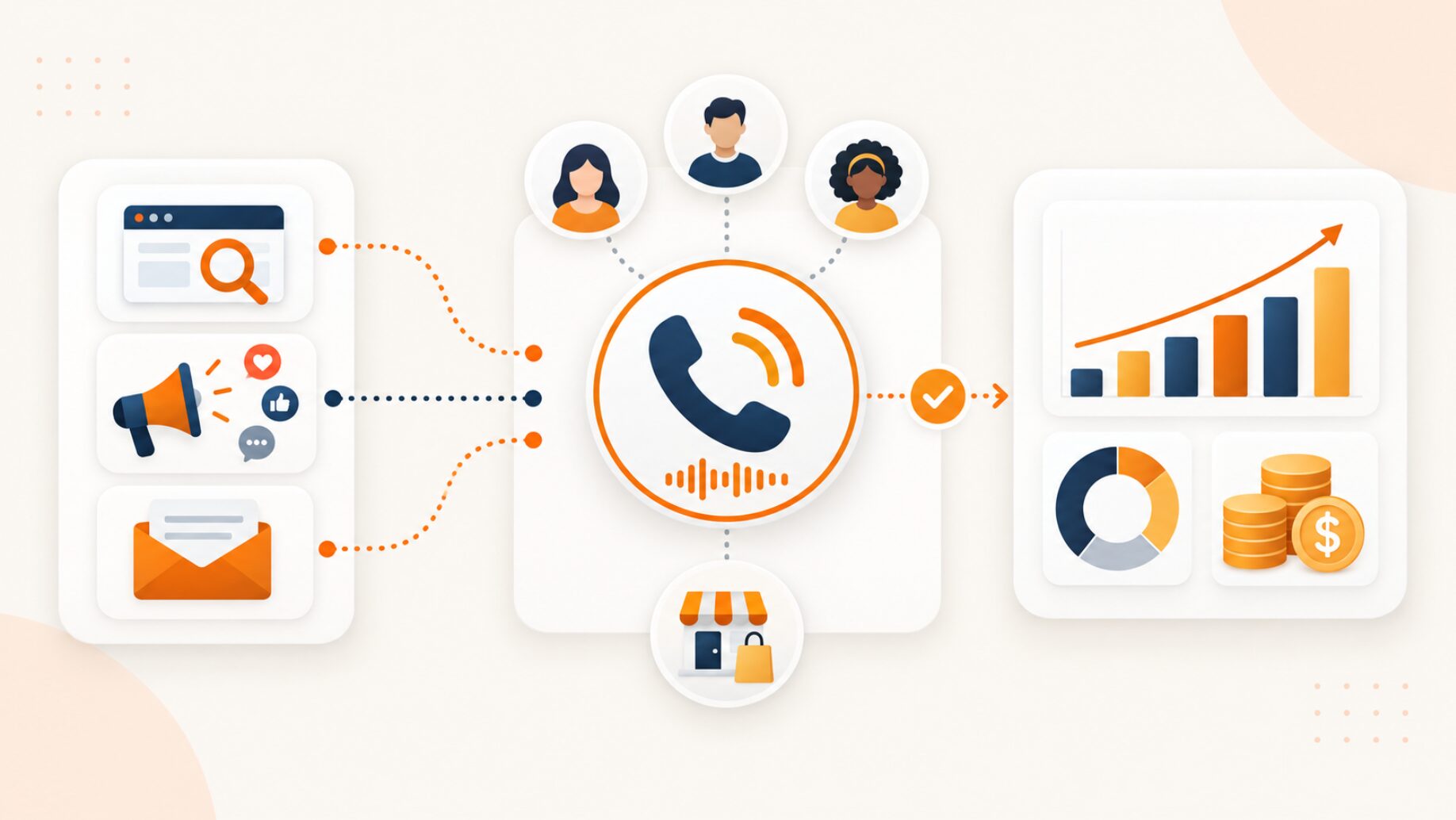
B2C call tracking connects customer phone calls with the marketing activity that generated them and helps marketers measure what those conversations produced.
Suppose a consumer clicks a Google Ads campaign, visits a service page, compares several options, and then calls instead of completing an online form or purchase. The ad platform records the click and the analytics platform records the session, but the most important part of the customer journey has moved to the phone.
Without the right measurement setup, the marketing team may know that a call happened without knowing whether the campaign generated a qualified inquiry, an appointment, a customer, or revenue.
A useful B2C call tracking setup therefore connects five stages:
Source → Call → Outcome → Customer → Value
The goal is not simply to count more calls. The goal is to understand which marketing activities generate customer calls that lead to useful business outcomes.
What is B2C call tracking?
B2C call tracking is the process of connecting customer phone calls with the marketing sources that generated them and measuring what happened after the customer called.
For a consumer-facing business, the original source might be:
- A paid-search campaign.
- Organic search.
- A location page.
- A social campaign.
- An email campaign.
- A direct-mail promotion.
- An offline advertisement.
- A specific landing page.
A call tracking platform can connect the resulting phone call with available campaign information. A stronger setup then adds the result of the conversation, such as an appointment request, a quote, a booking, a product inquiry, or another defined business outcome.
This extends call attribution beyond the question of where the phone call came from. The B2C marketer can also ask whether that source generated a valuable customer interaction and what happened afterward.
That distinction matters because call volume and customer value are not the same thing.
Why B2C customer calls create a marketing measurement gap
Digital marketing systems are good at recording online actions.
A marketer can usually see:
- Which campaign generated a click.
- Which page a visitor viewed.
- Whether a form was submitted.
- Whether an ecommerce transaction happened online.
- Which digital campaign received conversion credit.
The reporting becomes less complete when the customer moves from the website to a phone conversation.
For example, a customer may:
- Search for a service.
- Click a paid ad.
- Visit a landing page.
- Call the business.
- Ask about availability.
- Book an appointment.
- Complete a purchase several days later.
If the marketer measures only the click and website session, the campaign may appear less valuable than it actually was. If the marketer measures only the call, the business may know that demand exists without knowing whether the conversation produced a customer.
A stronger marketing attribution setup therefore keeps the marketing source connected with the phone interaction and, where possible, the later customer outcome.
The challenge becomes larger when several channels generate calls. Paid search, organic search, local SEO, email, social campaigns, landing pages, print, and other offline campaigns can all create phone demand.
A structured multi-channel call tracking setup helps marketers keep those sources separate rather than placing every phone lead into one general category.
How do B2C marketers track customer calls?
B2C marketers track customer calls by capturing the marketing source, recording the call event, classifying the conversation outcome, connecting the call with the later customer result, and associating business value with the original campaign where the available data allows it.
The complete measurement chain looks like this:
| Measurement stage | What to capture | Example data | Why it matters |
| Marketing source | What generated the visit or call | Channel, campaign, keyword, landing page, offline promotion | Shows where demand originated |
| Customer call | The phone interaction | Answered call, missed call, caller, location, duration | Confirms that marketing generated phone activity |
| Call outcome | What happened during the conversation | Qualified inquiry, appointment request, quote request, support call | Separates valuable conversations from raw call volume |
| Customer result | What happened after the call | Booking, appointment, order, customer, sale | Shows whether the conversation progressed |
| Business value | The resulting value | Revenue, booking value, customer value | Supports campaign-value analysis |
| Marketing decision | The action taken from the data | Increase spend, reduce spend, improve routing, change follow-up | Turns measurement into action |
1. Capture the marketing source
The first step is identifying what generated the call.
A simple setup may use a dedicated tracking number for a specific campaign. One phone number might be used for direct mail while another is assigned to a local advertising campaign.
Website attribution can go further.
Dynamic Number Insertion can display different tracking numbers according to visitor or traffic-source context. A visitor arriving through paid search can therefore see a different tracking number from someone arriving through organic search. AvidTrak’s DNI supports visitor- or session-level attribution through number-pool configurations.
When PPC decisions require more detail, keyword-level call tracking can connect inbound calls with campaign, ad-group, keyword, landing-page, and source information where those fields are available in the configured workflow.
The required attribution depth depends on the decision the marketer needs to make.
A marketing leader comparing channels may only need source-level data. A PPC manager deciding between campaigns or keywords needs more granular attribution.
2. Capture the customer call
The next step is recording the phone interaction itself.
Useful call-level data can include:
- The tracking number called.
- The caller’s number where available.
- The call date and time.
- Whether the call was answered.
- Whether the call was missed.
- The call duration.
- The location or team receiving the call.
- The associated source or campaign.
- The landing page or keyword where that level of attribution is configured.
Call tracking numbers can connect calls with campaign and source information while supporting routing, CRM, and reporting workflows. AvidTrak also supports geographic and rule-based routing for multi-location and territory-based environments.
However, a connected call still does not tell the marketer whether the interaction was valuable.
A 10-minute existing-customer support call and a 10-minute new-customer sales inquiry can look similar in a basic call log. The marketer therefore needs to understand what happened during the conversation.
3. Classify the call outcome
The third stage determines why the consumer called and what happened.
Useful B2C outcome categories might include:
- A new-customer inquiry.
- A pricing request.
- A quote request.
- An appointment request.
- A completed booking.
- A product-availability question.
- A location inquiry.
- An existing-customer support call.
- A cancellation.
- Spam or another irrelevant call.
The correct outcome categories depend on the business model.
A dental clinic may care about appointment requests. An automotive dealership may care about vehicle-availability or test-drive inquiries. A home-services company may care about quote requests. A retailer may care about product availability or store-specific questions.
This is where AI call analytics can reduce manual review. AvidTrak supports searchable transcripts, sentiment data, caller-intent signals, keyword mentions, and conversation outcomes.
AI classification should support the business’s qualification rules rather than define those rules. The marketing team still needs to decide which outcomes represent a valuable conversion.
4. Connect the call with the customer result
A qualified conversation is useful, but it is not always the final customer outcome.
The consumer may still need to:
- Attend an appointment.
- Accept a quote.
- Complete an application.
- Visit a location.
- Complete the purchase.
- Become a paying customer.
That information may live outside the call tracking platform.
A CRM call tracking workflow can connect call attribution and call data with customer records. AvidTrak supports Salesforce, HubSpot, and Zoho workflows, including campaign attribution and call information flowing into the CRM.
Other B2C organizations may rely on a booking platform, order database, point-of-sale system, or another customer-management system instead.
This distinction is important:
Call attribution identifies where the call came from. Downstream customer data identifies what the call eventually became.
When the business wants to connect marketing activity with eventual sales or revenue, a closed-loop attribution workflow can connect marketing, call tracking, CRM, sales, booking, or order data without forcing the call tracking platform to act as the only source of customer value.
5. Connect customer value with the campaign
The final stage connects the customer outcome with a financial or agreed business value.
Depending on the B2C business model, that value might be:
- Revenue.
- Booking value.
- Completed-sale value.
- Approved loan value.
- Customer lifetime value.
- Another defined conversion value.
The marketer can then evaluate the source that generated the customer rather than only the source that generated the phone call.
This is the point where campaign ROI becomes more meaningful.
The call tracking platform provides attribution and call-outcome data. A downstream business system may provide customer and revenue data. Campaign spend provides the investment side.
A detailed call tracking ROI analysis can then compare marketing cost with qualified calls, customers, revenue, or another return measure without treating total call volume as the return itself.
What should count as a valuable phone conversion?
A phone call should count as a valuable conversion only when the interaction meets a business-defined outcome that matters to the marketing objective.
The phone ringing is an interaction. It is not automatically a customer conversion.
| Phone interaction | Tracked call? | Potential marketing conversion? | Final customer outcome? |
| Existing customer asks about store hours | Yes | Usually no | No new customer outcome |
| New prospect asks for pricing | Yes | Potentially | Not yet |
| Prospect books an appointment | Yes | Yes | Booking achieved |
| Caller requests a quote | Yes | Yes, when quote requests are a defined goal | Sale still unknown |
| Customer completes a purchase after calling | Yes | Yes | Customer or revenue outcome achieved |
| Spam call | Yes | No | No |
| Missed high-intent call | Yes | Unresolved opportunity | Unknown |
The correct definition depends on the B2C business.
A marketer should define qualification rules before using call data to judge campaign performance. Otherwise, campaigns that generate a large number of low-value calls may appear stronger than campaigns that generate fewer but more valuable conversations.
A more useful analytic call tracking setup combines attribution with call outcomes, conversation data, and reporting rather than relying on total call count alone.
Missed calls also deserve attention. A campaign may generate valuable demand while poor call handling prevents that demand from turning into customers. In that case, the marketer should separate campaign performance from operational call handling.
Which B2C call tracking metrics matter?
The most useful B2C call tracking metrics connect marketing source, call quality, customer outcome, and business value.
A marketer does not need every available call metric to make a better campaign decision.
| Metric | What it shows | Why it matters |
| Calls by source or campaign | Where phone demand originated | Identifies campaigns generating calls |
| New versus repeat callers | Whether the caller appears to be new or returning where supported | Helps separate acquisition demand from existing-customer activity |
| Answered calls | Calls handled by the business | Shows how much generated phone demand was reached |
| Missed calls | Calls that were not answered | Highlights demand that may not have received a chance to convert |
| Qualified calls | Calls meeting the business’s qualification rules | Provides a stronger quality measure than total call volume |
| Call outcome | What happened during the conversation | Separates bookings, quotes, support, spam, and other results |
| Booking or appointment rate | How often relevant calls produce the intended action | Connects conversation quality with a business outcome |
| Call-to-customer rate | How often tracked or qualified calls become customers | Connects phone demand with acquisition |
| Cost per qualified call | Marketing spend relative to valuable conversations | Helps compare campaign efficiency |
| Revenue or value by source | Business value connected with marketing origin | Supports budget decisions |
| Location-level outcomes | Results by branch, store, clinic, office, or territory | Helps multi-location teams separate demand from local execution |
A call tracking dashboard can bring attribution, call outcomes, transcripts, and CRM-connected information into a central reporting environment when those fields are configured.
When the marketer needs detailed formulas for cost per qualified call, revenue per qualified call, or financial return, the call tracking ROI framework should own those calculations rather than repeating them here.
How does Dynamic Number Insertion fit into B2C call tracking?
Dynamic Number Insertion helps B2C marketers connect website calls with the traffic source or visitor context that preceded the call.
DNI becomes useful when several digital channels send visitors to the same website.
For example, a consumer-facing business may receive traffic from:
- Google Ads.
- Microsoft Advertising.
- Organic search.
- Paid social.
- Email.
- Referral sources.
If every visitor sees the same phone number, the marketing team may know that the website generated a call without retaining enough detail to identify the source.
DNI can display tracking numbers based on configured visitor or traffic-source rules. More detailed implementations can use number pools when session- or visitor-level attribution is required.
A static tracking number can still work for a fixed campaign or offline source, while DNI becomes more useful when several digital sources share the same website.
The required method should therefore follow the attribution question. DNI is not a requirement for every B2C campaign.
How call data connects with Google Ads, analytics, and CRM systems
Capturing a phone call inside a call tracking platform is only one part of the measurement process.
The data becomes more useful when it reaches the systems where marketers manage campaigns, analytics, and customer outcomes.
Google Ads
Google Ads supports phone-call conversion measurement for calls directly from ads, calls made after website visits, and call conversions uploaded from another system. Calls uploaded from another system can be used to align advertising reporting with CRM or sales outcomes.
This creates an important distinction.
A marketer can measure phone activity, but a stronger implementation can use the business’s own call outcome data to identify which calls produced sales or other valuable actions. Google Ads specifically supports importing externally tracked call conversions for this purpose.
AvidTrak’s Google Ads call tracking can support paid-search attribution without turning this article into a Google Ads setup guide.
For PPC teams that need more detail, keyword-level call tracking can connect calls with the keyword, campaign, ad group, and landing-page context available in the configured workflow.
Google Analytics 4
Google Analytics 4 can help place phone-related activity alongside website and campaign behavior, but marketers should distinguish a phone-number click from an actual completed phone conversation.
A mobile visitor clicking a telephone link creates a measurable digital event. A connected phone call tracked through a call tracking platform provides different evidence.
A structured Google Analytics call tracking setup can combine website behavior with phone-related reporting while preserving the distinction between a click and a completed call.
AvidTrak’s integration page also states that call tracking data can be sent into GA4 for analysis alongside digital campaign activity.
CRM, booking, and customer systems
A CRM or customer system becomes important when the marketing team needs to know what happened after the phone call.
For example:
- Did the caller become a qualified lead?
- Did the customer book?
- Did the customer attend?
- Did the quote close?
- Did the customer buy?
- What value did the customer generate?
AvidTrak’s CRM call tracking supports Salesforce, HubSpot, and Zoho workflows.
For more customized data movement, the call tracking API can retrieve call events, recordings, transcripts, outcomes, and attribution data while supporting CRM synchronization and reporting workflows.
A broader call tracking integration setup can connect phone attribution with advertising, analytics, CRM, and reporting systems.
The downstream system will vary by B2C business. A clinic may rely on appointment data, a retailer may use an order or point-of-sale system, and a home-services business may use a CRM or job-management platform.
The principle remains the same:
The phone call identifies the conversation. The downstream customer system identifies what the conversation became.
How should multi-location B2C businesses measure customer calls?
A multi-location B2C business needs to preserve both the marketing source and the location connected with each customer call.
A campaign may perform well overall while individual locations produce very different customer outcomes.
For example, the same paid-search campaign may generate calls to five locations. One location may answer quickly and convert many callers. Another location may miss calls or handle the same type of inquiry poorly.
If reporting compares only call volume by campaign, the marketing team may incorrectly blame the campaign for the performance difference.
A stronger setup should preserve:
- The marketing source.
- The campaign.
- The caller or customer location where available.
- The destination location.
- Answered and missed calls.
- The call outcome.
- The booking or customer outcome.
- The business value by location where available.
AvidTrak’s call tracking numbers support location-oriented and regional tracking workflows, including geographic and rule-based routing.
For more customized call distribution, AvidTrak’s call tracking API supports routing logic based on business hours, ZIP code, and team availability.
A useful multi-location report should therefore answer two separate questions:
Which marketing generated the demand?
Which location converted that demand into a useful customer outcome?
That distinction helps a central marketing team avoid reducing campaign investment when the real problem is local call handling.
How B2C call tracking supports campaign ROI
B2C call tracking supports campaign ROI measurement by providing the source and call-outcome data needed to connect marketing spend with customer value.
The complete chain is:
Campaign cost → attributed call → qualified outcome → customer result → business value
Call tracking supplies important parts of that chain, but it does not automatically create the final financial result.
The marketer may still need:
- Campaign-cost data from the advertising platform.
- Customer or booking data from a CRM or operational system.
- Revenue or customer-value data from the business.
- A defined attribution rule.
This is why closed-loop attribution matters when a business wants to move from lead attribution to customer and revenue attribution.
Once the required cost and value data exist, the marketer can apply the more detailed call tracking ROI methodology to compare campaign investment with qualified calls, customers, revenue, or another defined return.
The important B2C principle is that ROI sits at the end of the measurement chain. It should not be inferred from call volume alone.
How AvidTrak supports B2C call measurement
AvidTrak can support this measurement workflow by connecting inbound calls with campaign information and adding conversation and integration data where configured.
AvidTrak’s call tracking platform supports campaign attribution, Dynamic Number Insertion, CRM and marketing integrations, missed-call notifications, reporting, and advanced routing.
For conversation quality, AvidTrak AI call analytics provides searchable transcripts, sentiment data, caller-intent signals, keyword mentions, and conversation outcomes.
For downstream measurement, AvidTrak’s CRM call tracking, call tracking API, and broader call tracking integrations can move call and attribution data into systems used for customer follow-up, campaign optimization, analytics, and reporting.
AvidTrak should not be treated as the final source of revenue information in every implementation. A B2C organization may still need a CRM, booking system, sales platform, order database, point-of-sale system, or another downstream source to confirm the eventual customer and financial outcome.
Frequently asked questions
1. Does B2C call tracking require replacing the main business phone number?
No. Tracking numbers can forward calls to an existing destination number while allowing the marketing source to be measured separately.
The business can therefore keep its existing phone operation while using tracking numbers for campaigns, locations, or sources that require separate attribution.
2. Is Dynamic Number Insertion necessary for every B2C campaign?
No. DNI is most useful when a business needs to distinguish website calls from different traffic sources, sessions, campaigns, or keywords.
A dedicated static tracking number can be sufficient for a fixed offline campaign, direct-mail piece, billboard, or another source that does not require visitor-level attribution.
3. Can offline B2C campaigns be tracked with call tracking numbers?
Yes. A dedicated phone number can be assigned to an offline source such as print, direct mail, outdoor advertising, or a local promotion.
The resulting calls can then be attributed to that campaign instead of being grouped with general inbound phone traffic.
A broader multi-channel call tracking structure can help marketers keep online and offline sources separated consistently.
4. How should repeat customers be treated in call tracking reports?
Repeat customers should be separated from new-customer acquisition where the available data supports that distinction.
A repeat customer calling about an existing appointment, order, or service issue should not automatically be counted as a new marketing lead. Caller history, CRM data, call outcomes, and other customer information can help the marketing team classify the interaction more accurately.
5. Is call recording required for B2C call tracking?
No. Call attribution does not inherently require call recording.
Tracking numbers, DNI, campaign attribution, and call-event data can operate independently of recording. Recording, transcription, or conversation analysis can add more context when a business chooses to use those capabilities.
A business that records or analyzes customer conversations should follow the privacy, disclosure, consent, retention, and customer-data requirements that apply to its locations and use case.
Measure customer outcomes, not just call volume
B2C call tracking becomes useful when the marketing team can see more than the fact that the phone rang.
The stronger measurement chain connects:
Source → Call → Outcome → Customer → Value
That structure helps a marketer distinguish campaigns that generate phone activity from campaigns that generate valuable conversations, bookings, customers, and revenue.
It also produces better budget decisions. A campaign with fewer calls may deserve more investment if those calls consistently produce stronger customer outcomes.
AvidTrak offers a 14-day free trial without requiring a credit card. A B2C marketing team can start an AvidTrak free trial and test the measurement setup against its own customer journey.


