


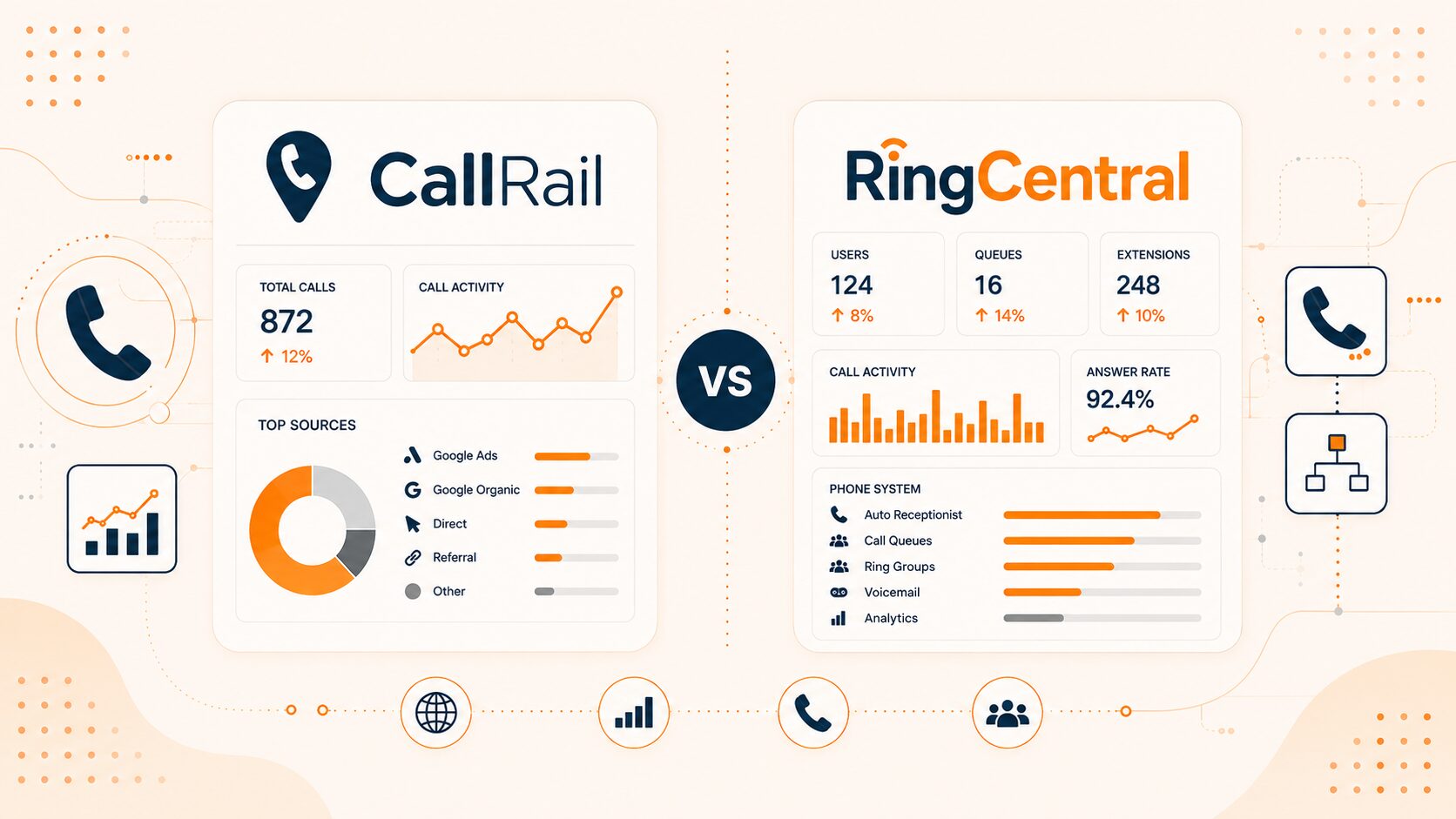
A CallRail vs RingCentral comparison looks at two platforms that handle phone calls for different purposes. CallRail focuses on marketing attribution and lead intelligence, while RingCentral RingEX focuses on employee calling and business communications.
Suppose a marketing team wants to identify which ads, keywords, campaigns, and landing pages generated qualified phone leads. CallRail addresses that requirement more directly.
Suppose five employees need managed business numbers, extensions, inbound and outbound calling, team messaging, meetings, and centralized phone administration. RingCentral RingEX addresses that requirement more directly.
A company may also use both platforms when marketing attribution and a full employee phone system are required.
AvidTrak is another call tracking platform to consider when the priority is attribution, routing, reporting, and call analysis rather than a complete employee communications suite.
CallRail vs RingCentral at a Glance
CallRail and RingCentral overlap in calling, routing, recording, transcription, messaging, analytics, and artificial intelligence. The purpose behind those functions is different.
CallRail connects marketing activity with phone leads. RingCentral gives employees a managed communications environment.
| Comparison point | CallRail | RingCentral RingEX |
| Primary purpose | CallRail focuses on marketing call attribution and lead intelligence. | RingEX focuses on employee calling and business communications. |
| Typical fit | CallRail fits marketing teams, businesses, multi-location brands, and agencies that need to measure phone leads. | RingEX fits organizations that need managed phone numbers, extensions, calling, messaging, meetings, and fax for employees. |
| Dynamic number insertion | DNI is a central CallRail attribution function. | DNI is not a primary RingEX function. |
| Phone numbers | CallRail assigns tracking numbers to campaigns, sources, or website visitors. | RingEX assigns business numbers and extensions to users, departments, and locations. |
| Inbound and outbound calling | Inbound tracking is central, while selected outbound workflows are also available. | Employee inbound and outbound calling is a core RingEX function. |
| Call routing and IVR | CallRail includes routing, with available call flows depending on the configuration. | RingEX supports routing, auto attendants, queues, transfers, and IVR according to the plan and selected products. |
| Call recording | Call recording is included in CallRail Lead Tracking. | RingCentral provides recording, with behavior depending on the plan and settings. |
| Transcription and analysis | CallRail includes transcription, while deeper summaries, sentiment, trends, and coaching depend on the package. | RingCentral provides AI notes and analysis, while additional conversation products may require separate services. |
| Text messaging | CallRail can connect tracked text conversations with marketing attribution. | RingEX provides business SMS, while some shared customer-text workflows require additional products. |
| Form attribution | Form attribution requires a higher CallRail package. | Marketing form attribution is not a primary RingEX function. |
| Team messaging and meetings | Team messaging and video meetings are outside CallRail’s main purpose. | Team messaging and video meetings are part of the RingEX communications model. |
| Fax | Internet fax is outside CallRail’s main scope. | RingEX supports internet fax. |
| Reporting | CallRail reporting connects campaigns, calls, texts, forms, conversations, and outcomes. | RingCentral reporting focuses more on users, devices, call activity, service quality, and phone operations. |
| Pricing model | CallRail uses an account package plus usage charges. | RingEX uses per-user pricing with monthly or annual billing and optional products. |
| Trial | CallRail lists a 14-day trial. | RingCentral lists a 14-day RingEX trial for new subscribers. |
| Official connection | CallRail provides an official RingCentral integration. | The connection requires an active RingEX account and RingCentral Super Admin authorization. |
Are CallRail and RingCentral Direct Competitors?
CallRail and RingCentral compete only where a requirement involves shared call-related functions. Both platforms can route calls, record conversations, support messaging, provide analytics, and use artificial intelligence.
The products separate once the intended outcome becomes clear.
CallRail is designed to show which marketing sources produced calls and what happened during those conversations. RingCentral RingEX is designed to give employees a managed phone and communications environment.
The platforms can also work together.
In a combined setup, CallRail can retain the marketing attribution role while RingCentral handles employee calling. The operating model therefore matters more than a raw feature count.
What Is CallRail?
CallRail is a marketing call tracking and lead intelligence platform.
The Lead Tracking package includes tracking numbers, call and text attribution, recording, routing, transcription, analysis, and automation rules. Higher packages add form attribution and broader conversation-analysis functions.
CallRail is particularly relevant when a company needs to associate phone inquiries with advertisements, search activity, campaigns, landing pages, or offline sources.
Dynamic number insertion can change the phone number shown to a website visitor according to the marketing source or session.
Campaign-specific numbers can also separate calls from other channels.
The resulting call record can include source information, recordings, transcripts, tags, and other lead data according to the selected package and configuration.
What Is RingCentral?
RingCentral RingEX is a cloud business communications platform.
RingEX combines employee phone service with team messaging, video meetings, SMS, fax, extensions, user administration, and call-management functions.
RingCentral also provides separate products and add-ons for customer engagement, contact centers, AI reception, and conversation intelligence.
RingEX is most relevant when a company needs to give employees business numbers and extensions, manage call flows, transfer calls, support remote work, and control phone settings from a central account.
The source document describes Core, Advanced, and Ultra plans, along with optional products that can change the final scope and price.
What Are the Biggest Differences Between CallRail and RingCentral?
Marketing Attribution Versus Business Communications
CallRail begins with a marketing question: which source generated the call, and what happened after the prospect called?
RingCentral begins with a communications question: how should employees make, receive, transfer, and manage business calls?
Both platforms can report call activity, but the information supports different decisions.
Tracking Numbers Versus Employee Phone Numbers
A CallRail number is normally assigned to a campaign, source, visitor, or attribution pool before the call forwards to another destination.
A RingCentral number is normally assigned to an employee, department, location, or company phone flow.
A company may use both types of numbers when marketing needs attribution and employees need stable business phone identities.
For marketing teams, keyword-level call tracking can add another layer by connecting inbound calls with PPC keywords, campaigns, landing pages, and search activity.
Account-Based Pricing Versus Per-User Pricing
CallRail uses account packages that contain numbers and minutes, followed by usage charges.
RingEX uses per-user pricing, with different costs for monthly and annual billing.
The cost difference changes according to employee count, tracking-number requirements, call volume, plan level, and optional products.
Campaign Reports Versus Phone Operations Reports
CallRail reporting connects phone leads with campaigns, calls, texts, forms, conversation data, and conversion signals.
RingCentral reporting focuses more heavily on employees, devices, call activity, service quality, queues, adoption, and phone administration.
The most useful reporting system depends on the decision being made.
A marketing manager may need to know which campaign produced a qualified phone lead. A phone-system administrator may care more about call volume, queue performance, device usage, and service quality.
How Do CallRail and RingCentral Features Compare?
Marketing Call Attribution and Dynamic Number Insertion
CallRail has the clearer fit for marketing attribution.
Tracking numbers can identify campaigns and offline sources, while dynamic number insertion can associate website calls with visitor channels or search activity.
Those records help marketers compare call volume, lead quality, and outcomes by source.
RingEX can show phone activity and caller information, but RingEX is not positioned as a replacement for a dedicated website attribution system.
A RingCentral customer that also needs campaign and keyword data may therefore add CallRail, AvidTrak, or another call attribution platform.
Business Phone Numbers and Employee Calling
RingCentral has the clearer fit for employee phone service.
Each user can receive a business number and extension, use supported desktop or mobile applications, and make or receive business calls.
A company can also administer users, departments, locations, devices, and permissions through RingCentral.
CallRail can forward tracked calls to employees and supports selected outbound workflows, but CallRail does not replace the wider RingEX employee communications system.
Call Routing, Queues, Transfers, and IVR
Both platforms can direct callers, but the routing context differs.
CallRail routing helps send a tracked lead to the appropriate employee, department, location, schedule, voicemail box, or automated service.
RingCentral supports phone-system routing through functions such as auto attendants, extensions, transfers, and queues. Some functions depend on the selected plan or add-on.
A company using both platforms needs a clear division of responsibility between the two call flows.
Duplicate IVR stages can lengthen the caller experience and may also interfere with the CallRail and RingCentral integration.
Businesses that need marketing-focused routing can also review advanced call routing options such as geographic routing, business-hour rules, sequential ringing, and simultaneous forwarding.
A multi-level IVR can also guide callers through menu selections before sending the call to an appropriate destination.
Call Recording and Transcription
CallRail includes recording, transcription, and analysis in Lead Tracking.
Higher packages add functions such as wider keyword analysis, summaries, sentiment, trend reporting, automatic conversion tags, and coaching.
RingCentral also supports recording and AI notes, although the exact recording behavior and analysis depend on the plan, settings, and products selected.
The required output is more important than simply confirming that “conversation intelligence” exists.
A recording, transcript, summary, sentiment classification, keyword result, and coaching note provide different information.
Artificial Intelligence and Conversation Analysis
CallRail applies artificial intelligence to marketing lead conversations through transcription and selected analysis or follow-up functions.
RingCentral applies AI across employee calls, meetings, messages, customer interactions, and separate conversation products.
RingCentral also lists AI Receptionist and Conversational Intelligence as products that can extend RingEX.
The relevant distinction is whether the organization mainly needs marketing lead analysis or a wider employee and customer communications environment with AI functions.
AvidTrak AI call analytics provides another comparison point when the requirement centers on transcripts, summaries, sentiment, keywords, caller intent, and conversation outcomes connected with marketing attribution.
Text Attribution and Business SMS
CallRail can connect tracked texts with marketing sources according to the package allowances and rules.
RingCentral supports business SMS as part of RingEX, while some shared customer-message workflows require an additional product.
The distinction depends on the use case.
Marketing attribution focuses on identifying the source that generated the conversation. Business communications focus more on giving employees managed business identities and messaging capabilities.
Form Tracking, Meetings, Messaging, and Fax
CallRail offers Form Tracking through higher packages so website submissions can be connected with marketing activity.
Marketing form attribution is not a central RingEX function.
RingEX instead includes team messaging, video meetings, and internet fax capabilities that sit outside CallRail’s main product scope.
These differences show why CallRail and RingCentral should not be evaluated as identical systems.
Reporting, Agency Accounts, and Multi-Location Administration
CallRail reporting is aligned more closely with campaign attribution and lead review.
CallRail also provides agency resources for managing client companies.
RingCentral administration is aligned more closely with users, devices, extensions, sites, phone activity, and company-wide communications.
A multi-location organization may use one platform for location-level marketing attribution and another for company-wide phone administration.
Agencies have an additional ownership question because client marketing reporting and the client’s internal phone system may belong to different accounts or teams.
AvidTrak call tracking for agencies is another option when the agency needs multi-client attribution, white-label reporting, client access, routing, and centralized reporting.
How Does the CallRail and RingCentral Integration Work?
The official CallRail and RingCentral integration connects two active services.
A RingCentral Super Admin authorizes the connection for a selected CallRail company.
When a prospect calls a CallRail tracking number, CallRail receives the tracked call and forwards it to an agent’s direct RingCentral number.
The RingCentral agent can receive attribution context identifying the tracking campaign or source.
The integration can also bring selected outbound RingCentral call data into the CallRail call log.
Outbound recordings depend on the required CallRail settings, RingCentral recording configuration, and user permissions.
The source documentation notes that new recordings may take several minutes to appear.
The source also states that ingested outbound records can display “RingCentral” as the agent name and that individual numbers or calls cannot be excluded from ingestion under the documented setup.
The integration does not create one account or contract.
CallRail retains the marketing attribution role, while RingCentral remains the business phone system. Both subscriptions, permissions, call flows, and billing structures still need to be managed separately.
What Are the CallRail and RingCentral Integration Limitations?
The source documentation identifies several operational limits that can affect a live setup.
RingCentral menu or IVR steps can prevent CallRail from passing a caller correctly.
Other documented limitations include:
- CallRail whisper messages do not run for inbound calls through the integration.
- The authorization token can expire after a period of account inactivity.
- Reauthorization requires the appropriate RingCentral Super Admin.
- Historical RingCentral data is not transferred into CallRail.
- Historical outbound recordings are not backfilled.
- New recordings depend on the required recording settings.
- Attribution information may not appear in RingCentral while the connection is temporarily disconnected.
- RingCentral continues to bill applicable outbound calls even when those records appear in CallRail.
- Some external call-flow arrangements can create charges across more than one tracking step.
A pre-launch test should cover the complete call path instead of testing only whether the two accounts connect.
Useful scenarios include direct calls, tracked calls, missed calls, transfers, outbound calls, voicemail, inactive periods, recording behavior, and reauthorization.
Call ownership also needs to be clear across IVR, schedules, queues, recording rules, permissions, and reporting.
What Does the CallRail Lead Center Closure Mean?
CallRail announced the Lead Center sunset and began a phase-out process.
Businesses that used Lead Center as a softphone may therefore need another system for queues, transfers, active routing, employee calling, and related phone functions.
CallRail presents RingCentral as one migration option, but RingCentral is not the only possible replacement.
According to the source guidance, existing CallRail plans, data, and tracking numbers can remain in place while calls are handled through RingCentral.
The migration path does not require tracking numbers to be ported because the destination receiving the tracked calls changes instead.
Existing Lead Center messages, calls, and voicemails remain in the CallRail call log rather than moving into RingCentral.
A replacement decision therefore needs to account for agent accounts, call flows, phone applications, outbound identity, message history, reporting ownership, subscription costs, and staff training.
CallRail vs RingCentral Pricing
How the Pricing Models Differ
CallRail charges an account fee plus usage.
The source pricing used for this comparison lists Lead Tracking at $50 per month with five numbers and 250 local minutes.
Additional numbers, minutes, toll-free use, text messages, forms, and analysis can add charges.
RingEX uses per-user pricing.
The source document lists Core at $20 per user per month with annual billing or $30 per user with monthly billing. Higher plans and optional products increase the amount.
A Five-User Small-Business Cost Example
Suppose a US business has five employees, five RingCentral users, five CallRail tracking numbers, and 250 tracked local minutes.
The example includes basic attribution and standard recording.
The calculation excludes taxes, telecom fees, promotions, hardware, toll-free use, contact center products, AI Receptionist, Conversational Intelligence, Voice Assist, and other optional services.
| Option | Calculation | Estimated monthly cost |
| CallRail only | Lead Tracking contains the five numbers and 250 local minutes used in this example. | $50 |
| RingCentral Core only with annual billing | Five users at the $20 monthly equivalent produce the total. | $100 monthly equivalent |
| RingCentral Core only with monthly billing | Five users at $30 each produce the total. | $150 |
| CallRail plus RingCentral Core with annual billing | The $50 CallRail package is combined with the $100 RingEX monthly equivalent. | $150 monthly equivalent |
| CallRail plus RingCentral Core with monthly billing | The $50 CallRail package is combined with the $150 RingEX amount. | $200 |
| AvidTrak call tracking only | The Starter plan contains five numbers and 500 local minutes. | $15 |
Why the Final Bill May Differ
The example compares only the stated scope.
RingCentral-only pricing does not provide CallRail-style campaign attribution. CallRail-only pricing does not provide five employees with a complete RingEX communications environment.
A combined setup also means two services, administrative responsibilities, separate permission models, and integration maintenance.
The total can change according to:
- The number of employees can change the RingCentral cost.
- The selected RingCentral plan can change the per-user rate.
- Additional tracking numbers can increase call tracking costs.
- Higher call volume can create usage charges.
- Toll-free calls can have different rates.
- SMS usage can create additional charges.
- Recording and transcription requirements can affect the total.
- Form submissions and AI processing can add usage charges.
- Queue or contact center products can require additional subscriptions.
- Hardware, international usage, taxes, and promotional terms can also change the final amount.
CallRail Strengths and Limitations
CallRail Strengths
- CallRail connects tracking numbers and website calls with marketing sources and lead data.
- The Lead Tracking package includes recording, routing, transcription, analysis, and automation rules.
- Higher packages add form attribution and broader conversation analysis.
- Dynamic number insertion supports website and campaign attribution.
- The official RingCentral integration supports a combined attribution and employee-phone workflow.
CallRail Limitations
- CallRail does not provide a complete employee communications suite with team messaging, meetings, fax, and centralized employee phone service.
- Additional usage, phone numbers, messages, forms, toll-free traffic, and selected AI services can increase the final cost.
- The RingCentral connection has documented restrictions involving IVR, whisper messages, recordings, historical data, and reauthorization.
- Former Lead Center users may need another phone platform for softphone, queue, transfer, and employee-calling functions.
RingCentral Strengths and Limitations
RingCentral Strengths
- RingEX provides employees with business numbers, extensions, inbound and outbound calling, messaging, meetings, and fax.
- RingCentral provides centralized administration for users, numbers, devices, locations, and phone flows.
- RingCentral offers routing, queues, analytics, and AI capabilities across different plans and products.
- The official CallRail connection allows RingCentral to handle employee calling while CallRail retains marketing attribution.
RingCentral Limitations
- RingEX does not replace a dedicated website dynamic number insertion and campaign-attribution system.
- Per-user pricing increases as employee count grows.
- Some administration, analytics, queue, recording, contact center, and AI functions depend on the selected plan or additional products.
- A combined CallRail setup requires clear ownership of IVR, routing, recordings, permissions, and billing.
Should You Choose CallRail, RingCentral, or Both?
Choose CallRail for Marketing Call Tracking
CallRail makes more sense when the main question is which campaign, advertisement, keyword, page, or source generated a phone lead.
The company also needs an existing destination where tracked calls can be answered because CallRail is not a full employee communications environment.
Choose RingCentral for Employee Phone Service
RingCentral makes more sense when employees need managed business numbers, extensions, calling, transfers, messaging, meetings, fax, desktop and mobile access, and centralized administration.
RingEX is the clearer fit when business phone operations matter more than marketing-source attribution.
Use Both When Attribution and a Full Phone System Are Required
A combined setup can make sense when marketing needs campaign attribution while employees need to answer those calls inside a complete business phone system.
Inbound prospects can enter through CallRail tracking numbers and then reach RingCentral destinations.
Selected outbound RingCentral records can also appear in CallRail when the documented options and permissions are active.
The platforms still retain separate roles rather than becoming one system.
Define Cost and Ownership Before Using Both
A combined setup involves more than connecting two pieces of software.
Ownership needs to be assigned for tracking numbers, employee numbers, IVR, schedules, queues, recordings, access, privacy rules, reporting, invoices, and reauthorization.
Testing the complete call path before moving live traffic can reveal routing or attribution conflicts.
Review Agency and Multi-Location Requirements Separately
An agency may need separate client accounts, branded reports, and location-level attribution while each client continues to own the internal phone system.
A multi-location company may similarly use RingCentral for central phone administration while maintaining separate attribution for marketing activity at each location.
Account design works better when data ownership, administrative responsibility, and billing are defined before implementation.
When AvidTrak May Be a Better Option
AvidTrak may provide a better fit when the requirement centers on campaign and keyword attribution, dynamic number insertion, call routing, recording, transcription, reporting, and call analysis without a complete employee communications suite.
AvidTrak pricing lists a Starter plan at $15 per month with five local numbers and 500 local minutes.
The Professional plan is listed at $30 per month, while the Agency plan is listed at $55 with 30 numbers, 2,500 local minutes, 2,500 recording minutes, and up to 1,000 client accounts.
AvidTrak also supports marketing-focused routing and call analysis.
Relevant functions include:
- AvidTrak supports dynamic number insertion and keyword attribution.
- AvidTrak supports business-hours and geographic routing.
- AvidTrak supports sequential and simultaneous forwarding.
- AvidTrak supports IVR menus, queues, and transfers.
- AvidTrak supports call recording and transcription.
- AvidTrak supports AI-based summaries, sentiment, keywords, intent, and outcome analysis.
- AvidTrak provides call tracking reports for marketing and call-performance analysis.
- AvidTrak supports client accounts and white-label reporting for agencies.
These functions are relevant when a company wants marketing attribution and call-handling data inside the same workflow.
AvidTrak does not replace RingCentral team messaging, video meetings, internet fax, or a complete employee UCaaS environment.
AvidTrak belongs on the shortlist when those employee communications functions are unnecessary or another phone system already provides them.
Final Verdict
CallRail is generally the closer fit for marketing call attribution, tracking numbers, dynamic number insertion, and lead intelligence.
RingCentral is generally the closer fit for employee phone service, extensions, inbound and outbound calling, messaging, meetings, fax, and centralized communications administration.
Some organizations may need both.
In that model, CallRail identifies the marketing source while RingCentral handles employee communication.
AvidTrak is worth comparing when the priority is published call tracking pricing, included numbers and minutes, keyword attribution, routing, call analysis, reporting, and agency management.
The right platform depends on whether the organization needs marketing attribution, employee communications, or a defined combination of both.
Frequently Asked Questions
1. Which Is Better, CallRail or RingCentral?
CallRail is generally better suited to marketing call tracking and attribution.
RingCentral is generally better suited to employee phone service and business communications. A company may use both when CallRail needs to identify the marketing source while RingCentral handles employee calling.
2. Are CallRail and RingCentral Direct Competitors?
CallRail and RingCentral compete across some call-related functions, including routing, recording, messaging, analytics, and artificial intelligence.
The platforms are not identical because CallRail centers on marketing leads while RingCentral RingEX centers on employee communications.
3. Can CallRail Work With RingCentral?
Yes. CallRail provides an official RingCentral integration.
The connection requires an active RingEX account and RingCentral Super Admin authorization. Tracked inbound calls can forward to direct RingCentral numbers, and selected outbound RingCentral records can appear in CallRail.
4. Do I Need CallRail If I Already Use RingCentral?
Another attribution platform may still be needed when RingCentral phone reports cannot show which campaigns, advertisements, keywords, landing pages, or website sessions produced calls.
A separate call tracking platform may be unnecessary when employee calling and phone administration are the only requirements.
5. Does RingCentral Provide Marketing Call Tracking?
RingCentral provides call records, analytics, phone numbers, routing, and reporting for business communications.
RingEX is not positioned as a complete replacement for a marketing attribution platform that uses dynamic number insertion and campaign or keyword tracking.
6. Can RingCentral Replace CallRail Lead Center?
RingCentral can replace many phone-system functions that some Lead Center users relied on, including employee calling, queues, transfers, and active routing.
CallRail presents RingCentral as a migration option, but the correct replacement depends on the existing call flows, data requirements, employee workflows, and costs.
7. How Much Does It Cost to Use CallRail and RingCentral Together?
In the five-user example from the source document, CallRail Lead Tracking plus RingCentral Core costs approximately $150 per month-equivalent with annual RingEX billing or $200 with monthly RingEX billing.
Taxes, additional usage, hardware, optional products, and other services can change the final amount.
8. What Is an Alternative to Both CallRail and RingCentral?
AvidTrak call tracking software is an alternative when a company needs call attribution, dynamic number insertion, routing, recording, transcription, reporting, call analysis, and agency account management.
AvidTrak does not replace RingCentral team messaging, meetings, fax, or the complete employee phone environment.
Start Tracking Calls With AvidTrak
When the primary requirement is attribution, routing, call analysis, reporting, and agency management rather than a complete employee communications suite, AvidTrak can be compared with the requirements identified throughout this article.
AvidTrak offers a 14-day free trial with $20 in credit and no credit-card requirement.
Businesses can also review AvidTrak pricing before selecting a plan.


