


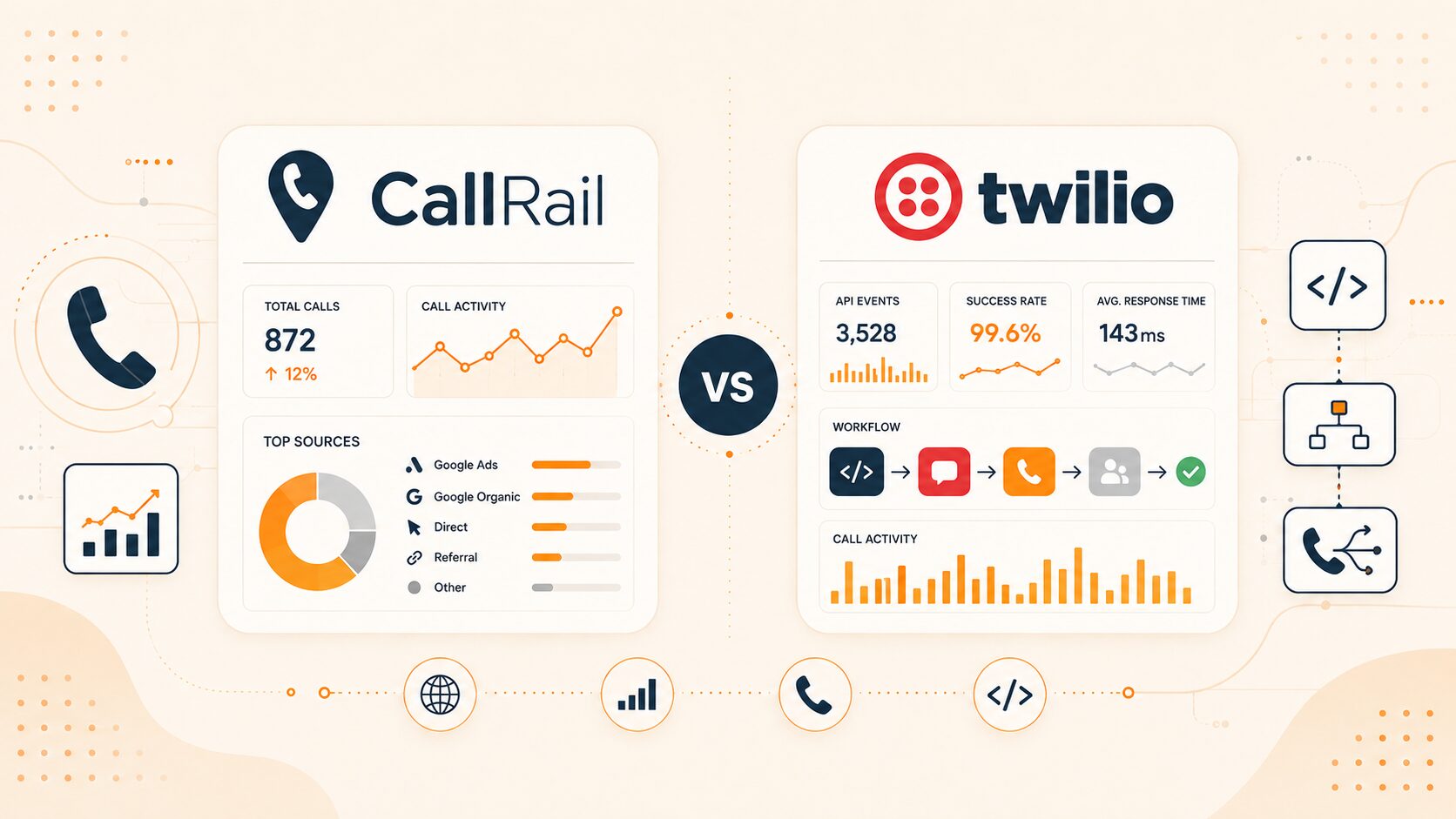
A CallRail vs Twilio comparison looks at two different ways to create a call tracking system. CallRail provides a finished marketing platform, while Twilio provides programmable communications products that can become part of a custom system.
Suppose a marketing manager needs campaign attribution and reports without starting a development project. CallRail is usually the more direct option because the tracking numbers, attribution, routing, recording, and reporting tools are already assembled.
Suppose a product team wants control over every routing rule, webhook, data model, and user experience. Twilio may provide the better foundation because the technical team can build around Twilio phone numbers, Voice APIs, webhooks, Studio, and related products.
A business that already uses Twilio numbers but wants a ready-to-use call tracking platform can also connect those numbers with AvidTrak.
CallRail vs Twilio at a Glance
CallRail and Twilio can both support call tracking, but each platform gives the buyer a different starting point.
CallRail starts with an application that marketers can configure. Twilio starts with communications services that a technical team can configure, connect, or develop into an application.
| Comparison area | CallRail | Twilio |
| Product type | CallRail is packaged call tracking and lead intelligence software. | Twilio is a programmable communications platform. |
| Best suited for | CallRail is suited to marketing teams that want a working call tracking system. | Twilio is suited to technical teams building custom voice and attribution products. |
| Ready-to-use marketing attribution | CallRail provides marketing attribution, with some functions depending on the selected plan. | Twilio generally requires the attribution layer to be developed or provided through another interface. |
| Dynamic number insertion | CallRail provides configurable dynamic number insertion inside the platform. | Twilio numbers can support DNI through custom or third-party logic. |
| Call routing and IVR | CallRail provides configurable call flows. | Twilio supports Studio, TwiML, APIs, webhooks, TaskRouter, and related routing tools. |
| Reporting | CallRail provides ready-made marketing reports. | Twilio provides operational tools, while marketing reports generally require development or another application. |
| Conversation analysis | CallRail provides conversation functions that vary by package. | Twilio provides usage-based Conversation Intelligence and related services. |
| APIs and webhooks | CallRail provides APIs and webhooks for extending the application. | Twilio uses APIs and webhooks as core components for building applications. |
| Agency structure | CallRail provides companies, users, agency access, and reporting tools. | Twilio provides subaccounts, while client reporting and white-label interfaces may require development. |
| Pricing model | CallRail uses monthly packages plus usage and selected product charges. | Twilio uses pay-as-you-go product and usage charges. |
| Trial | CallRail lists a 14-day platform trial. | Twilio lists a 30-day developer trial with product-specific free units and restrictions. |
| Main tradeoff | CallRail provides faster implementation but less control than a fully custom application. | Twilio provides greater control but requires more technical ownership. |
Are CallRail and Twilio Direct Competitors?
CallRail and Twilio overlap in the call tracking use case, but the platforms are not equivalent products. A buyer can use either approach to assign phone numbers to campaigns, route calls, record conversations, and collect call data.
The route from the phone call to the marketing report is different.
CallRail provides tracking numbers, dynamic number insertion, attribution, routing, recordings, transcripts, automation rules, and reports inside one application. CallRail also provides a REST API and webhooks for external systems.
Twilio’s approach starts with communications components. A technical team can purchase phone numbers, map them to marketing sources, configure webhooks, route calls, and collect events.
The business or its technology partner must then decide how visitor data will be stored, how calls will be matched with sessions, how reports will be presented, and how the complete system will be maintained.
The practical question is therefore not whether Twilio can support call tracking. Twilio can support call tracking.
The more useful question is whether the buyer wants a finished marketing application or wants to assemble a system around programmable services.
What Is CallRail?
CallRail is a marketing call tracking and lead intelligence platform. A marketing team can create tracking numbers, install dynamic number insertion, attribute calls and texts, review recordings and transcripts, build call flows, and use reports without developing the main application.
The Lead Tracking package includes phone numbers, local minutes, call and text attribution, recording, routing, transcription, analysis, and automation rules.
Additional packages add functions such as form attribution, call summaries, sentiment analysis, trend reports, and automatic conversion tagging.
CallRail also provides a REST API and webhooks. The API can access and modify account data, while webhooks can send call, form, and text events to external endpoints.
The main distinction is that a buyer receives a functioning marketing product before any custom connection is added.
What Is Twilio?
Twilio is a programmable communications platform. Programmable Voice, phone numbers, TwiML, voice webhooks, Studio, Functions, TaskRouter, recordings, transcription, Voice Insights, and Conversation Intelligence can all contribute to a call tracking system.
A technical team can purchase numbers, configure incoming-call webhooks, forward calls, store events, and create custom attribution rules.
Twilio Studio provides a visual flow builder, so every workflow does not require extensive coding. TwiML, Functions, APIs, and webhooks provide more control when a custom workflow is required.
Twilio does not provide a CallRail-style marketing attribution dashboard by default.
A business still needs a method for assigning numbers to sessions, matching calls with ads or keywords, creating reports, controlling user access, and sending conversion data to other systems.
Those functions can be built internally, purchased from another provider, or supplied through an integration such as AvidTrak’s Twilio call tracking integration.
What Is the Main Difference Between Buying and Building?
CallRail reduces the work required to launch a standard marketing call tracking program. Twilio gives a technical team more control over the call flow, application logic, data storage, and product experience.
That control can be valuable, but the business also becomes responsible for more of the system.
Buying a Packaged Call Tracking Platform
A packaged platform fits a buyer that needs attribution, number pools, routing, recordings, transcripts, reports, permissions, and marketing connections inside one application.
The business works within the platform’s supported:
- The business works within the available reports and dashboards.
- The business works within the supported routing and attribution workflows.
- The business works within the platform’s data model and account structure.
- The business works within the available plans, allowances, and overage rates.
- The business uses APIs or webhooks when additional connections are required.
CallRail’s API and webhooks allow custom connections, but CallRail does not replace every programmable communications component that Twilio provides.
Building With Programmable Communications Products
A custom Twilio system can match a company’s specific product requirements. The system can support specialized routing, custom account structures, international workflows, embedded voice, or proprietary interfaces.
The tradeoff is the work required around the telecom services.
A custom call tracking platform may require:
- The development team may need website JavaScript for visitor tracking and number replacement.
- The system may need number-pool assignment and recycling rules.
- The business may need session storage and a database.
- The application may need webhook validation and security controls.
- The team may need hosting, monitoring, and error handling.
- The business may need marketing attribution and reporting screens.
- The application may need user roles and permissions.
- The team may need Google Ads, GA4, CRM, and other marketing connections.
- The business remains responsible for maintenance as requirements and APIs change.
These internal or third-party costs belong in the total ownership decision. A low phone-number or per-minute rate does not show the full cost of a working call tracking application.
How Do CallRail and Twilio Call Tracking Features Compare?
CallRail provides many marketing functions as native application features. Twilio provides the technical capability for many of the same outcomes, but the buyer may need configuration, development, or another interface.
The correct comparison is therefore often “ready to use versus developer-built” rather than a simple yes or no.
Call Attribution and Dynamic Number Insertion
CallRail provides source, campaign, website visitor, and keyword attribution through tracking numbers and dynamic number insertion. A marketer can install the script, configure number pools, and review calls in the platform.
Dynamic number insertion connects website calls with the visitor or marketing source that generated them. The setup generally combines number assignment, website number replacement, session data, call forwarding, and attribution reporting.
Twilio’s phone number and Voice APIs can support number assignment and recycling. However, a business generally needs to create or connect the logic that selects a number, replaces the website number, stores the visitor session, maps the call back to the session, and reports the result.
Twilio therefore supports the technical components required for DNI. Twilio does not automatically create a marketing DNI system or connect an inbound call with a Google Ads keyword.
The implementation determines the depth of attribution.
Phone Numbers and International Requirements
CallRail provides tracking numbers within its supported markets and packages. CallRail is a practical choice when the required countries, number types, routing destinations, and compliance requirements match its service.
Twilio provides a broad international phone-number inventory and publishes country-specific number availability.
The available local, mobile, national, and toll-free number types vary by country. Registration documents, addresses, permitted use cases, telecom surcharges, and routing rates can also differ.
Twilio may suit a product team that needs an international number strategy or precise control over number provisioning.
A buyer should still confirm the required country, number type, registration requirements, and intended use case. An international inventory does not mean that every number type is immediately available in every country.
Call Routing and Interactive Voice Response
CallRail provides configurable call flows for routing, menus, schedules, recording, and related handling rules. A marketing or operations user can manage common flows inside the application.
Twilio can route calls with TwiML, APIs, webhooks, queues, TaskRouter, SIP, or custom logic. Studio can also create visual flows for menus and routing.
The difference again comes down to the amount of configuration and ownership the buyer wants.
A business that wants configurable advanced call routing without developing the surrounding marketing platform can also compare a dedicated call tracking platform.
For example, AvidTrak supports area-code and ZIP-code routing, caller ID rules, business-hours routing, sequential routing, simultaneous routing, and multi-level IVR.
Call Recording, Transcription, and Conversation Analysis
CallRail includes call recording and transcription in Lead Tracking, with published allowances and overages. Higher packages add functions such as summaries, sentiment analysis, trends, and automatic conversion tagging.
Twilio supports recording through Programmable Voice.
The source pricing used for this comparison lists:
- Twilio recording at $0.0025 per recorded minute.
- Twilio recording storage at $0.0005 per recorded minute per month.
- Standard recording transcription at $0.05 per minute.
- Batch Conversation Intelligence transcription at $0.024 per minute.
- Streaming transcription at $0.027 per minute.
Language analysis and custom generative operators can create additional usage charges.
Twilio Conversation Intelligence can provide summaries, sentiment, entity recognition, classification, and data extraction.
A team must still decide when recordings start, where results are stored, which analysis operators run, how sensitive data is handled, and how the findings appear in the final application.
Businesses comparing conversation functions can also review how AI call analytics connects transcripts, sentiment, caller intent, keyword mentions, and outcomes with campaign attribution.
Reporting, Dashboards, and Voice Insights
CallRail provides marketing reports designed to answer questions about lead sources, campaigns, calls, texts, forms, and conversation outcomes. The available reports depend on the selected package and enabled products.
Twilio Voice Insights serves a different primary purpose.
Voice Insights provides call summaries, metrics, events, quality information, historical data, and API access for understanding call performance.
Voice quality information can help a technical or operations team identify latency, jitter, call events, and delivery problems. Marketing attribution answers a different set of questions.
A marketing team generally wants to know which campaign, ad, keyword, landing page, or channel generated the call and what happened after the prospect called.
A custom Twilio application can connect those datasets. Voice Insights alone is not a replacement for a marketing attribution dashboard.
AvidTrak call tracking analytics, for example, connects inbound calls with campaigns, keywords, channels, landing pages, recordings, transcripts, and conversation outcomes.
Marketing Connections, APIs, and Webhooks
CallRail provides native connections for selected advertising, analytics, CRM, and marketing systems. CallRail’s API and webhooks can support additional workflows.
Twilio uses APIs, webhooks, SDKs, Functions, and event data as core parts of application development.
The company building the Twilio system decides how the data reaches a CRM, Google Ads, GA4, a data warehouse, or a client dashboard.
API availability does not create the same user experience in both products.
CallRail’s API extends a finished application. Twilio’s APIs can help form the application itself.
AvidTrak also provides a call tracking API for number provisioning, attribution, routing, IVR configuration, recordings, transcripts, outcomes, and CRM connections when a business wants API access alongside a ready-to-use platform.
Which Platform Works Better for Marketing Agencies?
CallRail is usually the closer fit for an agency that wants client call tracking without developing a client interface. CallRail supports companies, users, agency access, reporting, and account organization.
Twilio subaccounts can separate phone numbers, activity, and usage for different customers or applications.
A main Twilio account can create up to 1,000 subaccounts by default, according to the source information used for this comparison. Twilio bills the subaccount activity to the main account.
This structure is useful for separating resources and credentials, but a Twilio subaccount is not automatically an agency portal.
An agency may still need to create:
- The agency may need client-facing dashboards and reports.
- The agency may need account permissions and user roles.
- The agency may need onboarding and number administration.
- The agency may need white-label pages.
- The agency may need cross-client reporting.
- The agency may need client-level billing reports.
Twilio can support these requirements, but the agency owns the application work.
An agency that wants client accounts, attribution, reporting, white-label functions, and connected Twilio numbers can also consider AvidTrak call tracking for agencies.
AvidTrak’s Agency plan includes up to 1,000 client accounts. Twilio usage charges can still apply when Twilio services remain connected.
CallRail vs Twilio Pricing
CallRail pricing starts with a monthly software package and published usage allowances. Twilio pricing starts with individual products and usage units.
A fair comparison needs to account for both Twilio call legs and the cost of operating the surrounding application.
CallRail Package and Usage Costs
CallRail lists four monthly packages in the source pricing used for this comparison:
- Lead Tracking costs $50 per month plus usage.
- Lead Tracking Complete costs $95 per month plus usage.
- Lead Conversion costs $150 per month plus usage.
- Lead Conversion Complete costs $195 per month plus usage.
Each package includes five local numbers, 250 local minutes, and 25 text messages.
The source pricing also lists the following monthly usage charges:
- Each additional local number costs $3.
- Each additional local minute costs $0.06.
- Each toll-free number costs $5.
- Each toll-free minute costs $0.08.
- Each additional text message costs $0.03.
- Lead Tracking includes 250 transcription minutes and lists a $0.025 transcription overage.
Form submissions and premium conversation analysis follow separate package allowances and overages.
Custom API usage also has separate monthly tiers. The source lists the first 1,500 calls as free, 1,501 to 12,000 calls at $80, and 12,001 to 300,000 calls at $200.
Twilio Usage Costs and Call Legs
Twilio uses pay-as-you-go pricing for Programmable Voice.
The US rates referenced in the source document include:
- A local number costs $1.15 per month.
- A toll-free number costs $2.15 per month.
- Receiving a local call costs $0.0085 per minute.
- Receiving a toll-free call costs $0.022 per minute.
- Making a US or Canadian call costs $0.014 per minute.
- Recording costs $0.0025 per minute.
- Recording storage costs $0.0005 per recorded minute per month.
- Batch Conversation Intelligence transcription costs $0.024 per minute.
- Streaming transcription costs $0.027 per minute.
A forwarded tracking call can create more than one billable call leg.
First, a caller reaches the Twilio tracking number and creates an inbound leg. Twilio then places an outbound leg to the business or salesperson.
Recording, storage, transcription, Studio, Functions, analysis, SIP, browser voice, taxes, and telecom charges can create additional line items.
The exact total depends on the destination, country, number type, call flow, selected services, and contract terms.
Sample Cost for Five Numbers and 500 Calls
The following example uses five US local numbers and 500 inbound calls with an average call length of three minutes.
The scenario includes:
- The scenario includes 1,500 incoming minutes.
- The scenario includes 1,500 outgoing forwarding minutes.
- The scenario includes call recording.
- The scenario includes one month of recording storage.
- The scenario includes batch transcription.
- The scenario includes one Studio execution per call.
- The scenario does not include SMS or advanced language analysis.
Taxes, regulatory fees, support plans, discounts, development, hosting, databases, reporting, monitoring, and maintenance are excluded.
| Cost item | CallRail Lead Tracking | Twilio |
| Base package or five local numbers | $50.00 | $5.75 |
| Incoming or local call minutes | $75.00 in overages | $12.75 |
| Outgoing forwarding leg | The forwarding leg is included in the CallRail minute model. | $21.00 |
| Recording | Recording is included. | $3.75 |
| One month of recording storage | Recording storage is included in the platform. | $0.75 |
| Batch transcription | $31.25 in overages | $36.00 |
| Studio executions | Studio executions do not apply. | $0.00 within the first 1,000 executions |
| Estimated service total | $156.25 | $80.00 |
The Twilio figure is not the total cost of a working marketing call tracking platform.
The calculation excludes the website script, number-pool logic, session database, attribution model, reports, user access, CRM work, advertising connections, security, testing, and continuing technical support.
For comparison, AvidTrak pricing lists the Professional plan at $30 per month with 10 local numbers, 1,500 local minutes, and 1,500 recording minutes. The example volume therefore stays within those listed AvidTrak allowances.
A Twilio-connected AvidTrak setup is not a $30 all-in Twilio service. The business can still pay Twilio for phone numbers, call legs, recordings, storage, messages, and other selected Twilio products.
What Changes in an Agency Setup?
An agency scenario can become more complex because the system must support multiple clients instead of one business.
Suppose an agency has 20 clients, 100 numbers, 10,000 incoming minutes, 10,000 forwarding minutes, transcription, client dashboards, permissions, CRM connections, Google Ads reporting, and white-label access.
Twilio subaccounts can separate the clients, but the raw Twilio bill would still depend on the number types, call destinations, recording settings, transcription choice, flow executions, analysis operators, and country mix.
The agency would also need to account for the client interface, user permissions, reporting, monitoring, and maintenance.
CallRail would require the agency to evaluate the selected package, account arrangement, usage allowances, API volume, conversation analysis requirements, and agency terms.
AvidTrak would require the agency to evaluate the selected plan, numbers, minutes, overages, and the exact billing arrangement for any connected Twilio services.
A written configuration and cost estimate is more useful than forcing these different structures into one headline price.
CallRail Strengths and Limitations
CallRail Strengths
- CallRail provides a finished marketing call tracking application.
- CallRail provides attribution, routing, recording, transcription, automation, and reporting without requiring development of the main interface.
- CallRail provides dynamic number insertion and number pools for marketing attribution.
- CallRail provides agency and account-management functions.
- CallRail provides APIs and webhooks for sending data to other systems.
CallRail Limitations
- CallRail places some functions behind different package levels.
- Form tracking and premium conversation functions require selected packages.
- Number, minute, text, transcription, form, analysis, and API usage can affect the final bill.
- CallRail provides less control than a proprietary communications application.
- A business with highly specialized routing or product requirements may need more flexibility than a packaged platform provides.
Twilio Strengths and Limitations
Twilio Strengths
- Twilio gives technical teams detailed control over communications workflows.
- Twilio provides programmable phone numbers and Voice APIs.
- Twilio supports TwiML, webhooks, Functions, Studio, TaskRouter, SIP, and SDKs.
- Twilio can support custom routing and embedded communications.
- Twilio provides broad international number and communications capabilities.
- Twilio can become part of a proprietary voice or call tracking product.
Twilio Limitations
- Twilio’s communications capabilities do not automatically create a finished marketing call tracking system.
- A business may need to build attribution logic, website number replacement, session storage, reports, and permissions.
- The business may need separate monitoring, security, hosting, and maintenance.
- Marketing connections may require additional development.
- A low raw phone-number or voice rate does not necessarily mean a lower total ownership cost.
Should You Choose CallRail or Twilio?
The better choice depends on who will operate the system, how quickly the business needs usable reports, and how much control the product team requires.
For a Small or Midsize Business
CallRail is usually more practical when a business needs attribution and reports without starting a development project.
Twilio may fit when a technical resource is available or the company is adding call tracking to an existing application. Reporting and maintenance still need an owner.
For a Marketing, PPC, or SEO Team
CallRail is usually the closer match when the main requirement is campaign, keyword, landing-page, visitor, and lead attribution.
A PPC or SEO team needs to know which search activity produces phone leads, not simply whether a phone call reached a Twilio number.
Keyword-level call tracking can connect inbound calls with PPC keywords, ad groups, campaigns, landing pages, and organic search activity.
Twilio can support the same type of attribution, but a technical team must connect visitor data, number pools, calls, keywords, and advertising systems.
Businesses that already use Twilio can use AvidTrak’s Twilio integration to add an attribution and reporting interface around those numbers.
For a Development or Product Team
Twilio is usually stronger for a proprietary product, embedded communications experience, or unusual call workflow.
A product team can control the communication logic, database, interface, event handling, and account model.
CallRail remains relevant when the product only needs call tracking data or selected events. CallRail’s API and webhooks may provide enough access without requiring the company to build the complete call tracking application.
For a Marketing Agency
CallRail may fit an agency that wants account organization and client reporting without building the underlying platform.
Twilio may fit an agency that plans to own a proprietary multi-client application and has the technical resources to maintain it.
AvidTrak may fit an agency that wants multi-client call tracking, white-label reporting, attribution, and connected Twilio numbers.
For International or Specialized Communications
Twilio may provide the better foundation when a business needs broad country coverage, programmable number provisioning, SIP, browser or mobile voice SDKs, or a custom communications product.
Availability and registration requirements still need to be reviewed for each country and number type.
CallRail may be more appropriate when the platform’s supported market matches the business and marketing reporting matters more than infrastructure control.
The buyer should compare the actual country, number, routing, compliance, and reporting requirements instead of comparing platform names alone.
When AvidTrak With Twilio May Be a Better Option
AvidTrak provides a middle option for a business that already uses Twilio numbers but does not want to develop dynamic number insertion, marketing attribution, routing controls, and reports internally.
The AvidTrak Twilio connector connects Twilio phone numbers with AvidTrak’s marketing interface.
The connected setup can support:
- AvidTrak can provide dynamic number insertion around connected Twilio numbers.
- AvidTrak can provide campaign and keyword attribution.
- AvidTrak can provide marketing reporting and call analytics.
- AvidTrak can provide routing and IVR controls.
- AvidTrak can provide call recording and transcription.
- AvidTrak can provide conversation outcome analysis.
- AvidTrak can provide CRM and marketing connections.
- AvidTrak can provide agency and client-account management.
This approach may suit a business that wants to retain existing Twilio phone numbers while adding a ready-to-use marketing layer.
The approach may also suit a business that needs keyword-level attribution but does not want to build the session-matching and reporting interface internally.
AvidTrak does not replace every Twilio API, SDK, SIP product, messaging service, authentication product, or custom application.
A connected setup can include both AvidTrak subscription charges and Twilio usage charges.
Final Verdict
CallRail is usually the better fit for a marketing team that wants working attribution, routing, recording, and reports without building the core system.
Twilio is usually the better fit for a technical team that wants to create a proprietary communications or call tracking product.
The pricing decision should compare total ownership costs rather than comparing a CallRail package with one Twilio minute rate. Development, hosting, reporting, security, and maintenance can materially change the comparison.
AvidTrak deserves consideration when a business wants to retain or connect Twilio numbers but needs a ready-to-use marketing dashboard, dynamic number insertion, routing, attribution, call analytics, and agency tools.
Frequently Asked Questions
1. Which Is Better for Call Tracking, CallRail or Twilio?
CallRail is generally the better fit when a marketing team wants a finished call tracking application with attribution, reports, routing, recordings, and conversation tools.
Twilio is generally the better fit when a technical team wants to build a custom system or add voice functions to an existing product. The right choice depends on the required interface, development capacity, control, and total ownership cost.
2. Can Twilio Be Used for Call Tracking?
Yes. Twilio provides phone numbers, Programmable Voice, webhooks, routing tools, recordings, transcription, Voice Insights, and Conversation Intelligence that can support call tracking.
A business must still configure or connect the attribution, number assignment, session storage, reporting, and marketing-system logic required for the intended use case.
3. Does Twilio Provide Dynamic Number Insertion?
Twilio provides phone-number APIs and programmable voice components that can support dynamic number insertion. Twilio also documents DNI as a call tracking method.
The business or its technology partner generally needs to create or connect the number pool, website replacement script, visitor-session matching, campaign mapping, and reporting layer.
A dedicated dynamic number insertion platform provides those functions as part of a broader marketing attribution workflow.
4. Does Twilio Require Coding?
Not every Twilio workflow requires extensive coding. Studio provides a visual flow builder, and Twilio partners or third-party products can provide working interfaces.
A custom marketing attribution system can still require development for visitor tracking, data storage, reports, permissions, advertising connections, monitoring, and maintenance.
5. Is Twilio Cheaper Than CallRail?
Twilio can have lower raw phone-number and voice costs in some scenarios, but those charges do not include every cost of a working call tracking application.
A fair comparison includes Twilio call legs, recording, storage, transcription, analysis, Studio or Functions usage, development, hosting, reporting, security, and maintenance.
6. Does CallRail Provide an API?
Yes. CallRail provides a REST API that can access and modify data within a CallRail account.
CallRail also provides webhooks for selected events. Custom API calls have monthly usage tiers, and access to some data can depend on the selected plan.
7. Can an Agency Manage Client Accounts With Twilio?
Twilio subaccounts can separate resources and activity for customers, and a main account can manage multiple subaccounts.
The agency may still need to build client dashboards, permissions, white-label pages, onboarding, number administration, cross-client reports, and billing tools. A Twilio subaccount provides an account structure rather than a complete agency interface.
8. Can AvidTrak Use Existing Twilio Phone Numbers?
Yes. AvidTrak states that businesses can connect existing Twilio phone numbers with AvidTrak for dynamic number insertion, routing, recordings, attribution, reports, and other supported functions.
The connected setup does not remove Twilio’s own number, call, recording, messaging, or other service charges.
Connect Twilio Numbers With AvidTrak
When a business wants to retain Twilio phone numbers but does not want to build dynamic number insertion, attribution reports, routing controls, and marketing dashboards internally, the business can connect Twilio with AvidTrak.
AvidTrak adds call attribution, reporting, routing, recordings, and marketing analysis around connected Twilio numbers.
Businesses can also review AvidTrak call tracking pricing or start the 14-day free trial without a credit card.


