


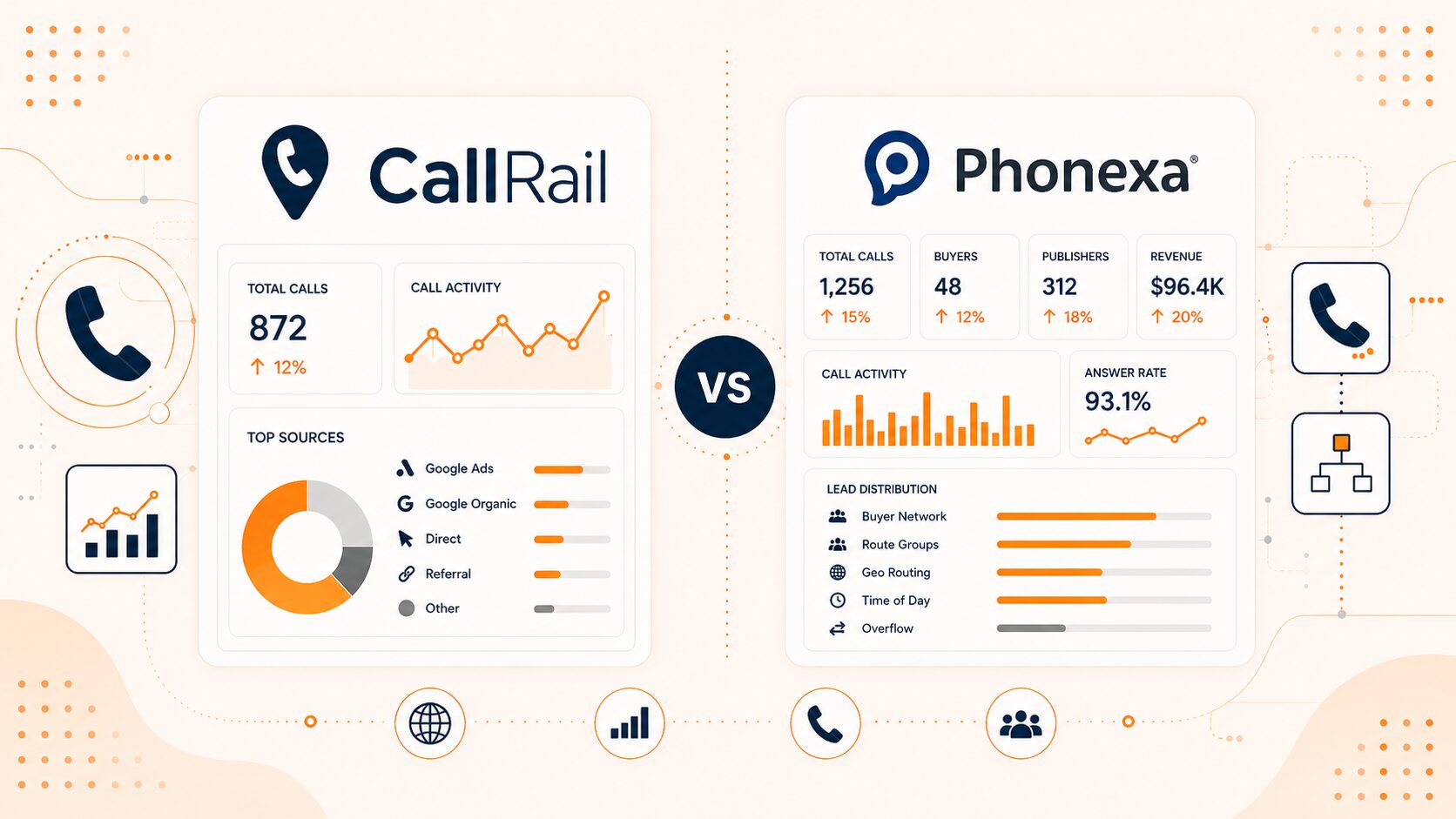
A CallRail vs Phonexa comparison looks at two platforms that overlap in call tracking but support different operating models. CallRail focuses more directly on call, text, form, and conversation tracking for leads generated by a business or agency.
Suppose a marketing team needs to connect calls with ads, keywords, campaigns, and sales outcomes. CallRail may provide the more direct fit.
Suppose the operation buys or sells calls, manages publishers, runs buyer auctions, or distributes web leads. Phonexa addresses that wider performance-marketing workflow.
AvidTrak is another option when the requirement centers on call attribution, routing, reporting, and agency account management without a buyer-and-publisher marketplace.
CallRail vs Phonexa at a Glance
CallRail and Phonexa overlap in call tracking, dynamic number insertion, routing, recording, reporting, and marketing integrations. The main difference appears after the lead enters the system.
CallRail primarily helps a business manage its own marketing leads. Phonexa can also distribute calls or web leads among buyers and publishers while tracking the commercial result.
| Comparison point | CallRail | Phonexa |
| Primary use case | Call tracking and lead engagement for businesses and agencies | Call and lead tracking, distribution, and monetization for performance marketing operations |
| Typical buyer | Small and midsize businesses, multi-location teams, and marketing agencies | Affiliate networks, lead generators, aggregators, publishers, buyers, and large advertisers |
| Call attribution | Tracking numbers with source-level or visitor-level attribution | Call Logic with source, campaign, caller, quality, and distribution data |
| Dynamic number insertion | Website visitor and keyword attribution | Local, toll-free, and vanity tracking-number programs |
| Forms and web leads | Form Tracking attributes submissions and supports follow-up | LMS Sync processes, validates, routes, and distributes web leads |
| Routing and IVR | Call Flow Builder supports greetings, menus, schedules, and routing steps | Call Logic includes a drag-and-drop IVR and custom distribution logic |
| Pay-per-call operations | Standard call tracking and routing are available; Phonexa-style buyer auctions are not publicly documented | Ping-post calls, real-time bidding, buyer matching, and distribution rules |
| Buyer and publisher management | Agency account tools focus on business and client accounts | Buyer, publisher, pricing, payout, and partner-reporting workflows |
| Conversation tools | Transcription is included, while summaries, sentiment, trends, and coaching depend on the package | Recording is available on demand; speech-to-text, keyword search, numerical redaction, and AI Call Agents can be added |
| Setup model | Published plans with self-service setup and support resources | Managed services include configuration help, monitoring, documentation, training, and an assigned contact |
| Pricing | Published plans plus usage | Call Logic requires a custom quote |
| Trial | A 14-day trial is listed without a credit-card requirement | A public self-service trial is not confirmed on the pricing page |
Are CallRail and Phonexa Direct Competitors?
CallRail and Phonexa are competitors when a buyer compares call tracking, attribution, routing, recording, transcription, reporting, and marketing data connections. Both products can assign tracking numbers, associate calls with marketing sources, send calls through configured flows, and report what happened after a prospect called.
The products are not identical in scope. CallRail packages call tracking with lead engagement functions for a business or agency managing its own leads.
Phonexa describes Call Logic as call tracking and distribution software for large-scale businesses, including operations that buy or sell calls. Phonexa also connects Call Logic with LMS Sync for web lead processing and distribution.
The decision therefore depends on the operating model, not only on the number of shared features.
A company that needs attribution for its own campaigns may pay for functions it does not use if it selects a platform designed for buyer, publisher, and bidding workflows. A performance marketing network may face the opposite problem if it selects a platform that tracks calls well but does not support commercial lead distribution.
The buyer should define the required workflow before comparing plan names or base prices.
What Is CallRail?
CallRail is a call tracking and lead engagement platform for businesses and marketing agencies. Lead Tracking includes call and text attribution, recording, routing, transcription, and automation rules.
CallRail is most relevant when a business wants to connect calls with ads, campaigns, search terms, landing pages, or offline sources. Tracking numbers and dynamic number insertion provide the attribution layer, while call routing sends each caller to the intended destination.
Additional packages can add Form Tracking and conversation intelligence.
- Form Tracking connects website submissions with marketing activity and follow-up.
- Premium Conversation Intelligence adds functions such as summaries, sentiment analysis, lead scoring, tags, trend reporting, and coaching.
What Is Phonexa?
Phonexa is a performance marketing platform built around call and lead distribution. Call Logic handles inbound calls, while LMS Sync manages web leads.
Phonexa is most relevant to lead generators, advertisers, publishers, affiliate networks, aggregators, and teams that manage high-volume lead flows. Call Logic can evaluate a caller against campaign and buyer rules before routing the call to a matching destination.
LMS Sync adds web lead intake, validation, filtering, pricing, and distribution.
- The system can check eligibility and buyer criteria before a lead is sent.
- Phonexa can apply bidding and distribution rules across approved buyers.
- Other Phonexa modules cover click tracking, user behavior, email, SMS, phone systems, compliance, and accounting.
What Are the Biggest Differences Between CallRail and Phonexa?
A Business’s Own Leads Versus a Partner Network
CallRail centers on leads generated by a business or an agency’s clients. Phonexa can manage that use case, but Phonexa also supports relationships among publishers, buyers, advertisers, and affiliate partners.
That difference affects permissions, reporting, pricing logic, routing rules, and the data each team needs to see.
Standard Routing Versus Commercial Distribution
CallRail can direct calls by menu choice, schedule, destination, campaign, or other configured steps. Phonexa can route a call to an internal sales team, but Call Logic can also choose among buyers according to price, priority, weight, eligibility, capacity, and other commercial rules.
A standard IVR question asks where the caller should go. A distribution system may also ask which buyer can accept the caller and what that connection is worth.
Form Attribution Versus Web Lead Processing
CallRail Form Tracking records a website submission, connects the submission with marketing activity, and can notify a team for follow-up. Phonexa LMS Sync accepts lead data, checks it against rules or validation services, and can distribute the lead to a selected buyer.
A buyer should not treat those functions as equivalents simply because both begin with a web form.
Published Packages Versus a Custom Quote
CallRail publishes package prices, included numbers and minutes, and selected feature differences. Phonexa asks the buyer to request a quote based on products, volume, functions, and service requirements.
The Phonexa model makes sense for a configurable implementation, but it prevents a reliable public dollar comparison without written scope and pricing.
How Do CallRail and Phonexa Features Compare?
Call Tracking and Attribution
Both platforms can connect inbound calls with marketing activity. CallRail focuses on campaign, source, visitor, keyword, and lead attribution for a business or agency.
Phonexa Call Logic also tracks sources and campaigns, but its reports can follow a call through distribution rules, buyer acceptance, revenue, and partner performance. CallRail is the more direct match for a team measuring its own advertising.
Phonexa provides more context when the call itself moves through a commercial network.
Dynamic Number Insertion
Both platforms support dynamic number insertion. CallRail can change the number shown to a website visitor so the resulting call can be associated with the visitor’s source or search activity.
Phonexa can use local, toll-free, or vanity numbers and associate the caller with the relevant campaign or source. Pool size, traffic volume, country coverage, session rules, and keyword requirements should be part of the quote for either product.
Call Routing and Interactive Voice Response
CallRail’s Call Flow Builder can use greetings, menus, schedules, dial steps, voicemail, tags, and other routing actions. That setup works well when a business wants to send callers to a team, location, employee, or automated service.
Phonexa provides a drag-and-drop IVR and routing rules within Call Logic. The Phonexa IVR documentation describes voice or keypad input that sends callers to an operator or department.
Call Logic can extend that flow with buyer matching, distribution choices, and partner-specific criteria. The buyer should separate basic call handling from revenue-based distribution when comparing scope.
Pay-Per-Call Distribution and Buyer Matching
Phonexa has the clearer fit for pay-per-call networks. Ping Post Calls 2.0 lets qualified buyers review selected call data and compete according to the configured rules.
Call Logic can use price, priority, weight, parallel pings, ping post, maximum earnings per lead, profit, or even distribution strategies.
CallRail can attribute, record, analyze, and route calls, but CallRail’s public product materials do not document a matching buyer marketplace with the same pricing, bidding, payout, and publisher functions. A business that only sends calls among its own teams may not need those functions.
A network that sells calls to outside buyers should treat them as a primary selection requirement.
Web Lead Tracking and Processing
CallRail Form Tracking fits a marketing team that wants phone and form inquiries in related reporting. CallRail can associate the form submission with marketing activity and notify a team.
Phonexa LMS Sync is meant for lead processing at a different operational level. LMS Sync can validate submitted data, reject duplicates or unwanted leads, apply buyer criteria, run distribution logic, and send accepted leads to a buyer.
A company may need one function, both functions, or neither.
Call Recording, Transcription, and Keyword Analysis
CallRail’s Lead Tracking package lists recording, transcription, and analysis. Higher packages add broader keyword analysis, summaries, sentiment, trend reporting, conversion tags, and coaching functions.
The plan comparison should confirm which output the team needs. A transcript alone does not provide the same information as a summary, score, sentiment label, or coaching note.
Phonexa’s call recording documentation states that recording is available on demand. Speech-to-text, keyword search, and numerical data redaction depend on recording and the related subscription settings.
The quote should name each required function and the call volume to which the function will apply.
Artificial Intelligence and Call Qualification
CallRail applies artificial intelligence to conversation review and follow-up. Depending on the package, the system can provide transcription, summaries, sentiment, lead qualification, tags, trend reports, coaching, action plans, and follow-up suggestions.
CallRail also offers Voice Assist as a separate call-answering option with its own pricing terms.
Phonexa’s AI Call Agents work as configurable blocks within an IVR. An agent can answer common questions, collect caller information, qualify a caller, update fields, and send the call to a matching sales representative or buyer.
Phonexa publishes a rate of $0.225 per minute for AI Call Agents. A buyer should confirm the rate and included setup in the written quote.
Reporting and Analytics
CallRail reporting is built around marketing sources, calls, conversations, and lead outcomes. The practical question is whether the team can connect each inquiry with the campaign and next action that matter.
Phonexa reporting includes marketing and call data, but it can also report buyer comparisons, publisher results, distribution paths, acceptance, revenue, payouts, and partner performance. Those extra fields matter when outside parties share a lead flow.
Fraud Controls and Numerical Redaction
Phonexa documents call and lead screening through iClear and related validation services. Phonexa also documents numerical data redaction for recordings, including bank-account, payment-card, or Social Security numbers, when the required recording and speech functions are active.
CallRail provides controls for recording, permissions, and account access. Buyers with formal fraud-screening or numeric-redaction requirements should obtain written confirmation for the exact workflow from each vendor.
CRM, Advertising, and API Connections
Both vendors connect with marketing, CRM, analytics, and reporting systems. CallRail lists common advertising and CRM connections and provides a REST API.
Phonexa supports third-party services, CRM connections, and custom API work across its products. A logo on an integration page is not enough for a technical decision.
The buyer should verify data direction, field mapping, update timing, retry behavior, rate limits, and any fee for the exact system in use.
How Do Setup, Training, and Ongoing Management Compare?
CallRail follows a packaged software model. A buyer selects a plan, starts a trial, creates companies or accounts, installs tracking code where needed, configures numbers and call flows, and adds users or data connections.
CallRail provides help content and agency resources, while advanced services or AI products may involve separate onboarding support.
Phonexa’s pricing page states that managed services are included. The listed service covers an assigned contact, core configuration support, monitoring, performance reporting, documentation, and up to four training sessions per month.
That model may suit a high-volume operation with buyer rules, publisher connections, distribution logic, or several Phonexa products. The quote should define what the managed team will configure and what the customer must maintain.
Neither setup should be described as easier without testing the actual implementation. A five-number call-tracking account is not comparable with a system containing twenty buyers, ten publishers, call auctions, lead validation, revenue rules, and several APIs.
The buyer should compare the work required for the same approved scope.
CallRail vs Phonexa Pricing
CallRail lists Lead Tracking at $50 per month, Lead Tracking Complete at $95, Lead Conversion at $150, and Lead Conversion Complete at $195, plus usage. The listed packages include five numbers and 250 local minutes.
The entry package includes call and text attribution, recording, routing, transcription, analysis, and automation rules.
CallRail’s official pages show more than one starting-price reference. Some CallRail comparison pages describe the starting price as $55 per month or $50 with annual billing, while the main pricing page displays $50 per month.
The Voice Assist terms also include a $55 reference. A buyer should confirm the billing cadence, local-minute rate, phone-number charges, SMS charges, toll-free rates, and AI fees at checkout.
Phonexa does not publish a standard monthly price for Call Logic. The pricing page states that included minutes vary by package and directs buyers to request a custom quote.
The final fee depends on the selected products, call or lead volume, recording, speech-to-text, AI Call Agents, buyer and publisher requirements, onboarding work, and other agreed terms.
For a call-tracking-only quote, the buyer can ask both vendors to price the same scope:
- 20 tracking numbers and 5,000 monthly call minutes
- 10 marketing campaigns and three users
- One IVR flow, call recording, speech-to-text, and keyword analysis
- No buyer bidding, publisher network, or web lead distribution
For a performance marketing quote, the buyer can ask Phonexa to price a second scope:
- 50 tracking numbers and 25,000 monthly call minutes
- 20 buyers and 10 publishers
- Real-time bidding, ping-post calls, and partner reporting
- Fraud screening, call recording, AI qualification, and web lead processing
Those scopes help the buyer compare requirements. They are not cost estimates.
The final decision should use written quotes that specify allowances, overages, setup work, contract length, support, and optional services.
CallRail Strengths and Limitations
CallRail Strengths
- CallRail publishes plan prices and standard allowances for a faster initial budget check.
- CallRail combines call and text attribution with recording, routing, transcription, and automation in the entry package.
- CallRail offers Form Tracking for teams that want calls and form submissions in related lead reporting.
- CallRail offers higher-level conversation summaries, sentiment, trends, tagging, and coaching in selected packages.
- CallRail provides Account Center and white-label options for agencies managing client accounts.
CallRail Limitations
- CallRail’s final cost can rise with usage, phone numbers, messages, toll-free traffic, and selected AI services.
- Form attribution and premium conversation functions require higher packages.
- CallRail’s official pages contain a $50 versus $55 starting-price inconsistency that requires checkout confirmation.
- CallRail’s public materials do not confirm Phonexa-style buyer auctions, publisher workflows, or payout reporting.
Phonexa Strengths and Limitations
Phonexa Strengths
- Phonexa supports call tracking and routing within a wider pay-per-call operating system.
- Phonexa supports buyer matching, publisher workflows, ping-post calls, real-time bidding, and several distribution strategies.
- Phonexa connects Call Logic with LMS Sync for web lead validation and distribution.
- Phonexa documents recording, speech-to-text, keyword search, numerical redaction, fraud controls, and AI Call Agents.
- Phonexa includes managed services for configuration, monitoring, documentation, training, and ongoing guidance.
Phonexa Limitations
- Phonexa does not publish a standard Call Logic monthly fee, so the buyer must request a quote.
- A wider multi-product implementation requires more scope decisions than a basic call-tracking account.
- Some recording and conversation functions are on demand or depend on subscription settings.
- A business that only needs basic attribution and routing may not need buyer, publisher, bidding, or lead-distribution functions.
Which Platform Is Better for Each Use Case?
A Small or Midsize Business
CallRail is usually the more direct fit when a small or midsize business wants to track calls and texts, connect them with marketing sources, route callers, review recordings, and add form or conversation functions through published packages.
Phonexa becomes more relevant when the business also buys leads, sells calls, manages several outside lead sources, or needs custom distribution across partners.
A Marketing Agency
CallRail may fit an agency that manages client attribution, reporting, form tracking, and call quality. CallRail’s agency resources cover client-owned accounts, direct client billing, Account Center access, and white-label options.
Phonexa may fit an agency or performance partner that also manages buyers, publishers, lead sales, or high-volume distribution. The deciding issue is whether the agency reports client marketing or operates a commercial lead network.
A Pay-Per-Call Network
Phonexa is the stronger match for a pay-per-call network that must qualify calls, match buyers, run bidding, apply caps or schedules, record revenue, and report results to partners.
CallRail may still be useful for attribution and conversation analysis, but those functions do not replace the network controls documented for Call Logic.
An Affiliate or Lead Distribution Team
Phonexa is usually the better match when a team receives traffic from publishers, validates consumer data, applies buyer criteria, distributes phone or form leads, and tracks revenue or payouts.
CallRail is more relevant when the affiliate team only needs to measure and handle calls generated for its own business or client accounts.
A High-Volume Performance Marketing Company
Phonexa should receive closer review when a high-volume company needs Call Logic, LMS Sync, partner reporting, fraud controls, custom APIs, or managed configuration.
CallRail may still win for a division that only needs campaign attribution and lead engagement. A company can compare the platforms at the workflow level instead of forcing one product to cover every department.
When May AvidTrak Be a Better Option?
AvidTrak may be a better fit when the requirement centers on call attribution and lead handling rather than buyer auctions or lead resale. AvidTrak combines keyword-level tracking, dynamic number insertion, recording, AI transcription, conversation outcomes, routing, IVR, reporting, and agency account management.
AvidTrak pricing lists a Starter plan at $15 per month, a Professional plan at $30, and an Agency plan at $55. The plans include different allowances for numbers, minutes, recordings, and CNAME lookups.
The Agency plan includes up to 1,000 client accounts, while usage beyond the included allowances can create additional charges.
AvidTrak is particularly relevant when a business or agency needs the following call tracking functions:
- The platform can connect inbound calls with campaigns, keywords, landing pages, and marketing channels.
- The platform supports dynamic number insertion, call recording, AI transcription, conversation outcome analysis, and call tracking reports.
- The platform supports IVR menus, area-code and ZIP-code routing, and sequential or simultaneous forwarding.
- AvidTrak agency call tracking supports multi-client management and white-label reporting.
AvidTrak does not replace Phonexa’s ping-post lead distribution, real-time buyer bidding, partner revenue rules, or large affiliate-network workflows.
AvidTrak belongs on the shortlist when the buyer needs call tracking and related lead handling without that commercial distribution infrastructure.
Final Verdict
CallRail, Phonexa, and AvidTrak fit different operating models:
- CallRail is the more direct choice for a business or agency that wants packaged call, text, form, and conversation tracking for its own leads.
- Phonexa is the stronger fit for a pay-per-call or performance marketing operation that manages buyers, publishers, bidding, distribution, validation, and revenue data.
- AvidTrak is worth comparing when public monthly pricing, keyword attribution, routing, reporting, and agency account capacity are priorities.
The better selection depends on whether the business mainly tracks its own leads or distributes leads across commercial partners.
Frequently Asked Questions
1. Which Is Better, CallRail or Phonexa?
CallRail is usually better for a business or agency tracking leads generated by its own marketing. Phonexa is usually better for a pay-per-call network, lead distributor, affiliate network, or other operation that manages buyers, publishers, bidding, and lead monetization.
The required workflow determines the better option.
2. Are CallRail and Phonexa Direct Competitors?
CallRail and Phonexa compete in call tracking, attribution, routing, recording, reporting, and conversation tools. Phonexa extends beyond that shared area with buyer and publisher management, ping-post calls, real-time bidding, web lead distribution, and partner revenue reporting.
3. Is Phonexa a Call Tracking Platform?
Yes. Phonexa Call Logic tracks inbound calls, marketing sources, campaigns, caller information, routing results, and performance.
Call Logic also supports call distribution and pay-per-call operations, which gives Phonexa a wider scope than a basic call-tracking product.
4. Does CallRail Support Pay-Per-Call Distribution?
CallRail tracks, routes, records, and analyzes inbound calls. CallRail’s public materials do not confirm the same buyer auctions, publisher controls, ping-post calls, payout logic, and commercial distribution strategies that Phonexa documents.
A pay-per-call network should verify every required network function in writing.
5. Does Phonexa Publish Pricing?
Phonexa publishes its pricing model and selected usage information, but the US pricing page does not provide a standard monthly Call Logic fee. Buyers request a custom quote based on the selected products, volume, functions, managed services, and implementation scope.
6. Which Platform Is Better for Marketing Agencies?
CallRail may fit an agency that tracks and reports leads for client campaigns. Phonexa may fit an agency that also operates pay-per-call programs, manages lead buyers and publishers, or distributes leads among partners.
AvidTrak is another agency option when white-label reporting, public pricing, and high client-account capacity are priorities.
7. Which Platform Is Better for Affiliate and Pay-Per-Call Campaigns?
Phonexa is usually the stronger fit because Call Logic and LMS Sync support partner management, buyer matching, bidding, call and lead distribution, fraud controls, and revenue reporting.
CallRail remains relevant when the affiliate operation only needs attribution, routing, or conversation analysis for calls handled by its own team.
8. What Is an Alternative to Both CallRail and Phonexa?
AvidTrak call tracking software is an alternative when a business needs call tracking, keyword attribution, routing, recording, transcription, reporting, and agency account management with published monthly plans.
AvidTrak does not replace Phonexa’s buyer marketplace, ping-post distribution, real-time bidding, or web lead sales system.
Start Tracking Calls With AvidTrak
If the requirement is call attribution, keyword tracking, routing, recording, transcription, reporting, or agency management, AvidTrak offers a 14-day free trial with $20 in credit and no credit-card requirement.
Buyers can also review AvidTrak pricing before selecting a plan.
A performance marketing operation that needs buyer auctions, publisher workflows, or lead distribution should compare Phonexa for that wider scope.


