


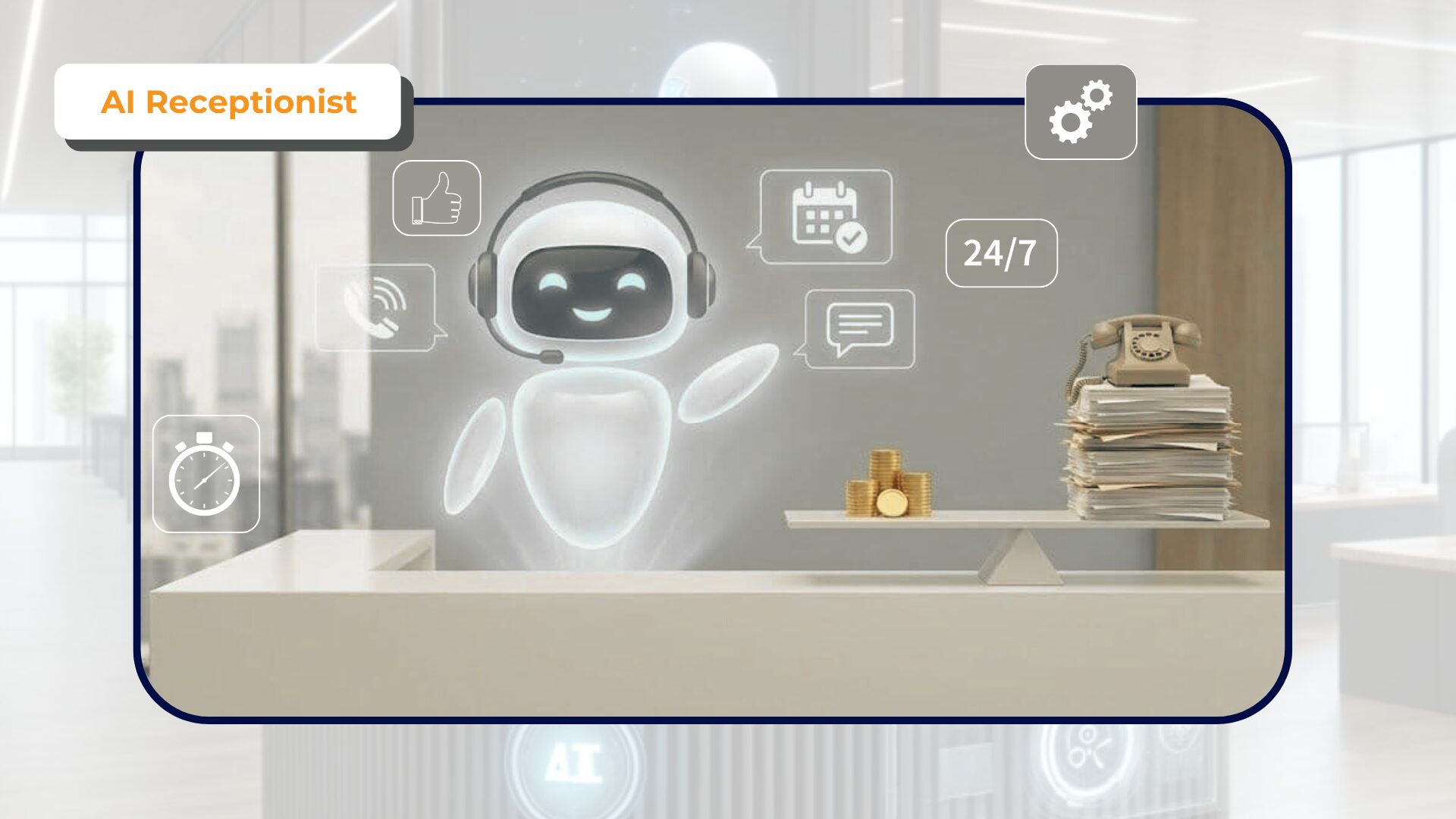
The best AI receptionists are voice-based systems that answer incoming voice calls, guide callers through natural conversations, route calls correctly, and capture important details without relying on human receptionists, traditional answering service providers, or basic IVR menus.
In 2026, businesses are adopting AI receptionist software to handle calls, support appointment scheduling, and remain available 24/7. Modern platforms now combine voice AI, AI-powered transcription and outcomes, call routing, and call summaries, giving business owners clear call data, better customer interactions, and faster follow-up without expanding their call center teams.
What is an AI receptionist in 2026?
An AI receptionist in 2026 is built to handle real business conversations, not just pass calls along. It goes beyond scripted menus and works as a front-line virtual receptionist that understands intent and responds naturally.
- Uses voice-based conversational AI to answer calls in a natural, human-sounding way
- Handles call answering, identifies caller intent, and supports lead qualification
- Manages call routing, message taking, and appointment scheduling without manual help
- Acts as the best AI virtual receptionist for 24/7 service, covering after-hours and peak times
- Provides call summaries, making it the best AI solution for virtual receptionist call summaries
- Differs from IVRs by holding conversations instead of forcing button-based call flows
- Differs from basic virtual receptionists by using AI voice technology and artificial intelligence, not scripts
For many teams, this shift has made AI receptionist software one of the most practical solutions for businesses that depend on inbound calls.
What Makes a Great AI Receptionist in 2026?
Not every AI receptionist handles real business calls the same way. The best tools are judged by how well they manage conversations, share information, and support daily operations without friction.
- Natural, human-like voice that callers can understand and respond to comfortably
- Intent recognition for inbound sales, customer service, bookings, and urgent calls
- Smart call routing that sends calls to the right person or team based on purpose
- Voicemail and message capture when calls are missed, or when staff are unavailable
- Appointment booking or handoff using tools such as Google Calendar
- AI-powered transcription that creates accurate call transcripts and call summaries
- CRM and workflow integrations to share call data across systems
- Analytics covering missed calls, call patterns, and routing outcomes
- Scalability to support growing call volume without changing the phone system
This checklist sets the standard used throughout this guide to evaluate the best AI receptionists for different business needs.
AI Receptionist vs Traditional Call Answering Services
Businesses often compare AI receptionists with traditional answering services when deciding how to handle inbound calls. The differences become clear once you look at how each option handles scale, availability, and call information.
AI receptionist
- Lower ongoing cost for handling high call volume
- Available 24/7 without shift limits
- Consistent call handling using the same call scripts and call flows
- Scales easily as voice calls increase
- Trained using a knowledge base and training documents, not repeated onboarding
- Automatically tags call outcomes such as booking requests or pricing inquiries using AI-powered conversation outcome extraction
- Provides call transcripts, call summaries, and structured call data
Traditional answering service
- Costs increase as call volume grows
- Limited availability based on staffing and schedules
- Call handling varies by agent
- Scaling requires hiring and onboarding live agents
- Training depends on manuals and repeated coaching
- Limited reporting beyond basic call logs
For many business owners, AI receptionist software offers a more predictable way to manage call handling, especially when call volume changes or after-hours coverage is needed.
List of 5 Best AI Receptionists in 2026
- AvidTrak
- Smith.ai
- Dialzara
- Synthflow
- Talkdesk
1. AvidTrak
What it is
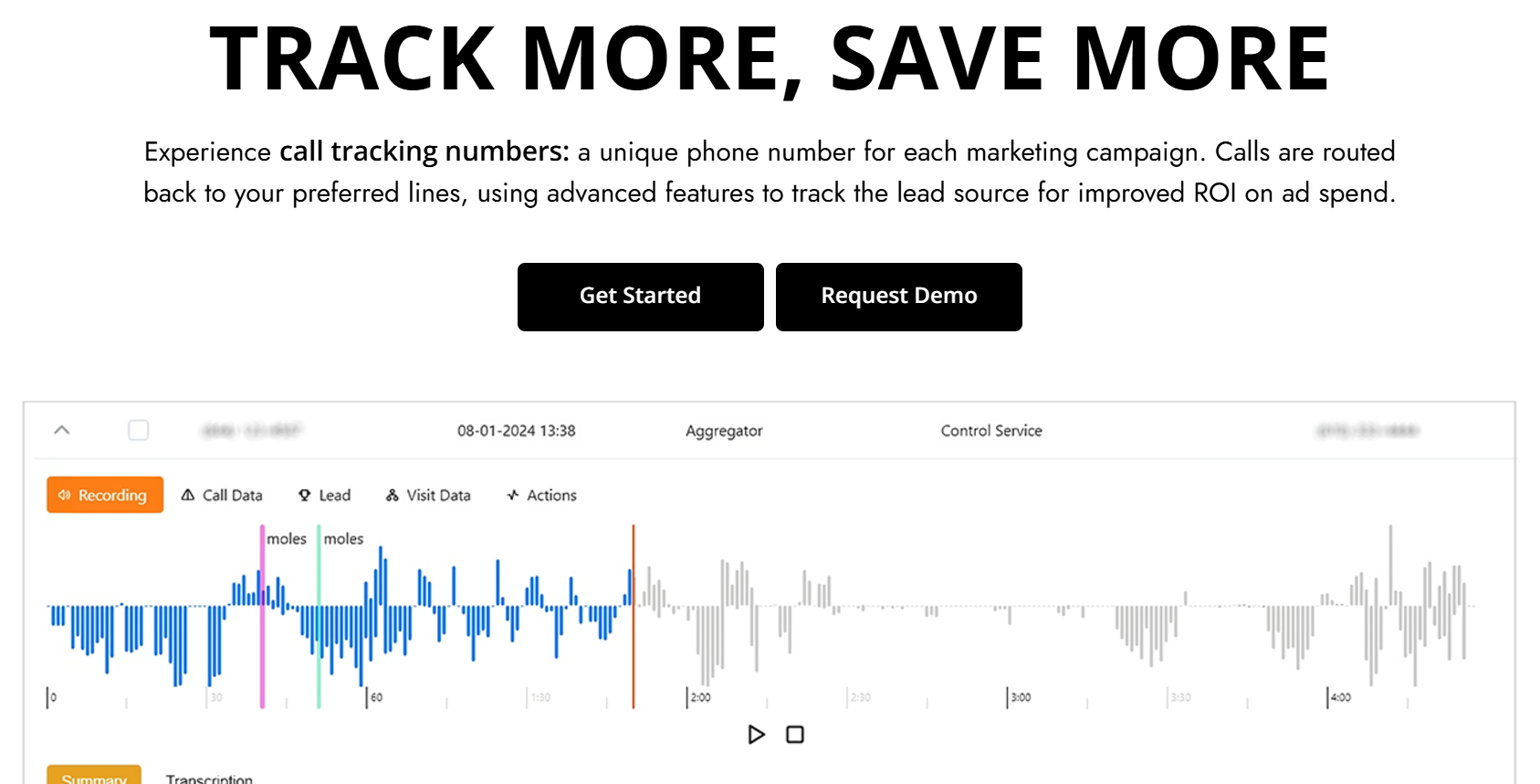
AvidTrak is a call tracking platform that offers built-in AI receptionist capabilities through Leena, its AI-based Virtual Receptionist and Voice Assistant. Together, they bring call routing, call handling, and conversation visibility into a single system, with affordable pricing, responsive product support, and years of hands-on experience solving complex call tracking and routing challenges for businesses that rely on inbound phone calls.
Best for
Service-based businesses, multi-location teams, and marketing-driven organizations that need reliable call routing, clear call tracking, and visibility into why customers are calling.
Key AI receptionist features
- Call answering: Uses voice AI to answer inbound calls and handle common customer questions when staff are unavailable. Calls are greeted consistently, and callers are guided through natural conversations rather than rigid menus.
- Routing: Supports IVR, intent-based call routing, sequential and simultaneous forwarding, and zip code routing. This allows calls to be directed based on caller’s needs, location, department, or business rules, which is especially useful for multi-location and service-based teams.
- AI-powered transcription and conversation outcome extraction: Converts voice calls into searchable transcripts and tags key outcomes such as booking requests and pricing inquiries, helping teams review conversations and prioritize follow-up without manual effort.
- Booking/handoff: Supports appointment handoff and message capture when a live agent is unavailable. Caller details and call context are recorded so teams can follow up with the right information.
- Integrations: Shares structured call data, transcripts, and outcomes across CRM and marketing workflows, allowing teams to connect phone conversations with lead tracking and reporting processes.
Strengths
- Combines AI receptionist behavior with built-in call tracking and routing
- Flags booking requests and pricing inquiries using AI-powered conversation outcome extraction
- Works well for businesses managing multiple locations or departments
- Offers predictable, transparent pricing without hidden fees
- Backed by strong product support and long-standing domain expertise in call tracking
Limitations
- No GHL integration
Pricing
AvidTrak pricing is structured into two parts: a required call tracking package, with Leena available as an AI receptionist add-on.
AvidTrak call and lead tracking packages:
- Starter: $15/month
- Professional: $30/month
- Agency: $55/month
These plans provide the call tracking, routing logic, customizable dashboards, and multiple integrations that support AI receptionist workflows.
Leena – AI-based Virtual Receptionist & Voice Assistant (add-on):
Leena, AvidTrak’s AI-based Virtual Receptionist and Voice Assistant, is offered as a separate AI solution and requires an active AvidTrak subscription.
- Starter: $9.95/month (includes 25 AI-handled calls)
- Professional: $19.95/month (includes 55 AI-handled calls)
- Agency: $39.95/month (includes 110 AI-handled calls)
Additional AI-handled calls are billed per call beyond the included volume.
This structure allows businesses to start with affordable call tracking and add AI receptionist coverage through Leena, keeping costs predictable while supporting both simple and complex call-handling requirements.
Final Verdict
AvidTrak is a strong option among the best AI receptionists for businesses that want clarity around phone leads, not just someone answering calls. It suits teams where call volume, routing accuracy, and follow-up consistency matter day to day. For organizations looking for a system that supports complex call flows, offers steady product support, and keeps costs affordable, AvidTrak aligns well with those priorities.
2. Smith.ai
What it is
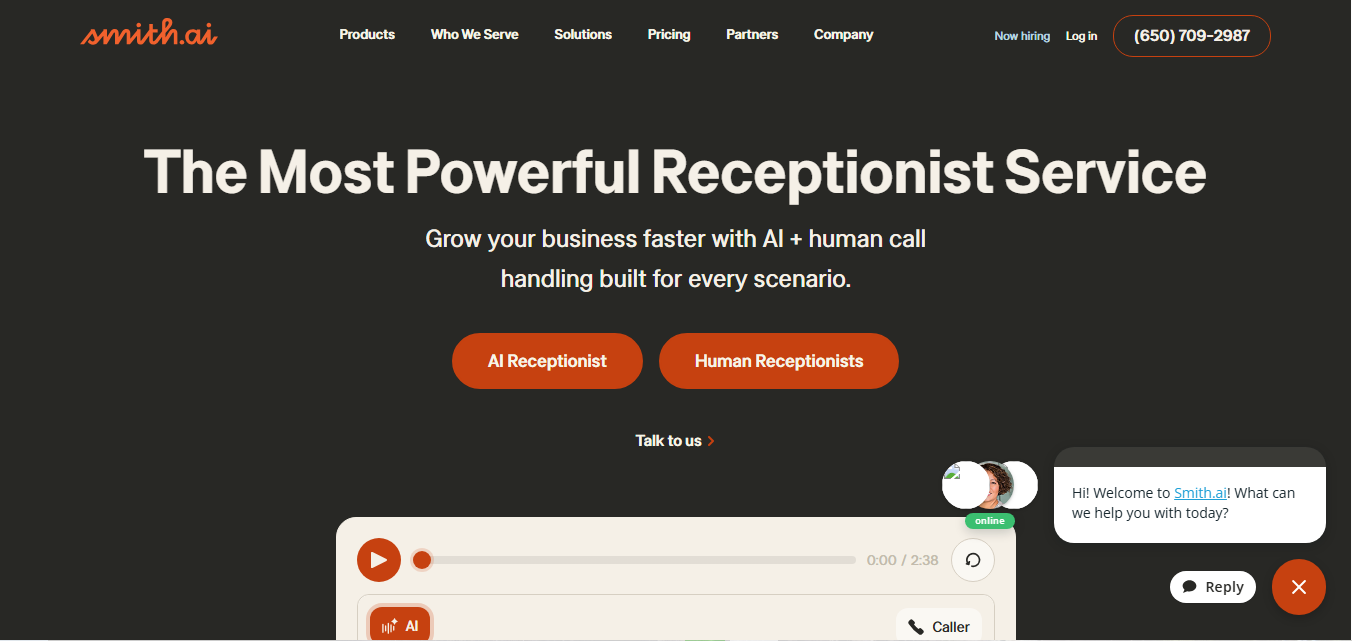
Smith.ai provides an AI receptionist supported by a network of live human agents. Calls can be handled by AI, humans, or a combination of both, making it suitable for businesses looking for the best AI virtual receptionist 24/7 service with built-in human availability.
Best for
Small and mid-sized businesses that want automated call answering and lead intake, with the option to involve live agents for complex or sensitive conversations.
Key AI receptionist features
- AI call answering: The AI receptionist answers inbound calls, greets callers using brand-specific scripts, and manages common inquiries before escalating to live agents when needed.
- Human agent escalation: Live agents are available on demand, allowing caller-initiated or AI-initiated transfers. This setup supports businesses that want automation without removing human interaction entirely.
- Lead capture and qualification: Custom call playbooks help collect caller details and qualify leads, making Smith.ai a frequent choice for teams seeking the best AI virtual receptionist for lead qualification with human oversight.
- Appointment booking and handoff: Supports appointment scheduling and warm transfers to internal staff or live agents during the call.
- Integrations: Syncs call data with CRM systems, scheduling tools, and internal workflows to keep records centralized.
Strengths
- Hybrid AI and human model reduces missed calls
- 24/7 coverage with North America–based agents
- Strong intake and qualification workflows
- Broad integration ecosystem
Limitations
- Costs increase as live agent usage grows
- Call reporting focuses more on intake than on marketing attribution
Pricing
Smith.ai offers the following plans:
- Starter: 50 calls $95 / month
- Basic: 150 calls $270 / month
- Pro: 500 calls $800 / month
- Enterprise: Custom
Final verdict
Smith.ai fits businesses looking for the best hybrid AI receptionist with human fallback, especially when consistent coverage, live-agent escalation, and structured intake matter more than deep call tracking or attribution.
3. Dialzara
What it is
Dialzara is an AI receptionist platform built to answer every inbound call automatically. It focuses on continuous availability, natural voice conversations, and quick setup, which is why many businesses consider it the best AI receptionist for always-on call coverage, helping prevent missed calls and after-hours inquiries from leading to lost opportunities.
Best for
Local and service-based businesses that want an AI receptionist to answer calls around the clock, book appointments, and capture leads without relying on live agents.
Key AI receptionist features
- AI call answering: Dialzara’s AI receptionist answers calls 24/7 and handles conversations using natural voice responses. Calls are managed fully by AI, without human intervention.
- Voice technology and customization: Businesses can choose from multiple AI voices and configure greetings and tone so calls reflect their brand and communication style.
- Appointment booking: The AI receptionist can book appointments directly to a connected calendar, allowing callers to schedule without staff involvement.
- Call summaries: After each call, Dialzara sends email-based call summaries with caller details and conversation context for quick review.
- Lead capture and screening: Dialzara captures caller information and qualifies leads before passing details to the business.
- Phone system compatibility: Works with existing phone numbers through call forwarding. No new hardware or phone system changes are required.
Strengths
- Always-on AI receptionist with no dependence on live agents
- Quick setup process, often completed within minutes
- Automated appointment booking and lead capture
- Broad industry coverage across local and service businesses
- Designed to reduce missed calls
Limitations
- No human fallback if a caller requests a live agent
- Limited support for complex call routing scenarios
- Less focus on marketing attribution and call source analysis
Pricing
Pricing plans offered by Dialzara are as follows:
- Business Lite: $29/month
- Business Pro: $99/month
- Business Plus: $199/month
Final verdict
Dialzara is a good fit for businesses that want a fully automated AI receptionist focused on availability and simplicity. For teams that value consistent call coverage and automated booking over human escalation or complex routing, Dialzara appears in comparisons of the best AI receptionist services for businesses.
4. Synthflow
What it is
Synthflow is a no-code voice AI platform that lets teams design, test, and deploy AI voice agents for inbound phone calls. It focuses on configurable call flows, enterprise telephony control, and multi-agent logic, rather than relying on a fixed, preconfigured receptionist setup.
Best for
Mid-market and enterprise teams that want control over how AI receptionists handle calls, bookings, and lead qualification without writing code.
Key AI receptionist features
- Call answering: Synthflow voice agents answer inbound calls using defined conversational flows. Businesses control how calls are handled at each step through a visual flow designer.
- Voice technology: Provides configurable voice agents with human-like speech quality, often evaluated by teams comparing AI virtual receptionist voice quality across different use cases.
- Appointment booking: Supports real-time appointment scheduling by connecting voice agents to calendars and backend systems, making it suitable for AI-powered virtual receptionist workflows in healthcare, real estate, and service environments.
- Conversation records and analysis: Captures call recordings and structured conversation data that can be reviewed, monitored, and analyzed across connected systems, rather than relying on simple post-call summaries.
- Routing and actions: Voice agents can route calls, collect caller information, trigger actions, and complete tasks based on intent defined within the workflow.
- Integrations: Connects with CRMs, CCaaS platforms, calendars, and enterprise systems such as Salesforce, HubSpot, and SIP-based telephony providers.
Strengths
- No-code flow designer for custom call logic
- Supports complex, multi-step receptionist workflows
- Built-in telephony with SIP flexibility
- Designed for high call volume and multi-agent deployments
- Strong fit for teams extending or replacing traditional call center operations
Limitations
- Requires setup and configuration before going live
- More complex than plug-and-play receptionist tools
- Pricing and deployment are geared toward larger teams
Pricing
Synthflow offers usage-based pricing built around call volume and platform usage. Plans start with a self-serve tier for testing and small deployments, while larger teams and enterprises use custom plans that scale based on minutes, workflows, integrations, and deployment requirements.
Pricing is designed for teams running production-level voice AI agents rather than simple receptionist setups.
Final verdict
Synthflow fits organizations that want to design how an AI receptionist behaves instead of using a predefined setup. It suits teams that prioritize customization, structured call logic, and system integrations over simplicity or fast deployment.
5. Talkdesk
What it is
Talkdesk is a cloud-based contact center platform that uses AI to manage customer conversations across voice and digital channels. Its AI receptionist capabilities are part of a broader customer experience automation system designed for large-scale call operations rather than standalone call answering, and are often evaluated by enterprises comparing the best AI virtual receptionist voice technology within contact center environments.
Best for
Mid-market and enterprise organizations that manage high inbound call volume across customer service, support, and sales teams, and require AI-assisted call handling within a full contact center environment.
Key AI receptionist features
- Call answering: Talkdesk AI agents answer inbound calls and guide callers using conversational flows that operate within the contact center framework, rather than as a separate virtual receptionist product.
- Intent detection and routing: Uses AI to identify caller intent and route calls to the appropriate queue, department, or agent based onpredefined business logic.
- Virtual agent automation: Automates routine interactions such as FAQs, account-related requests, and basic service inquiries before handing calls off to live agents when needed.
- Conversation records and quality analytics: Captures call recordings and structured conversation data that feed into quality management, interaction analytics, and performance reporting tools.
- Omnichannel handling: Supports voice alongside chat and other digital channels, allowing businesses to manage customer interactions within a unified contact center setup.
- Integrations: Connects with enterprise systems and CRMs through Talkdesk AppConnect and embedded integrations, supporting industry-specific workflows.
Strengths
- Built for large contact center environments
- Strong AI-driven routing and automation at scale
- Supports regulated industries such as healthcare and financial services
- Designed with security and compliance requirements in mind
Limitations
- More complex than dedicated AI receptionist tools
- Requires configuration, onboarding, and platform setup
- AI receptionist functionality is tied to the broader contact center platform
Pricing
Talkdesk offers the following pricing plans:
- Digital Essentials: $85 USD per user, per month
- Voice Essentials: $105 USD, per user, per month
- Elite: $165 USD, per user, per month
- Industry Experience Clouds: $225 USD per user, per month
Final verdict
Talkdesk suits organizations that need AI-assisted call handling as part of a full contact center system rather than a lightweight receptionist replacement. It works best for enterprises prioritizing scale, compliance, and multi-channel operations over simplicity or predictable pricing.
How Businesses Measure Success With an AI Receptionist
Businesses comparing the best AI receptionists do not judge success by call answering alone. They assess whether the system improves call-handling outcomes and reduces operational load.
Key metrics include:
-
Missed call reduction
Measures how many inbound calls are answered after adding an AI receptionist, especially during after-hours or high-volume periods.
-
Call containment
Tracks how many calls are fully handled by the AI receptionist without needing a transfer to human staff.
-
Average handle time
Evaluates whether structured call flows help callers reach the right outcome faster.
-
Booking completion rate
Shows how often appointment or callback requests are completed during the call instead of requiring follow-up. This is a key benchmark when evaluating the best AI-powered virtual receptionist for appointments, especially for service-based businesses.
-
Customer satisfaction indicators
Assessed through repeat calls, successful resolutions, or call outcomes tied to customer interactions.
-
Cost comparison vs human receptionists
Compares ongoing AI receptionist costs with staffing, training, and coverage expenses tied to human receptionists.
For platforms such as AvidTrak, these measurements are supported by call tracking, AI-powered transcription, and AI-powered conversation outcome extraction, giving businesses visibility into why calls occur and how they are resolved.
Common Mistakes Businesses Make When Choosing AI Receptionists
Many issues with AI receptionists come from selection decisions rather than the technology itself.
Common mistakes include:
- Choosing basic AI IVR tools that rely on rigid menus instead of conversational call handling
- Overlooking call routing complexity for multi-location or service-based businesses
- Ignoring call transcripts, call outcomes, and follow-up visibility
- Focusing only on voice quality instead of call data and routing accuracy
- Selecting tools with unclear pricing or limited product support
The best AI receptionists support both simple call answering and complex routing scenarios. Solutions such as AvidTrak are designed to handle evolving call flows while keeping costs and support predictable.
Final Takeaway: Why AvidTrak Leads the Best AI Receptionists in 2026
When businesses compare the best AI receptionists, the real difference comes down to control, clarity, and reliability, not just whether calls get answered.
AvidTrak brings AI receptionist coverage into a system that was built from the ground up for call routing, call tracking, and real operational use. Instead of treating call handling as a standalone feature, it connects every conversation to measurable outcomes and follow-up actions, backed by responsive product support and years of domain experience.
For businesses that take phone leads seriously and want confidence in how calls are handled, routed, and tracked, AvidTrak sets the standard.
Sign up for a free trial with AvidTrak and see how an AI receptionist backed by real call data fits into your daily workflow.
Frequently Asked Questions
1. What is an AI receptionist?
An AI receptionist answers inbound phone calls, understands caller intent, routes calls, captures messages, and tags outcomes. AvidTrak also connects calls with tracking, AI-powered transcription, and follow-up workflows.
2. Is an AI receptionist better than a virtual receptionist?
An AI receptionist handles calls automatically using voice recognition and intent detection. A virtual receptionist typically relies on scripts or human agents. Businesses choose AI when they want consistent call handling and clearer call data without staffing limits.
3. How much does an AI receptionist cost?
Pricing depends on call volume and features. Some tools charge per user, per minute, or per call. AvidTrak offers transparent, affordable monthly plans for call tracking and routing, starting at $15 per month.
4. Can an AI receptionist replace a human receptionist?
An AI receptionist can handle routine call answering, appointment intake, and message capture. Many businesses still keep humans for complex conversations. AvidTrak supports both by capturing call details and passing structured call data to staff when needed.
5. Is AI receptionist software reliable for customer service?
Yes, when it matches real call flows. Reliable tools use intent detection, call routing, and AI-powered conversation outcome extraction to improve routing accuracy and speed up follow-up, without blocking human support when needed.
6. What is the best AI receptionist for small businesses?
For small businesses, the best option balances affordability, support, and flexibility. AvidTrak offers Leena, an AI receptionist, which fits teams that want call routing and tracking in one place, with clear reporting and predictable costs.
7. Do AI receptionists work after hours?
Yes. Most AI receptionists can answer 24/7. AvidTrak supports after-hours handling, holiday schedules, voicemail capture, and routing rules, so calls are addressed even when staff are unavailable.
8. Are AI receptionists secure and compliant?
Security depends on the platform. AvidTrak supports privacy controls, including data retention settings, call recording password protection, and controlled access to call logs and transcripts, helping businesses align with internal privacy and data-handling policies.


