


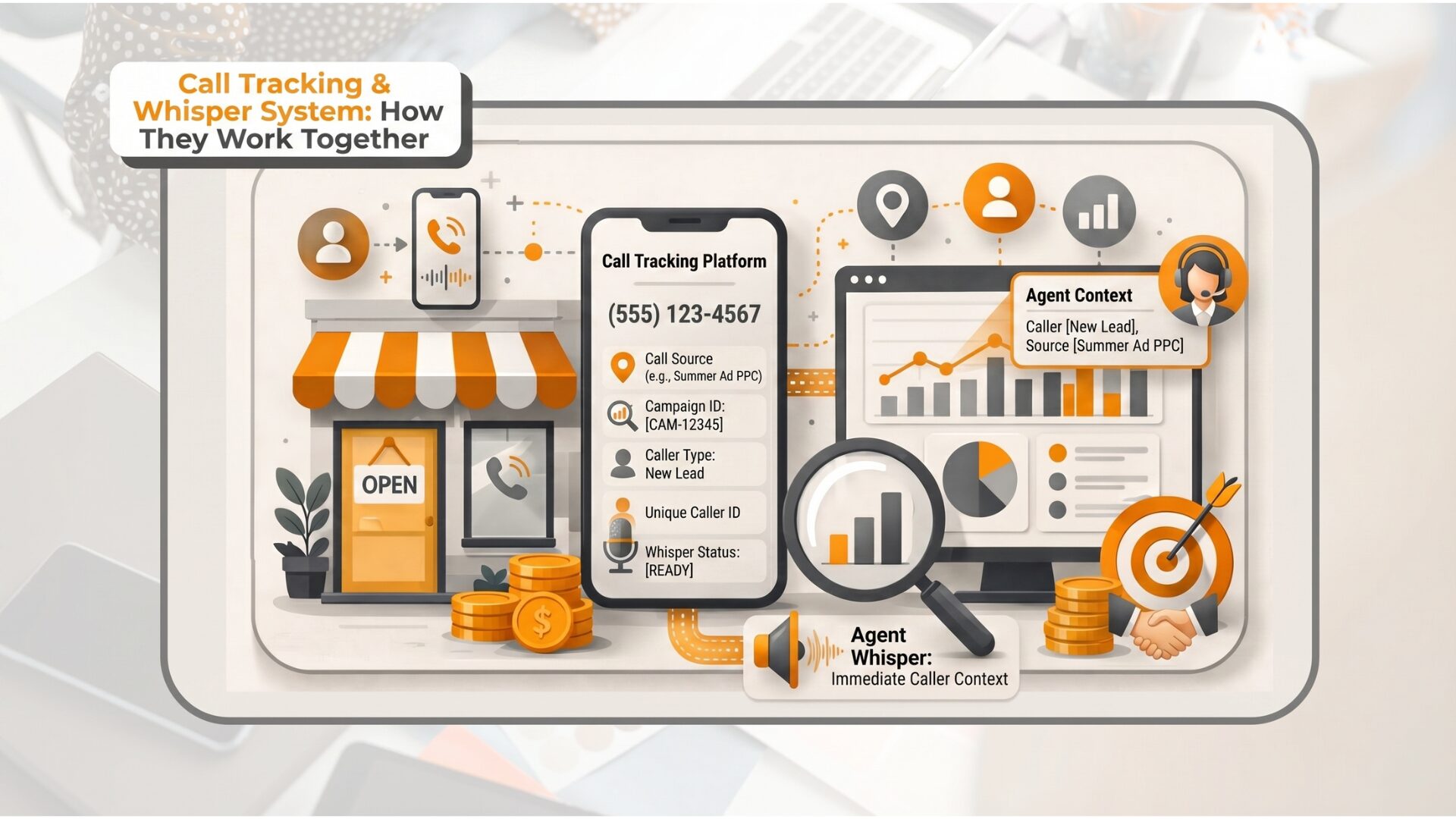
Call tracking and whisper system features work together by combining source attribution with live call context. Call tracking shows which campaign, keyword, page, or location generated the call, while a whisper system gives the person answering a private heads-up before the caller is connected. Together, they improve both reporting and call handling.
Phone calls often sit at the point where marketing turns into sales. A campaign generates the lead, the phone rings, and the first few seconds can shape whether that opportunity moves forward or gets lost.
That is why call tracking and whisper features matter together. Call tracking helps businesses understand where the call came from. A whisper system helps the rep or agent respond with more context from the start. One improves attribution. The other improves live call handling. When used together, they help teams manage marketing-driven calls more effectively and convert more of the right opportunities.
What Call Tracking Does
Call tracking helps businesses connect inbound calls to the marketing source that generated them. Depending on the setup, that source may be a channel, campaign, keyword, landing page, ad, or location.
In practical terms, call tracking helps answer questions such as:
- Which campaign drove the call?
- Which keyword or page influenced it?
- Which location received it?
- Did the call turn into a lead, appointment, or sale?
That is what makes call tracking useful beyond basic call logs. It helps marketing teams measure what is generating calls and helps sales or operations teams understand which calls are actually producing business value.
What a Whisper System Does?
A whisper system gives the rep, agent, or call recipient a short private message before the caller is connected. In some setups, a supervisor can also join a live call and speak only to the agent without the caller hearing it.
That private message can include context such as:
- which campaign triggered the call
- which line or location the caller dialed
- which service the call may relate to
- whether a supervisor is coaching the agent live
The purpose is simple: give the person answering the call a better context without disrupting the caller’s experience. That extra context can help the team respond faster, start the conversation more accurately, and handle high-intent calls with more confidence.
How Call Tracking and Whisper Work Together
Call tracking and whisper are most effective when they work as one connected system. Call tracking captures where the call came from. Whisper gives the person answering the call immediate context before the conversation starts.
Here is how that usually works in practice:
1. Marketing generates the call
A prospect clicks an ad, visits a landing page, or dials a tracked number tied to a campaign, source, or service line. Call tracking captures that source data before the call reaches the team.
2. The platform identifies the call source
Before the rep answers, the system may already know key details about the call path, such as the channel, campaign, keyword, landing page, tracked number, or location associated with the call.
3. The whisper gives the rep context
The rep hears a short private message before the caller is connected. That message may include details such as:
- Google Ads HVAC campaign
- emergency plumbing line
- franchise location inquiry
- implant consultation lead
- VIP call from landing page A
That quick heads-up helps the rep begin the conversation with more accuracy and urgency.
4. The team handles the call more effectively
Because the rep has context from the start, they can respond with the right tone, service focus, script, or level of urgency. That can reduce confusion, shorten the opening part of the call, and improve the chance of a better outcome.
5. The business reviews what happened
After the call, the team can review the source data, call outcome, and in some cases the recording, transcript, or notes. That helps improve both marketing decisions and live call handling over time.
This is where the combination becomes useful. Call tracking helps the business measure what generated the call, while whisper helps the team respond to that call more intelligently in the moment.
Why Call Tracking and Whisper Matter in Real Operations
Many businesses already track where calls come from. Others already use a call whisper feature to support live conversations. The bigger advantage comes when both work together in one flow.
Without that connection, marketing may know which campaign drove the call, but the person answering still starts with little context. The call gets tracked, yet the live interaction can still feel generic, delayed, or mismatched to the caller’s intent.
When call tracking and whisper system features work together, source data becomes useful in the moment the call is answered. A rep can hear a short private message tied to the campaign, service line, or location behind the call and respond with better direction from the start. That can improve first response, reduce confusion, and help the team handle high-intent calls more effectively.
This matters most in businesses where phone calls are a major conversion point. In those environments, whisper call tracking helps connect attribution with execution. The business is not only measuring what generated the call after the fact. It is also improving how that call is handled while the opportunity is still live.
Practical Use Cases for Call Tracking and Whisper
A call tracking and whisper system is most useful in businesses where the first few seconds of a call can shape lead quality, caller experience, and conversion outcomes. The combination helps teams connect marketing source data with live call handling, so the person answering has better context from the start.
1. Paid search campaigns
A business running Google Ads across multiple services can use call tracking to identify which campaign, keyword, or landing page generated the call. A call whisper system can then alert the rep that the caller came from a high-intent campaign such as emergency repair, implant consultation, or legal consultation.
That added context helps the rep open the call with better direction instead of treating every inbound call the same way.
2. Multi-location businesses
A healthcare group, franchise brand, or dealer group may route calls across multiple locations, departments, or service lines. Call tracking shows the source and routing path, while a call whisper feature can alert the receiving team which market, branch, or service context applies to the caller.
That helps reduce confusion and improves how quickly the team moves the call in the right direction.
3. Agencies managing client accounts
Agencies often need to show which campaigns are generating calls, but campaign performance alone is not enough if the client team handles leads poorly. Whisper call tracking helps close that gap. Call tracking shows which source drove the call, while whisper helps the client-side rep receive that lead with more context and greater accuracy.
That makes it easier to connect campaign performance with real call handling outcomes.
4. Supervisor coaching and live support
In live monitoring setups, a whisper system can also let a manager coach an agent privately while the caller cannot hear it. This is useful for training, objection handling, escalation support, and protecting high-value lead opportunities.
That makes the call whisper feature useful not only for source context, but also for stronger live coaching during important conversations.
Main Benefits of Using Both Together
Better first response
When a rep knows where the call came from before the conversation begins, the opening can be more focused and more relevant. A call whisper feature gives the person answering a short private heads-up, while call tracking provides the source data behind that message. Together, they help reduce early confusion and improve how quickly the rep gets to the caller’s actual need.
Stronger campaign handling
Not every inbound call should be treated the same way. A high-intent campaign, urgent service line, or priority location may need a different opening, faster routing, or a different script. Whisper call tracking helps teams connect campaign-level attribution with live call handling, so high-value calls are not treated like generic inbound volume. AvidTrak’s platform is built around campaign attribution, routing, and call analysis in one flow.
Better caller experience
When the rep starts with more context, the caller usually spends less time repeating basic information. That makes the conversation feel smoother and more relevant from the start. In practical terms, a call tracking and whisper system helps the business connect what generated the call with how the call is handled in real time, which can improve both speed and clarity during the first few seconds of the interaction.
Better coaching and live support
A whisper system is not only useful for source context. It is also valuable for supervisor support during important conversations. AvidTrak’s live monitoring page explains that supervisors can listen in on live calls, whisper guidance to the agent privately, or barge into the call when direct intervention is needed. That makes the feature useful for training, objection handling, and protecting high-value opportunities while the call is still active.
Better post-call review
The value of this setup does not end when the call is over. Businesses can combine source data, live handling context, and post-call review to understand what worked and what did not. If the platform also includes AI-powered transcription or conversation outcome extraction, teams can review calls faster, search for intent signals, and compare results across campaigns or service lines without listening to every recording manually.
Better reporting
The biggest benefit is that the business is not only measuring which campaign drove the call. It is also improving how that call is handled once it reaches the team. That makes reporting more useful because attribution and execution are no longer treated as separate issues. Instead, the business can connect source data, live call handling, and outcomes in one view.
Where AvidTrak Fits
AvidTrak fits this workflow by connecting marketing attribution with live call handling tools in one platform. A business can use AvidTrak to track which campaign, keyword, landing page, or location generated the call, while also giving the team live support through features such as whisper, monitoring, routing, and post-call review.
That matters because call tracking and whisper system features are more useful when they are not treated as separate tools. Source data should not stay limited to reports after the call. It should help the team handle the call more effectively while the opportunity is still live.
In practical terms, AvidTrak can help businesses:
- track which campaign, keyword, or source drove the call
- route the call to the right team or location
- give the rep private call context through a whisper system
- support live supervisor coaching when needed
- review recordings, transcripts, and outcomes after the call
That kind of connected setup is especially useful for agencies, multi-location businesses, service-based companies, and teams handling different call types across campaigns or departments. It helps the business connect what generated the call, how the call was handled, and what happened next.
A Simple Setup Checklist
A call tracking and whisper system works best when the source data, routing logic, and live call handling process are aligned. If any one part is weak, the setup becomes harder for teams to use consistently.
Use this checklist to make the system more effective:
- assign tracked numbers by campaign, service line, location, or source
- make sure routing logic matches how the business actually handles calls
- decide what source details should reach the rep through the whisper message
- keep whisper messages short, clear, and immediately useful
- train reps on how to respond when whisper context is provided
- define when supervisors should use live whisper coaching
- track call outcomes after the conversation
- review which sources generate the best calls and which ones need better handling
The goal is not just to track calls or deliver a whisper message. The goal is to make sure the source information helps the team respond better in the moment and gives the business cleaner reporting after the call. A well-configured call whisper system should support both better execution and better measurement.
Final Thoughts
Call tracking and whisper system features do different jobs, but they create more value when they work together. Call tracking shows what generated the call. A call whisper system helps the person answering respond with better context, better direction, and better control from the start.
That is what makes the combination useful in real operations. One improves measurement. The other improves live execution. When both are connected, businesses can do a better job of turning marketing-driven calls into better conversations, stronger lead handling, and clearer outcomes.
Businesses that want to connect attribution, routing, live monitoring, and post-call review in one platform can use AvidTrak to track the source behind each call and support the team handling it in real time. That makes AvidTrak a strong fit for businesses that rely on phone calls to convert leads and want more than basic call reporting.
FAQs
What is a call tracking and whisper system?
A call tracking and whisper system combines two functions. Call tracking shows where an inbound call came from, such as a campaign, keyword, landing page, or location. A whisper system gives the person answering a short private message before the caller is connected. Together, they improve both attribution and live call handling.
How does a call whisper system work?
A call whisper system plays a short private message to the rep, agent, or call recipient before the live conversation begins. That message can include context such as the campaign source, service line, location, or priority of the call. In some setups, a supervisor can also whisper guidance to the agent during the call without the caller hearing it.
What is the difference between call tracking and a call whisper feature?
Call tracking measures where the call came from and helps connect it to marketing performance. A call whisper feature helps the person answering handle the call with more context. One improves reporting and attribution, while the other improves live call execution.
Why use whisper call tracking together?
Whisper call tracking helps businesses connect source data with live call handling. Instead of only reviewing campaign performance after the call, the team can use source context while the call is still active. That can improve first response, reduce confusion, and help high-intent calls get handled more effectively.
Who benefits most from a call tracking and whisper system?
This setup is especially useful for businesses where phone calls are a major conversion point, such as home services companies, healthcare groups, legal teams, agencies, franchises, dealer groups, and multi-location businesses. It is most valuable when the call source, urgency, or service type should shape how the call is handled.
Can AvidTrak support call tracking and whisper together?
Yes. AvidTrak supports call tracking, routing, live monitoring, whisper, and post-call review tools that help businesses connect marketing source data with live call handling. That makes it easier to improve both attribution and call performance in one setup.
What are the main benefits of a call whisper feature?
A call whisper feature can help reps respond with better context, improve the opening of the call, reduce unnecessary back-and-forth, support live coaching, and handle higher-value calls with more confidence.


