


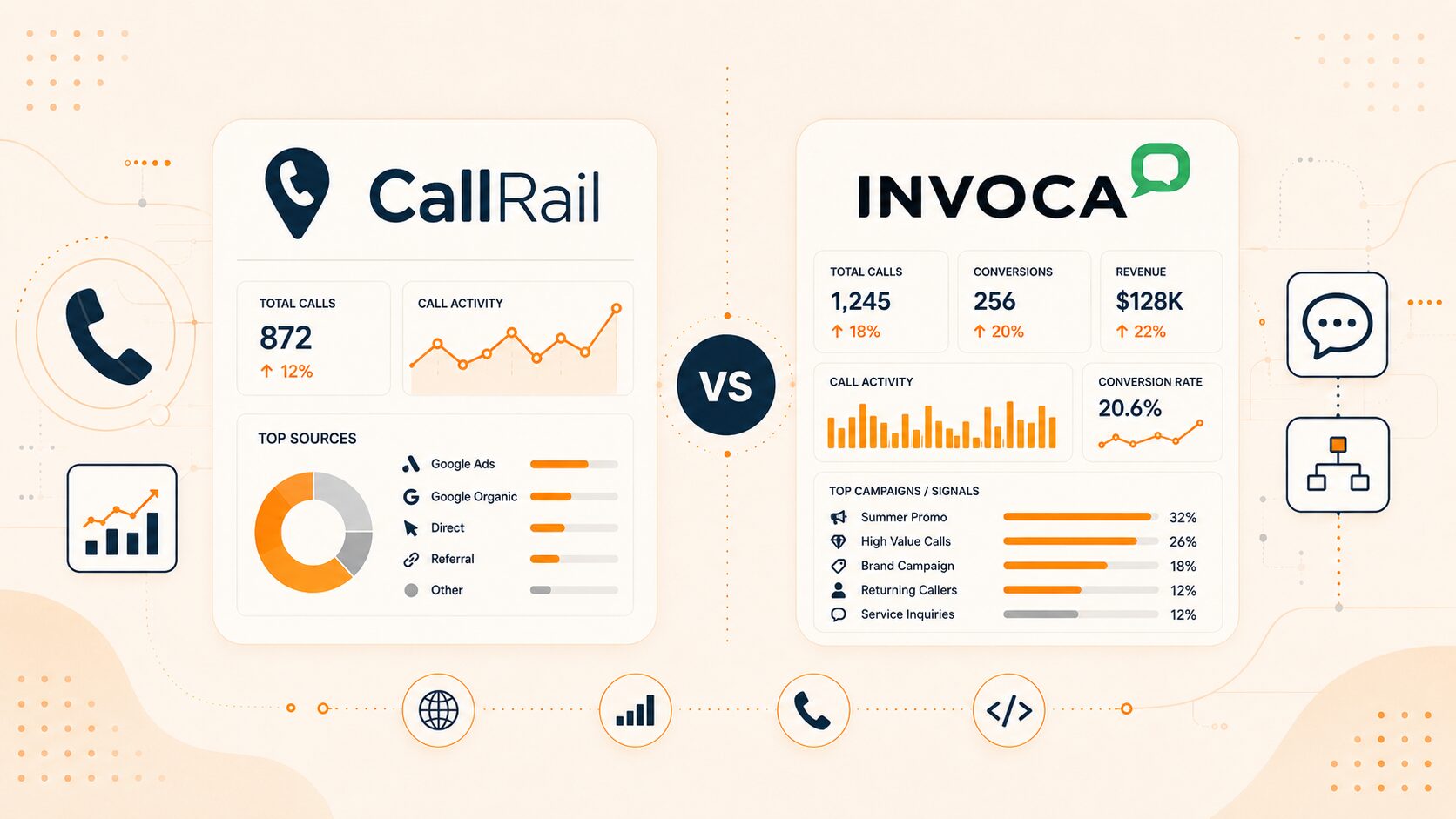
A CallRail vs Invoca comparison looks at two call tracking platforms that overlap in marketing attribution but support different operating requirements. CallRail uses packaged plans, while Invoca extends call attribution into enterprise conversation intelligence, multi-location operations, contact centers, and revenue workflows.
Suppose a business or agency wants a call tracking platform with a published entry price, attribution, routing, recording, and reporting. CallRail may provide the more direct purchasing path.
Suppose a larger organization needs custom AI models, enterprise advertising data, location-level controls, contact center context, or complex revenue attribution. Invoca may provide the closer fit.
AvidTrak is another option when the requirement centers on attribution, routing, reporting, AI call analysis, and agency management without the wider enterprise contact center product set.
CallRail vs Invoca at a Glance
The main difference is how each platform is packaged and deployed.
CallRail combines marketing call tracking with lead-management and conversation functions inside published plans. Invoca uses custom pricing and can combine attribution with custom conversation analytics, multi-location programs, contact center products, and enterprise requirements.
| Comparison area | CallRail | Invoca |
| Typical fit | Businesses and agencies seeking packaged lead tracking and conversation analysis | Mid-market and enterprise teams with larger attribution, multi-location, or contact center requirements |
| Pricing | Published monthly plans plus usage | A custom quote is required |
| Main plans | Lead Tracking, Lead Tracking Complete, Lead Conversion, and Lead Conversion Complete | Pro, Enterprise, and Elite, plus separate performance marketing plans |
| Dynamic number insertion | Included with call tracking | Included |
| Marketing attribution | Campaign, source, visitor, keyword, and call attribution | Session-level digital attribution, offline conversion imports, revenue attribution, and tier-dependent data collection |
| Form tracking | Included in the two Complete plans | Form tracking is not the platform’s primary packaged function |
| Text tracking | Included in CallRail lead tracking packages | Text tracking is not the platform’s primary purpose |
| Conversation analysis | Standard analysis in Lead Tracking; premium functions require a Lead Conversion plan | Signal AI is available as an optional product |
| Custom AI models | Custom AI models are not positioned as CallRail’s primary product model | Custom models are available through Signal AI and custom Signals |
| Call routing and IVR | Call routing is included | Custom IVR is included, while more advanced IVR and data-driven routing depend on the tier |
| Multi-location use | Multi-location tracking is supported according to the account setup | Multi-location programs are a major stated use case |
| Contact center functions | Call tracking data can be passed to connected systems | PreSense, SIP, quality management, and data-driven routing support deeper contact center use cases |
| Agency use | Agency management resources and account access are available | Brand and agency plans are available through a quote |
| Trial | A 14-day trial is listed without a credit card | The pricing page does not state a public self-service trial |
| Main limitation | Higher packages or usage charges apply when forms and premium conversation analysis are required | A complete cost calculation requires a custom quote |
Are CallRail and Invoca Direct Competitors?
CallRail and Invoca compete directly when a company needs call tracking, dynamic number insertion, marketing attribution, recording, transcription, routing, reporting, and conversation analysis.
The comparison becomes less direct once enterprise contact center data, custom AI models, large multi-location programs, or specialized performance marketing workflows enter the requirements.
Both platforms can connect a call with the marketing activity that led to the conversation. Both platforms can also analyze what happened during the call.
The difference appears in the wider operating model.
CallRail packages call and text attribution, routing, transcription, reporting, and related lead tools into plans that can be reviewed before purchase.
Invoca uses Pro, Enterprise, and Elite tiers within a quote-based buying process. A deployment can also include Signal AI, PreSense, AI-Powered Quality Management, premium connections, and other products.
The required workflow therefore matters more than the number of shared feature names.
Is DialogTech Still a Separate Call Tracking Platform?
No. Invoca acquired DialogTech, and DialogTech became part of Invoca’s conversation intelligence business.
DialogTech was an AI-based call tracking and analytics company serving brands, agencies, and enterprise organizations.
A search for “CallRail vs DialogTech” now represents a CallRail versus Invoca comparison.
Older DialogTech packages and pricing should not be used to estimate the cost or scope of an Invoca deployment.
DialogTech remains a useful legacy search term, but DialogTech is not a separate platform available for a new purchase.
What Is CallRail?
CallRail is a lead tracking and conversation intelligence platform built around calls, texts, forms, and marketing attribution.
A business can assign tracking numbers, use dynamic number insertion, record inbound calls, route callers, and connect lead activity with campaigns and reporting.
CallRail publishes four core monthly packages:
- Lead Tracking costs $50 per month plus usage.
- Lead Tracking Complete costs $95 per month plus usage.
- Lead Conversion costs $150 per month plus usage.
- Lead Conversion Complete costs $195 per month plus usage.
Lead Tracking includes five local numbers, 250 local minutes, 25 text messages, call and text attribution, recording, routing, transcription, analysis, and automation rules.
The Complete plans add form tracking and attribution.
The Lead Conversion plans add Premium Conversation Intelligence functions such as call summaries, sentiment analysis, conversation trends, automatic conversion tagging, and conversion tools.
What Is Invoca?
Invoca is a revenue execution and conversation intelligence platform that connects digital marketing activity with phone conversations and business outcomes.
Invoca supports dynamic number insertion, session-level attribution, call recording, custom IVR, offline revenue imports, APIs, webhooks, and advertising data.
Invoca’s primary brand and agency tiers are Pro, Enterprise, and Elite. The pricing structure also includes Performance Professional and Performance Enterprise for pay-per-call and affiliate marketing programs.
Every Invoca package requires a quote.
The Pro tier includes 6,000 annual local or toll-free numbers, five custom Signals, dynamic number insertion, recording, custom IVR, revenue imports, real-time alerts, APIs, webhooks, and named advertising and analytics connections.
Signal AI, PreSense, AI-Powered Quality Management, advanced IVR functions, and premium connections are listed as optional products at the Pro level.
Enterprise adds additional digital data collection, advertising connections, advanced IVR, advanced reporting, SAML single sign-on, a sandbox environment, and 50 custom Signals.
Elite adds PreSense, intelligent data-driven routing, SIP connectivity, an affiliate marketing feature set, more connections, and 100 custom Signals.
What Are the Biggest Differences Between CallRail and Invoca?
CallRail centers on packaged lead tracking that can be priced before a sales conversation. Invoca centers on a configurable enterprise deployment that can connect marketing, revenue, multi-location, and contact center data.
Public pricing, AI customization, enterprise controls, and contact center scope are the main distinctions.
Product Packaging and Procurement
CallRail allows companies to compare four plans, review included usage, start a trial, and estimate common overages.
That structure can suit a business or agency that wants a defined purchasing path without a lengthy procurement process.
Invoca requires a conversation with the sales team.
An Invoca proposal can account for factors such as:
- The selected tier and contract terms
- Call volume and phone-number requirements
- Custom Signals and AI products
- Advertising, analytics, and CRM connections
- Location count and routing requirements
- Security controls and implementation requirements
A custom quote can support a more specific enterprise deployment, but the quote prevents a reliable public dollar comparison.
Core Lead Tracking Versus Revenue Execution
CallRail focuses on identifying which calls, texts, and forms came from marketing. The platform then helps a business review, route, analyze, and respond to those leads.
Invoca also performs marketing attribution, but the wider scope can connect digital journey data, revenue, conversation intelligence, multi-location operations, and contact center workflows.
The distinction does not mean that CallRail only serves small businesses or that every Invoca customer is a large enterprise.
Instead, the products reflect different assumptions about scale, workflow, and purchasing requirements.
How Do Call Tracking and Attribution Compare?
Both platforms can show which marketing activity led to an inbound call.
The required attribution depth becomes the main consideration. Some organizations need straightforward campaign and keyword reporting, while others need configurable digital data, revenue imports, multi-location reporting, and feedback into enterprise advertising systems.
Dynamic Number Insertion
Dynamic number insertion replaces a website phone number with a trackable number according to the visitor or marketing source.
CallRail and Invoca both support DNI.
Depending on the setup, DNI can connect a call with:
- A marketing channel
- A campaign
- A landing page
- A website visitor or session
- Search or keyword data
CallRail uses website number pools to support visitor-level tracking and keyword data.
Invoca associates calls with session-level digital information and can collect additional fields according to the selected tier and configuration.
Important implementation factors include pool size, website traffic, geographic number requirements, session data, and reporting needs. DNI therefore involves more than confirming whether a platform offers the feature.
Keyword, Session, and Campaign Attribution
CallRail can provide campaign, source, visitor, and keyword-level attribution for inbound calls.
That information is useful for PPC and SEO teams that need to compare phone leads with advertising spend and search activity.
Keyword-level call tracking can also connect phone inquiries with campaigns, search activity, landing pages, and marketing outcomes.
Invoca can associate calls with search keywords, campaigns, landing pages, referring sources, sessions, GCLIDs, digital activity, and call outcomes.
Invoca Enterprise also supports additional configurable digital data fields, including information such as product IDs and shopping-cart details.
Neither platform can be labelled more accurate without a controlled implementation.
Tracking design, number pools, consent settings, website traffic, integrations, and reporting rules all affect attribution quality.
Offline Conversions and Revenue Attribution
Invoca Pro includes the ability to import offline conversions and revenue through a file upload or API.
That capability can connect the marketing source with a phone conversation and a later revenue event.
CallRail can also connect lead and conversion information with marketing reports, although the exact process depends on the selected plan and connected system.
For organizations relying on custom offline revenue fields, the evaluation needs to cover the available data schema, conversion imports, write-back behavior, and reporting logic.
CallRail Conversation Intelligence vs Invoca Signal AI
CallRail provides packaged conversation analysis. Invoca offers Signal AI as an optional suite that supports custom models and broader enterprise analysis requirements.
The more relevant distinction is whether the team needs standard transcripts, summaries, sentiment, and conversion tags or custom intent, outcome, topic, quality, and compliance models.
Businesses comparing these functions can also review how AI call analytics connects transcripts and conversation analysis with marketing attribution.
CallRail Conversation Intelligence
CallRail Lead Tracking includes call transcription and analysis.
The Lead Conversion plans add Premium Conversation Intelligence functions such as:
- Call transcripts and keyword analysis
- Call summaries and sentiment analysis
- Conversation trend reports
- Automatic conversion tagging
- Coaching and conversion tools
The published structure makes it easier to identify which package contains summaries and sentiment.
Higher monthly call volumes can still create additional transcription or analysis costs when the included allowances are exceeded.
Invoca Signal AI
Invoca lists the Signal AI conversation analytics suite as an optional product on the primary plans.
Signal AI can support:
- Caller intent identification
- Product-interest detection
- Conversation outcomes and topics
- Keyword spotting
- Generative AI transcripts
- Redaction
- Custom artificial intelligence models
Custom Signals are also included by tier.
The pricing structure lists five custom Signals on Pro, 50 on Enterprise, and 100 on Elite.
The number of Signals alone does not determine suitability.
More useful evaluation questions include which events need detection, how those events will be configured, and where the resulting data must be sent.
Summaries, Sentiment, Outcomes, and Redaction
CallRail provides a clear packaged option when a marketing team needs transcripts, summaries, sentiment, trend reporting, and automatic conversion tags.
Invoca may provide a closer fit when the organization needs custom models for caller intent, product interest, topics, outcomes, quality, compliance, or redaction.
Signal AI is not automatically included with every Invoca account.
The proposal therefore needs to specify the selected AI products, custom Signal allowance, implementation requirements, and required data destinations.
How Do Routing and IVR Compare?
Both platforms can route inbound calls, but Invoca documents more tiered functions for digital-intent and contact center routing.
CallRail includes call routing in Lead Tracking.
Invoca includes custom IVR in Pro, adds speech recognition and numeric input in Enterprise, and adds intelligent data-driven routing in Elite.
For a smaller operation, standard forwarding, schedules, menus, and routing rules may cover the requirement.
For a larger multi-location organization, routing can depend on the caller’s location, campaign, product interest, website behavior, business hours, and available contact center destination.
Before comparing routing functionality, define:
- The number of call destinations and locations
- Menu and schedule requirements
- Queue and failover requirements
- Whether website activity needs to influence routing
- Whether SIP connectivity is required
- Whether calls need to reach a local team or a central contact center
- Which data needs to follow the caller into the receiving system
A dedicated advanced call routing platform can also support rules based on geography, schedules, caller information, and destination availability.
AvidTrak also supports multi-level IVR for organizations that need configurable menus and call distribution without Invoca’s wider enterprise contact center scope.
Which Platform Is Better for Multi-Location Businesses?
Invoca may provide the closer fit for a large franchise, healthcare network, automotive group, financial services organization, retailer, or home services brand that needs centralized attribution, location-level access, contact center context, and data-driven routing.
CallRail can still support multi-location tracking when the required number pools, users, reports, and routing remain within the platform’s operating model.
A useful multi-location evaluation can cover:
- Tracking numbers and number pools by location
- Central and local reporting access
- User permissions and account structure
- Local campaign and keyword attribution
- Routing to local offices or central contact centers
- CRM ownership and revenue data
- Advertising feedback by location
- SAML and sandbox requirements where applicable
The number of locations alone does not determine the better platform.
A 100-location organization with straightforward call attribution can have different requirements from a 20-location organization with a large contact center, complex routing, and strict identity controls.
Which Platform Has Stronger Contact Center Functions?
Invoca has the more extensive documented contact center layer.
PreSense can pass digital journey information into a contact center, while Elite includes intelligent data-driven routing and SIP connectivity.
AI-Powered Quality Management is available as an optional product and can support scorecards, agent-performance analysis, and compliance review.
CallRail is primarily a marketing lead tracking platform.
CallRail can record, route, transcribe, and analyze conversations, and the platform can connect lead data with other systems.
Organizations seeking digital journey context inside a large contact center, SIP-based data exchange, automated quality scorecards, or other specialized contact center functions should examine Invoca’s applicable products.
The distinction needs to remain specific.
Invoca’s contact center products are not all included in every tier, and CallRail’s narrower scope may be appropriate when the primary requirement is marketing attribution and conversation analysis.
How Do Marketing, CRM, and Data Connections Compare?
Both platforms can send call data into advertising, analytics, CRM, and reporting systems.
Invoca publishes a more tiered enterprise connection model, while CallRail provides integrations and APIs within a packaged call tracking platform.
Invoca Pro names connections such as Google Ads, Google Analytics 4, Microsoft Ads, Meta Ads, HubSpot, and Slack.
Enterprise adds more advertising platforms, while premium connections include systems such as Salesforce and Adobe Experience Cloud.
CallRail also connects with major advertising, analytics, CRM, and marketing systems and provides an API for custom workflows.
Rather than counting logos on an integrations page, examine:
- The exact objects and fields transferred
- Available triggers
- Attribution windows
- Conversion-import behavior
- Data write-back capabilities
- Expected transfer timing
- User and account permissions
A longer integration list does not automatically make one platform a better choice.
The deciding issue is whether the required call, campaign, transcript, outcome, and revenue data reaches the correct system with the required timing and permissions.
Which Platform Is Better for Agencies?
CallRail may suit agencies that want client call tracking, lead reporting, published package costs, and an online buying process.
Invoca may suit agencies managing enterprise performance marketing, large brand programs, or pay-per-call campaigns that require custom Signals, revenue imports, and specialized routing.
For an agency comparison, key considerations include:
- Account and phone-number ownership
- Client billing structure
- User roles and client access
- White-label or branded reporting
- Number of client accounts, brands, and locations
- Call and transcription volume
- API and webhook requirements
- Pay-per-call, affiliate, or payout requirements
Invoca’s Performance Professional and Performance Enterprise plans add functions for pay-per-call and affiliate marketing programs.
Those plans are materially different from a conventional agency account used mainly for client attribution and reporting.
A standard digital agency does not necessarily need the performance marketing product set.
An agency that primarily needs multi-client attribution, reporting, routing, and branding can also compare AvidTrak call tracking for agencies.
CallRail vs Invoca Pricing
CallRail is easier to budget from public information because subscription prices, allowances, and several usage charges are published.
Invoca requires a custom quote based on the selected tier and deployment.
A fair comparison therefore needs to focus on the required functions and pricing structure rather than placing an invented Invoca dollar amount beside CallRail’s entry price.
CallRail Pricing
CallRail lists the following monthly packages:
| Plan | Monthly price | Main scope |
| Lead Tracking | $50 plus usage | Call and text attribution, recording, routing, transcription, and analysis |
| Lead Tracking Complete | $95 plus usage | Lead Tracking plus form attribution and a custom form builder |
| Lead Conversion | $150 plus usage | Lead Tracking plus Premium Conversation Intelligence |
| Lead Conversion Complete | $195 plus usage | Calls, texts, forms, and Premium Conversation Intelligence |
Every plan begins with five local numbers and 250 local minutes.
The pricing information used for this comparison also lists:
- Additional local numbers at $3 each
- Toll-free numbers at $5 each
- Toll-free minutes at $0.08
- SMS usage at $0.03
The source pricing notes that local-minute, transcription, and analysis overages can vary according to the active pricing table or purchase flow.
Confirming those usage rates before calculating the final amount prevents an inaccurate total.
Invoca Pricing
Invoca does not publish a monthly dollar amount for Pro, Enterprise, Elite, Performance Professional, or Performance Enterprise.
The pricing process requires a custom quote.
A useful written proposal should specify:
- The selected tier and contract term
- Local and toll-free number requirements
- Expected call volume and geographic coverage
- Required custom Signals
- Signal AI, PreSense, and quality-management products
- IVR, routing, SIP, and contact center requirements
- Advertising, CRM, and premium platform connections
- Location count, reporting, and user-access requirements
- SAML, sandbox, security, and implementation requirements
Custom pricing does not prove that Invoca is automatically more expensive.
A meaningful total-cost comparison becomes possible only after the proposed scope and pricing are documented.
Example for a Marketing Team
Suppose a marketing team needs 10 local numbers, 1,500 local call minutes, dynamic number insertion, keyword attribution, recording, transcription, summaries, sentiment, Google Ads, GA4, HubSpot, and one business account.
CallRail would require a Lead Conversion plan for the named premium conversation functions.
Using the source pricing figures, the calculation begins with the $150 monthly subscription, adds five additional numbers at $3 each, and adds local-minute usage beyond the included 250 minutes.
Depending on the applicable local-minute rate, the base subscription, numbers, and stated minute volume would total approximately $227.50 to $240 before any other applicable charges.
Invoca would require a quote for the same scenario.
The proposal would need to cover the tier, Signal AI scope, custom Signals, phone numbers, call volume, integrations, implementation, and contract terms.
This example shows why the lowest subscription price is not a complete comparison. The required attribution and conversation-analysis functions determine the appropriate package.
CallRail Strengths and Limitations
CallRail Strengths
CallRail’s main strength is a defined purchasing path for call tracking, lead attribution, and conversation analysis.
A buyer can review plans, allowances, and a trial before requesting a proposal.
Notable strengths include:
- Published package prices and common usage charges
- Call, text, and plan-dependent form attribution
- Dynamic number insertion and keyword reporting
- Included routing, recording, transcription, and automation rules
- Premium summaries, sentiment, trend reports, and conversion tags in higher packages
- A practical account structure for many businesses and agencies
CallRail Limitations
Potential limitations include:
- Form attribution requires a Complete plan.
- Premium conversation functions require a Lead Conversion plan.
- Usage can increase the monthly total beyond the base subscription.
- The platform is not primarily positioned as an enterprise contact center data layer.
- Custom AI, SAML, sandbox, SIP, or large-scale routing requirements may require further technical evaluation.
Invoca Strengths and Limitations
Invoca Strengths
Invoca’s main strength is the ability to connect marketing attribution, conversation data, revenue outcomes, multi-location operations, and contact center workflows within an enterprise-oriented deployment.
Notable strengths include:
- Session-level attribution and configurable digital data collection
- Offline conversion and revenue imports
- Custom Signals and optional Signal AI
- Tiered IVR and data-driven routing
- Multi-location and contact center use cases
- PreSense, SIP, SAML, sandbox, and quality-management options
- Brand, agency, and performance marketing plans
Invoca Limitations
Potential limitations include:
- The public website does not provide enough information to calculate the complete cost.
- Signal AI and several contact center products are optional rather than universal.
- Premium connections and enterprise controls depend on the tier or proposal.
- The sales-led purchasing process may be more than a smaller team needs.
- A meaningful comparison requires well-defined implementation requirements.
Should You Choose CallRail or Invoca?
CallRail generally makes more sense when the priority is packaged call tracking, lead attribution, public pricing, a self-service trial, and a clear path to form or premium conversation analysis.
Invoca generally makes more sense when the requirement includes enterprise digital data, custom AI, large multi-location programs, contact center context, advanced security controls, or specialized performance marketing.
For a Small or Midsize Business
CallRail is likely the more practical starting point when a business needs calls, texts, forms, routing, attribution, and conversation analysis without an enterprise procurement process.
Plan selection then depends mainly on form tracking, premium conversation requirements, and expected usage.
Invoca can still be relevant to a midsize company with custom attribution or contact center needs.
A custom deployment becomes more reasonable when specific enterprise functions justify the additional procurement and implementation process.
For an Enterprise Marketing Team
Invoca may provide the stronger fit when the organization needs configurable digital data, offline revenue imports, many custom Signals, enterprise advertising connections, SAML, a sandbox environment, or digital data passed into a contact center.
CallRail remains worth considering when the enterprise requirement is narrower and centers mainly on marketing call attribution, lead response, and packaged conversation analysis.
For a Multi-Location Organization
Invoca may suit a large program that connects location-level attribution with centralized reporting, digital-intent routing, CRM revenue, and contact center operations.
CallRail may cover a multi-location organization whose needs center on phone numbers, attribution, reports, user access, and standard routing.
Operational complexity matters more than location count alone.
For a Marketing Agency
CallRail may fit an agency that needs a defined pricing structure and repeatable call attribution for clients.
Invoca may fit an agency managing enterprise brands, performance marketing, affiliate calls, custom Signals, or complex revenue-routing programs.
AvidTrak may also fit an agency that needs client call tracking and white-label reporting under a published pricing structure.
For a Contact Center and Revenue Team
Invoca provides the closer match when the required functions include PreSense, digital journey context, SIP, data-driven routing, automated quality management, or custom outcome models.
CallRail can still support marketing attribution and lead conversation review, but CallRail should not be treated as an identical contact center product set.
When AvidTrak May Be a Better Option
AvidTrak may suit a business or agency that needs call attribution, routing, reporting, and AI call analysis with published pricing but does not require Invoca’s full enterprise contact center and revenue execution product set.
A direct comparison works better when based on specific requirements rather than assuming that AvidTrak replaces every Invoca capability.
AvidTrak pricing lists:
- The Starter plan at $15 per month with five local numbers and 500 local minutes.
- The Professional plan at $30 per month with 10 local numbers, 1,500 local minutes, and 1,500 recording minutes.
- The Agency plan at $55 per month with 30 local numbers, 2,500 local minutes, 2,500 recording minutes, and up to 1,000 client accounts.
AvidTrak can be relevant when the requirements include:
- Dynamic number insertion and keyword-level attribution
- Call recording, dashboards, and call tracking reports
- Call routing and interactive voice response
- AI transcripts, summaries, sentiment, keywords, and outcome detection
- Client accounts and white-label reporting for agencies
- Published pricing with included numbers and minutes
For the 10-number and 1,500-minute example above, the AvidTrak Professional base plan is $30 according to the source pricing.
AI processing carries separate usage charges, so the final amount depends on the minutes processed and selected analysis functions.
AvidTrak does not claim equivalence with Invoca’s PreSense, enterprise sandbox, SAML controls, SIP layer, every premium connection, or every quality-management function.
Organizations requiring those capabilities should include them explicitly in the Invoca proposal and technical evaluation.
Final Verdict
CallRail and Invoca overlap in call tracking, attribution, recording, routing, reporting, and conversation analysis, but the platforms are not packaged for the same typical purchase.
CallRail is likely the better fit when a business or agency wants published plans, a self-service trial, call and text attribution, optional form tracking, and packaged premium conversation analysis.
Invoca is likely the better fit when an organization needs custom Signals, enterprise digital data, advanced multi-location operations, contact center context, quality management, SAML, SIP, or a sales-led deployment.
AvidTrak deserves consideration when the core requirement is call attribution, routing, AI analysis, reporting, and agency management under a published pricing structure.
The final choice depends on the required data, volume, routing, AI, security, multi-location, and contact center functions.
Frequently Asked Questions
1. Which Is Better, CallRail or Invoca?
CallRail is generally the better fit for a company seeking packaged call tracking, public pricing, and an online trial.
Invoca may provide the better fit when enterprise attribution, custom AI, large multi-location operations, contact center products, or specialized performance marketing are required. Neither platform is universally better.
2. Is Invoca More Expensive Than CallRail?
The available public information does not support that conclusion.
CallRail publishes monthly prices and usage rates, while Invoca requires a custom quote. A valid comparison needs the appropriate CallRail package, expected usage, optional products, implementation requirements, and the actual Invoca proposal.
3. Does Invoca Publish Its Pricing?
Invoca publishes plan names, included capabilities, number allowances, custom Signal allowances, and optional products.
Monthly dollar prices are not published for the main plans. Pro, Enterprise, Elite, Performance Professional, and Performance Enterprise require a quote.
4. Which Platform Has Better Conversation Intelligence?
The answer depends on the required type of analysis.
CallRail packages transcripts, keyword analysis, summaries, sentiment, trends, and conversion tags within the Lead Conversion plans.
Invoca Signal AI supports custom models, intent, topics, outcomes, keyword spotting, transcripts, and redaction as an optional suite.
Invoca may fit more customized enterprise analysis, while CallRail may fit organizations that want standard conversation analysis under a packaged plan.
5. Which Platform Is Better for Multi-Location Businesses?
Invoca may suit a large multi-location program that needs centralized attribution, enterprise permissions, digital-intent routing, revenue data, and contact center handoff.
CallRail can suit multi-location businesses with more straightforward number, reporting, user, and routing requirements. Operational complexity matters more than the number of locations alone.
6. Which Platform Is Better for Marketing Agencies?
CallRail may fit agencies that want published prices, client call attribution, and a repeatable packaged setup.
Invoca may fit agencies managing enterprise brands, pay-per-call programs, affiliate marketing, custom Signals, or complex revenue routing.
AvidTrak is another agency option when call attribution, routing, client accounts, and white-label reporting are required under a published pricing structure.
7. Is DialogTech Now Part of Invoca?
Yes. Invoca acquired DialogTech, and DialogTech is no longer a separate platform for a new purchase.
A reader researching CallRail versus DialogTech should now compare CallRail with Invoca and treat older DialogTech packages and prices as historical information.
8. Do CallRail and Invoca Both Support Dynamic Number Insertion?
Yes. Both platforms use dynamic number insertion to associate website calls with digital marketing activity.
Implementation requirements can differ according to website traffic, number-pool size, session data, keyword attribution, geographic coverage, consent requirements, and reporting needs.
9. Can CallRail or Invoca Send Call Data to Advertising and CRM Systems?
Yes. Both platforms provide integrations, APIs, and webhooks for advertising, analytics, CRM, and reporting workflows.
Availability and data depth vary by plan, product, and receiving system. Relevant considerations include required fields, conversion imports, write-back behavior, timing, and permissions.
10. What Is an Alternative to CallRail and Invoca?
AvidTrak call tracking software is an option for businesses and agencies that need dynamic number insertion, keyword attribution, call recording, routing, reporting, AI call analysis, client accounts, and published pricing.
AvidTrak is not positioned as a substitute for every Invoca enterprise contact center or revenue execution function.
Start AvidTrak’s 14-Day Free Trial
When the primary requirement is call attribution, routing, reporting, agency management, and AI call analysis rather than a large enterprise revenue execution stack, AvidTrak can be compared with the requirements identified throughout this article.
AvidTrak provides a 14-day free trial with $20 in credit and no credit-card requirement.
Businesses can also review AvidTrak pricing before selecting a plan.


