


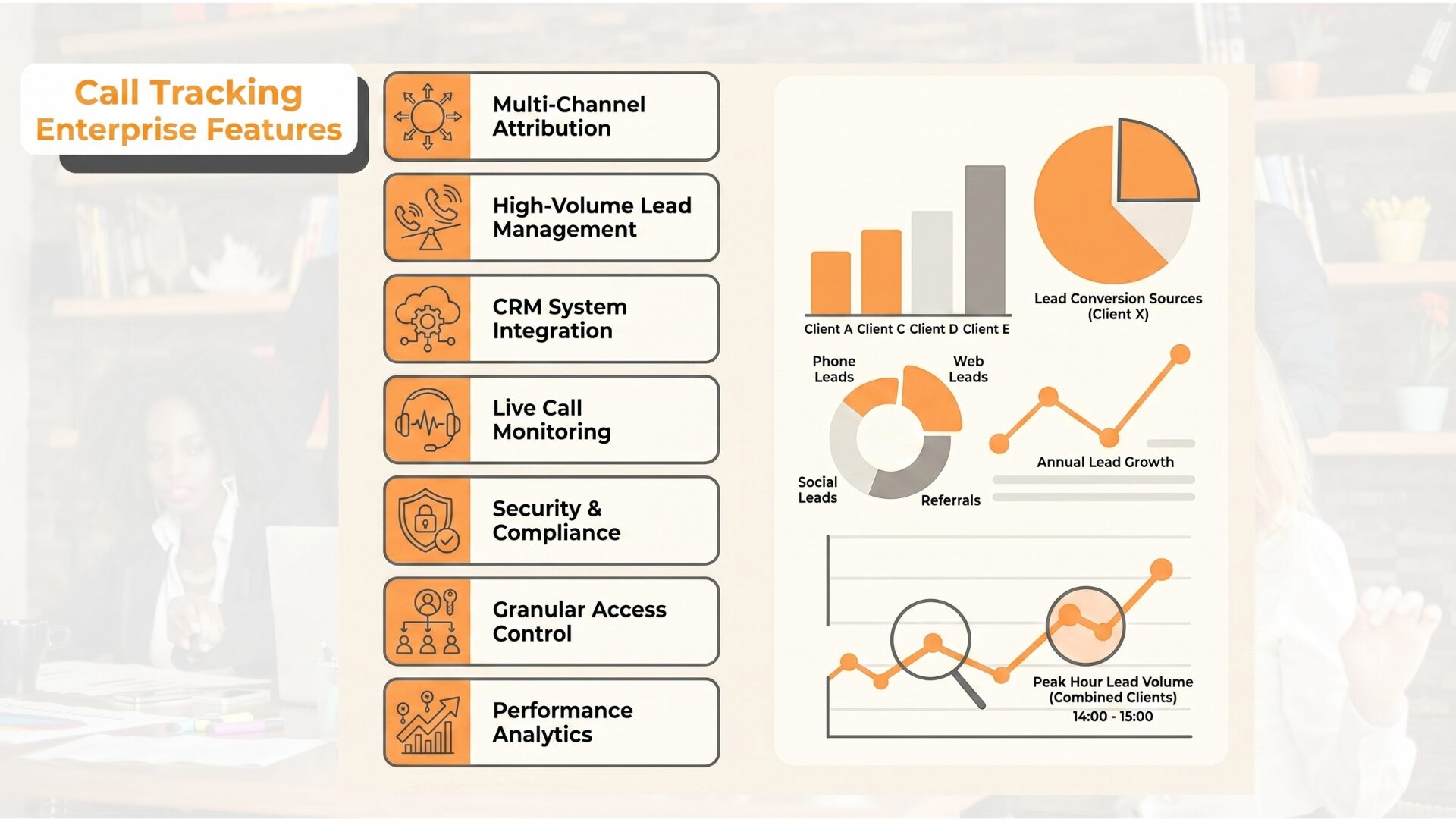
Call tracking helps agencies manage multiple client campaigns by separating call data by account, source, campaign, keyword, landing page, and location. That makes it easier to report on phone leads accurately, spot missed-call problems, review lead quality, and show clients which marketing activities are producing real business outcomes.
Managing one client campaign is relatively simple compared with managing several at once. Once an agency is handling multiple accounts across paid search, SEO, landing pages, local campaigns, and offline follow-up, attribution gets harder, reporting gets messier, and client conversations get more difficult when phone calls are part of the conversion path.
That is why agency call tracking for multiple clients matters so much. It helps teams connect calls to the correct client, campaign, keyword, landing page, and business outcome. It also supports multi-client call tracking by making it easier to compare locations, identify missed calls, review lead quality, and improve agency campaign call management across different accounts.
Why agencies need stronger call visibility across accounts
Most agencies already know how to report on impressions, clicks, and form submissions. The real reporting problem starts when valuable leads come in by phone.
That is where multi-client call tracking becomes more important. When several client campaigns are active at once, phone leads can easily become harder to separate, harder to explain, and harder to defend in client conversations.
Common problems usually include:
- calls from different campaigns looking the same in reports
- clients asking which campaigns actually drove phone leads
- account teams struggling to explain weak results when the client is missing calls
- local branches handling calls differently across the same account
- manual reporting taking too much time
- strong campaigns getting blamed for intake, routing, or follow-up problems
This is especially common in industries such as home services, legal, healthcare, automotive, real estate, and insurance, where the phone call is often the real lead event.
For agencies, the questions are usually straightforward:
- Which campaigns drove the calls?
- Were those calls relevant?
- What happened after the call?
Without agency call tracking for multiple clients, those answers are often incomplete. That makes agency campaign call management harder than it needs to be and weakens the agency’s position when reporting results across several accounts.
What call tracking helps an agency do
At a practical level, call tracking helps agencies bring more structure, accuracy, and accountability to phone-based lead reporting across accounts. That is especially important when several clients, campaigns, locations, and stakeholders are active at the same time.
For agencies managing multiple client campaigns, call tracking helps teams:
- assign calls to the correct client account
- connect calls to the correct source, channel, campaign, keyword, or landing page
- separate calls by location, market, or service line
- identify missed calls and slow response issues
- review lead quality when needed
- report on qualified calls, appointments, quotes, and sales
- show clients a clearer path from marketing activity to business outcome
This is what makes multi-client call tracking so valuable in agency operations. Without that structure, reporting becomes harder to trust, harder to defend, and harder to scale across accounts.
Strong agency call tracking for multiple clients does more than count calls. It helps agencies organize data cleanly, explain results more clearly, and improve agency campaign call management when phone calls are part of the lead path.
Why agencies often need call tracking even more than in-house teams
An in-house team usually works with one brand, one reporting structure, and one internal group of stakeholders. An agency has to manage several brands, several decision-makers, and several reporting expectations at the same time.
That creates more pressure around:
- account separation
- naming consistency
- location-level reporting
- user permissions
- dashboard clarity
- monthly reporting accuracy
- client retention
This is why agency call tracking for multiple clients needs to be more structured than a basic single-account setup. Agencies are not only measuring calls. They are also protecting reporting quality across accounts, defending campaign performance, and keeping client conversations grounded in evidence.
A platform built for multi-client call tracking can make a major difference here. It helps agencies keep accounts organized, maintain cleaner reporting, and support stronger agency campaign call management when several clients, locations, and service lines are active at once.
1. Call tracking keeps client data clean and separated
This is one of the first major benefits for agencies.
When multiple client accounts are active at the same time, clean separation matters. Each client needs the right tracking numbers, source mapping, routing logic, and reporting view. If the setup is messy, the reporting will be messy too.
This becomes even more important for:
- agencies handling several clients in the same industry
- franchise accounts
- multi-location businesses
- agencies working with internal teams and outside contractors
- client groups with multiple service lines
Example
An agency may manage search campaigns for several dental groups, law firms, or clinic brands at once. Without structured call tracking, it becomes harder to prove which calls belong to which client, campaign, or location. With the right setup, each account has its own reporting structure, and the agency can show results without confusion.
Where AvidTrak Fits
AvidTrak is especially useful here because it helps agencies organize accounts more cleanly, assign tracking numbers by client or campaign, and keep reporting structured across multiple accounts. That makes agency call tracking for multiple clients easier to manage and gives teams a stronger foundation for multi-client call tracking without forcing everything into one loose reporting setup.
Where AvidTrak fits
AvidTrak is particularly useful here because agencies can organize accounts cleanly, assign numbers by client or campaign, and keep reporting structured across multiple accounts instead of forcing everything into one loose setup.
2. Call tracking shows which channels are actually producing calls
Many client reports still focus too heavily on clicks, form fills, and platform-reported conversions. That creates a major blind spot when the real lead action happens by phone.
This is where multi-client call tracking becomes much more valuable. It helps agencies measure calls from channels such as paid search, organic search, Google Business Profile, paid social, landing pages, email, referrals, and offline campaigns. AvidTrak’s core call tracking platform is built around tracking inbound calls back to campaigns, pages, and channels, while its agency page emphasizes separate account control and client reporting across multiple accounts.
That matters because a campaign can look average in web reporting while still producing strong phone lead volume.
Example
A plumbing client may generate phone-heavy demand from local search and paid search, while social campaigns create more awareness than direct calls. If the agency only reports on web forms, the real contribution of search can look weaker than it actually is.
Why This Matters
Clients make budget decisions based on what they can see. If the agency cannot show where phone leads are coming from, some of the strongest channels may be undervalued, and weaker channels may get too much credit. Google’s own attribution documentation explains that attribution assigns credit across the touchpoints that influence conversion paths, which is exactly why phone-call attribution matters when calls are part of the lead journey.
Where AvidTrak Fits
AvidTrak is a strong fit here because agencies can use it to connect calls back to the correct client, channel, campaign, and source without mixing reporting across accounts. Its integrations page also supports tying call data into ad, CRM, and analytics workflows so agencies can report more clearly on client campaign performance.
3. It gives agencies campaign, keyword, and landing page visibility
Serious optimization does not happen at the channel level alone. Agencies need to know which campaign drove the call, which keyword influenced it, and which landing page created enough intent for the caller to act.
This is where agency campaign call management becomes much stronger. Instead of reporting that paid search or SEO generated calls, the agency can identify which campaigns, search terms, and pages are producing qualified phone leads. AvidTrak’s call tracking platform is built around source-level attribution, including campaign and keyword visibility, which is especially useful when agencies need to explain performance across several active accounts. (avidtrak.com)
Agencies can use this level of visibility to answer questions such as:
- Which campaign generated the most calls?
- Which keywords drove qualified calls?
- Which landing pages created the strongest call intent?
- Which service pages are creating calls but not appointments?
- Which ads are creating call volume but weaker-fit leads?
Example
A legal marketing agency may find that broader personal injury terms generate more calls overall, while more specific vehicle accident terms produce stronger consultation quality. That gives the agency a better basis for budget shifts, landing page updates, and keyword refinement.
Where AvidTrak Fits
AvidTrak is a strong fit for agency call tracking for multiple clients because it helps agencies connect calls back to campaigns, keywords, and pages more clearly. That makes multi-client call tracking more useful in real client reporting because account managers can explain performance with more precision than a simple “Google Ads drove calls” summary.
4. Call tracking helps agencies prove value beyond clicks
One of the hardest parts of agency work is proving business value in a way the client actually trusts.
Clicks, impressions, and platform conversions are useful, but they do not always answer the question clients care about most: Did this campaign produce real opportunities?
That is where multi-client call tracking becomes far more valuable than traffic-only reporting. Call tracking helps agencies report on outcomes such as qualified calls, appointment calls, quote requests, consultation calls, sales inquiries, and call-to-lead or call-to-appointment performance. When call data is paired with CRM or offline outcome tracking, agencies can move the conversation closer to pipeline and revenue instead of stopping at activity metrics.
Example
A campaign may show a higher cost per click than the previous month, but if it is also producing more qualified calls and better appointment outcomes, the real business result may still be stronger. Call tracking helps the agency show that more clearly and defend the campaign with better evidence.
Why This Matters
Clients do not retain agencies because reports are full. They retain agencies when reporting is clear, credible, and connected to business outcomes. Agency call tracking for multiple clients helps account teams explain not only what happened in the ad platform, but also what happened when prospects called.
Where AvidTrak Fits
AvidTrak helps agencies move beyond click-level reporting by combining source attribution, call review, AI-powered transcription, conversation outcome extraction, and reporting in one platform. That makes agency campaign call management more useful because agencies can show which campaigns generated calls and whether those calls were actually handled well enough to create business value.
5. It helps agencies catch missed-call problems before the client blames the campaign
This is one of the most useful agency benefits.
A campaign can appear weak even when the media is doing its job. The real problem may be that the client is missing calls, taking too long to respond, or sending callers to voicemail.
Call tracking helps agencies monitor:
- answer rate
- missed call rate
- voicemail rate
- after-hours calls
- callback response time
- routing success
Example
An HVAC agency account may be generating strong demand during extreme weather periods, but if the client misses a noticeable share of inbound calls during peak hours, booked jobs will fall. Without call tracking, the client may think the campaign failed. With call tracking, the agency can show the real breakdown.
Where AvidTrak fits
This is one area where AvidTrak is especially practical for agencies. Because the platform includes routing controls, after-hours handling options, and clear call outcome visibility, agencies can point to operational issues with real data instead of assumptions.
6. Call tracking helps agencies manage multi-location clients better
Many agencies work with clients that have several branches, clinics, offices, franchises, or service areas.
In these accounts, reporting has to work on two levels:
- a full account view
- a local performance view
Call tracking helps agencies compare:
- calls by location
- answer rates by branch
- campaign performance by market
- missed calls by office
- call quality by region
- revenue outcomes by location where available
Example
A healthcare agency may see that one clinic receives fewer calls but books more appointments, while another clinic receives more calls and misses too many during lunch hours. That kind of difference matters in account planning, staffing discussions, and budget allocation.
Where AvidTrak fits
AvidTrak is a strong fit for agency-managed multi-location accounts because it supports routing by area, after-hours workflows, and account structures that make location-level reporting more manageable.
7. It helps agencies move from call volume to call quality
More calls does not always mean better campaign performance. Agencies need to know what kind of calls those were.
Depending on the setup, call tracking can help identify:
- qualified calls
- sales inquiries
- quote requests
- appointment calls
- support calls
- spam calls
- wrong numbers
- repeat callers
This helps agencies separate useful demand from noise.
Example
A med spa campaign may generate a large number of promotional calls, but many may be price-only inquiries with low booking intent. Another campaign may create fewer calls but stronger consultation quality. That difference matters more than raw volume.
Where AvidTrak fits
With AvidTrak, agencies can review calls, use AI-powered transcription, and classify outcomes more clearly. That makes it easier to report on lead quality and not just call counts.
8. Call tracking helps agencies review call quality when needed
Agencies do not need to listen to every call. That would not be practical. But selective call review can be very useful when:
- the client questions lead quality
- one location converts worse than others
- the account is generating calls but weak business results
- the agency needs to verify intent from a campaign
- a service line is underperforming
Call recordings and transcripts can help agencies identify:
- repeated objections
- intake script issues
- slow or weak responses
- mismatched targeting
- strong-fit versus weak-fit calls
- trends by campaign or location
Example
A real estate client may say the agency is bringing weak leads. Call review may show something different. The calls may be strong, but the leasing team may be slow, unclear, or weak at moving callers into tours.
Where AvidTrak fits
AvidTrak’s call recording and AI-powered transcription make this easier for agencies because teams can review conversations without depending only on call length or client opinion.
9. It helps agencies connect marketing to offline outcomes
This is where agency reporting becomes much stronger.
Phone calls often lead to outcomes that happen later, such as:
- appointments
- consultations
- quotes
- demos
- opportunities
- closed sales
When call tracking is connected to CRM and offline conversion workflows, agencies can report on what happened after the call, not just the call itself.
Example
A home improvement client may care most about booked site visits. A B2B client may care about qualified consultations. A legal client may care about signed cases. Call tracking helps the agency align reporting with the client’s actual business goal.
Where AvidTrak fits
AvidTrak supports CRM integrations and offline conversion workflows that can help agencies tie calls back to revenue stages more clearly, especially in accounts where calls are only the first step in the sales path.
10. It reduces manual reporting work across accounts
Manual reporting becomes a major time drain in agencies. Teams often have to pull numbers from ad platforms, analytics tools, spreadsheets, CRM systems, and client notes just to explain what happened.
Call tracking reduces that friction by giving agencies a dedicated reporting layer for phone-based conversions.
That can support:
- client dashboards
- scheduled reports
- channel-level call summaries
- location comparisons
- missed-call reporting
- lead quality reporting
- agency-friendly reporting structures
Why this matters
This is not only about saving time. It also improves consistency and reduces reporting errors. When agencies rely less on patchwork reporting, monthly reviews become smoother and more credible.
Where AvidTrak fits
AvidTrak is useful here because agencies can centralize call reporting, support client-facing reporting needs, and reduce the amount of manual work needed to explain phone-based lead performance.
11. It strengthens the agency’s position in client conversations
Agencies often sit between marketing activity and client operations. That means they get blamed for issues that are not always media-related.
Call tracking helps bring evidence into those conversations.
It can show:
- campaigns did generate enough calls
- a location missed a high share of inbound leads
- after-hours demand was not being handled
- one service line produced stronger calls than another
- the intake process may be hurting conversion
- one market is converting calls much better than another
That helps agencies speak with more clarity and more confidence.
Example
A clinic group may question why lead cost increased. The agency can show that calls remained strong, but one location’s answer rate fell and callback response slowed. That changes the diagnosis and protects the campaign from being blamed unfairly.
12. It helps agencies scale account management across more clients
As agencies grow, they need systems that keep reporting structured across accounts. Call tracking helps create that consistency.
A growing agency can standardize:
- account setup rules
- source naming
- campaign mapping
- location tagging
- dashboard structure
- missed-call checks
- quality review steps
- monthly reporting language
This becomes especially useful for agencies focused on one or two verticals, such as:
- dental
- legal
- HVAC
- automotive
- clinics
- franchises
Where AvidTrak fits
Because AvidTrak is designed with agency use cases in mind, it supports this kind of repeatable structure better than a simple standalone tracking tool. That makes it easier for agencies to build a consistent process across similar client accounts.
13. It supports stronger client retention
Many agency-client relationships weaken because results are not explained clearly enough, not because the campaigns failed completely.
Call tracking helps agencies answer common client questions with better evidence:
- Which campaigns drove the phone leads?
- Were those leads qualified?
- Which locations handled calls best?
- Are missed calls hurting performance?
- Why are some campaigns getting more budget?
- Which service line is producing better call quality?
- Are we seeing calls turn into appointments or sales?
Clients stay longer when reporting is clearer, more business-focused, and easier to trust.
A practical agency setup for multi-client call tracking
For agencies, strong results depend on setup discipline. A weak setup creates reporting problems later.
A practical structure should include:
Separate account environments
Each client should have its own clean structure, user access, numbers, and reporting rules.
Consistent naming
Campaigns, channels, service lines, and locations should follow the same naming system.
Location mapping
For multi-location clients, every market or branch should be assigned clearly.
Conversion stage definitions
The agency and client should agree on what counts as:
- a call
- a qualified call
- an appointment call
- a sales call
- a closed outcome where possible
Reporting ownership
Decide who monitors missed calls, quality issues, and offline outcome syncing.
Access control
Give the right people the right level of access so reporting stays useful and secure.
Metrics agencies should monitor across client campaigns
To manage multiple client accounts well, agencies should track more than total calls.
Demand and response metrics
- total calls
- answered calls
- missed calls
- voicemail calls
- after-hours calls
- callback response time
Attribution metrics
- calls by channel
- calls by campaign
- calls by keyword
- calls by landing page
- calls by location
- first-touch and last-touch attribution where available
Quality metrics
- qualified calls
- spam call rate
- wrong number rate
- appointment booking rate
- quote rate
- sales inquiry rate
Outcome and revenue metrics
- call-to-lead rate
- call-to-appointment rate
- call-to-sale rate
- revenue by campaign from calls
- revenue by channel from calls
- cost per qualified call
- missed call revenue risk
These metrics help agencies manage both media performance and client-side lead handling.
Real-World Agency Examples
Example 1: Performance Marketing Agency
A performance marketing agency managing several HVAC and plumbing accounts sees strong call volume from paid search, but booked jobs remain lower than expected. Call tracking shows that a large share of after-hours calls is being missed, which means the media is doing its job but the lead response process is breaking down. With that insight, the agency can protect the campaign strategy, explain the gap clearly, and recommend a response workflow that supports better conversion.
Example 2: Legal Marketing Agency
A legal marketing agency notices that one personal injury campaign is generating a high number of calls, but consultation quality is inconsistent. Call tracking at the keyword level shows that broader search terms are attracting mixed-intent callers, while more specific case-related terms bring stronger prospects. The agency uses that data to refine targeting, improve qualified call rate, and present a stronger case for budget reallocation.
Example 3: Healthcare Marketing Agency
A healthcare marketing agency working with a clinic group sees one location getting healthy traffic and solid call volume, yet booked visits remain below average. Call tracking reveals that the location has a weaker answer rate and slower callback response than other branches. That gives the agency a clear explanation for the lower conversion rate and helps keep the media work from being judged unfairly.
Example 4: Multi-Location Digital Marketing Agency
A digital marketing agency managing a franchise account compares call performance across several markets. One region is converting calls well, while another is sending too many calls to voicemail despite similar campaign spend and traffic levels. Call tracking helps the agency show where local sales handling is affecting results, improve campaign planning by market, and guide the client toward better call response practices.
Final thoughts
Call tracking helps agencies do much more than count phone leads. It gives them a structured way to manage multiple client campaigns, measure source performance, catch missed-call problems, compare markets, review lead quality, and connect media work to real business outcomes.
That is why it matters so much in agency operations. When several client accounts are active at the same time, agencies need reporting that is organized, defensible, and tied to business reality. With the right setup, and especially with an agency-friendly platform such as AvidTrak, agencies can turn phone-based lead tracking into a stronger reporting and retention advantage.
FAQs
Why do agencies need call tracking if they already have conversion tracking?
Because many valuable leads come in by phone, not only by form. If phone calls are part of the buying path, the agency needs visibility into those calls or the reporting picture stays incomplete.
Can call tracking help agencies keep clients longer?
Yes. Stronger attribution, clearer reporting, and better visibility into missed calls and lead quality help agencies explain performance more clearly and protect trust.
Is call tracking only useful for local clients?
No. It is especially useful for local and multi-location clients, but it also helps any client where phone calls play a role in lead generation or sales.
What is the biggest benefit for multi-location clients?
It gives the agency both central and local visibility, which makes it easier to compare markets, review call handling, and report on branch-level performance.
Where does AvidTrak make the biggest difference for agencies?
AvidTrak is especially useful for agencies that manage multiple clients, locations, or service lines and need structured reporting, routing options, call recording, AI-powered transcription, and CRM-connected outcome tracking in one platform.


