


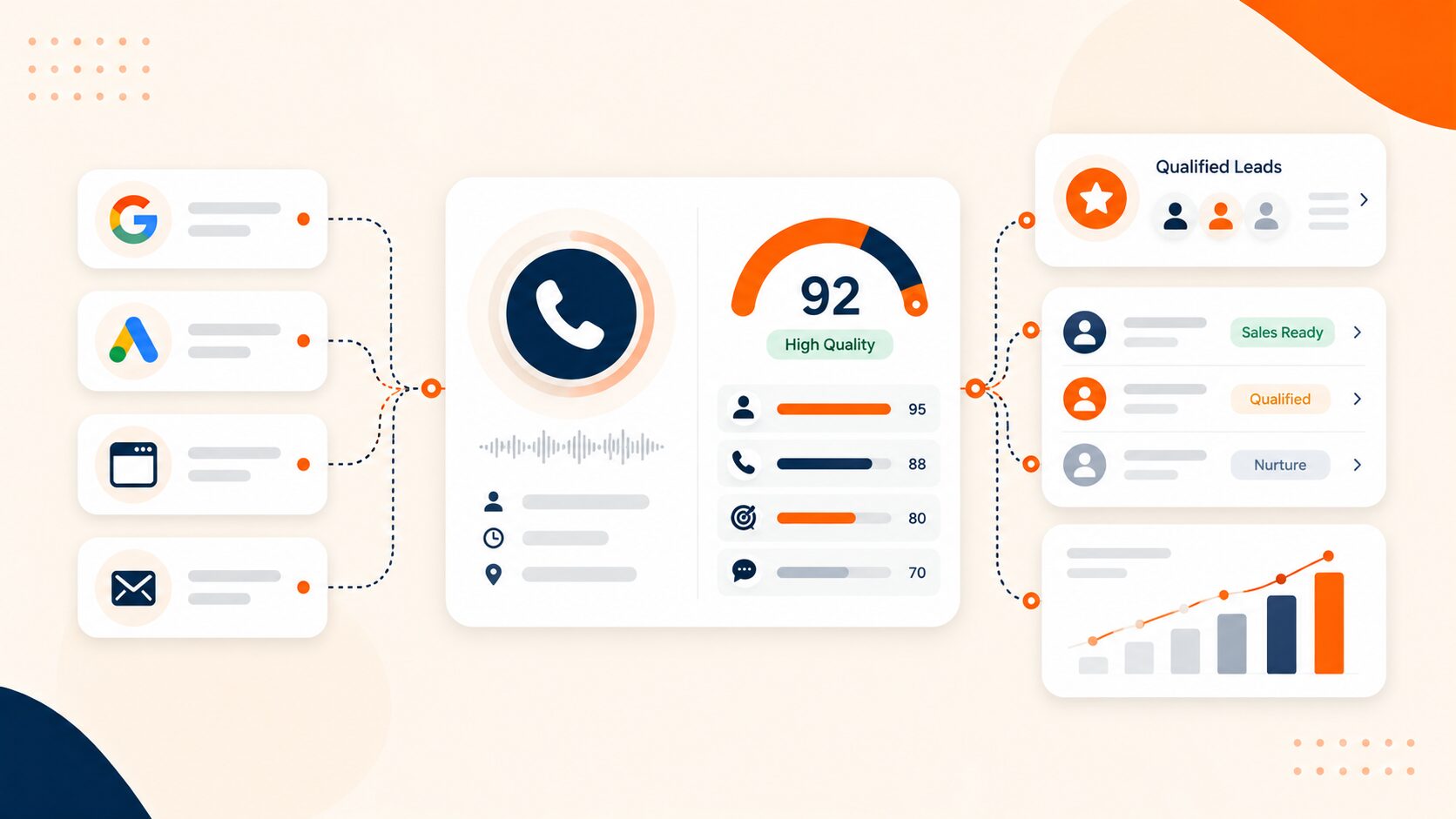
Call scoring for marketing leads evaluates phone inquiries against defined business-fit and buying-intent criteria. It helps marketing and sales identify relevant demand, explain why an inquiry qualifies, and decide what should happen next.
A useful scorecard answers a different question from “Did the caller book?” A prospect can be a good fit even when the business has no appointment available. A long, well-handled billing call can have no new-lead value.
Keep three decisions separate: qualification, follow-up priority, and confirmed outcome. Combining them into one score makes campaign performance harder to interpret.
What does marketing call scoring measure?
Choose the purpose before choosing the points.
| Process | Main question | Typical evidence |
| Marketing call scoring | Does this inquiry fit the business and show relevant buying intent? | Requested service, eligibility, and caller intent |
| Agent quality review | How well was the conversation handled? | Questions asked, accuracy, response, and follow-through |
| Broader lead scoring | How does the prospect fit across several interactions? | CRM information, account fit, website activity, and conversations |
CallTrackingMetrics describes scoring calls against predefined standards for marketing, sales, and agent review. HubSpot’s broader lead-scoring model distinguishes fit from engagement.
These processes can inform each other, but a poor agent response should not erase a relevant inquiry. Likewise, good customer service should not turn a support call into a new acquisition lead.
Call tracking, recording, and analytics supply different evidence: where the call came from, what was said, and how the interaction was interpreted.
Define a qualified phone inquiry before assigning points
For a local service business, a practical definition is:
A qualified phone inquiry concerns an offered service, meets the business’s stated eligibility requirements, and contains a genuine request to evaluate or buy that service.
Adapt the definition to the business. A contractor may need the service and property location; a B2B provider may need account or implementation fit.
Define eligibility separately from temporary operating capacity. “We do not serve this area” and “We have no appointment today” are different reasons for not booking.
Classify the reason for calling
Separate:
- New sales inquiries.
- Existing customers requesting another purchase or service.
- Support, billing, or administration.
- Vendors, job inquiries, spam, or wrong numbers.
- Calls whose purpose cannot yet be established.
An existing customer’s new purchase can be a sales opportunity. Report it separately from new-customer acquisition.
Support and other non-sales calls stay outside the sales qualification score. A missed call with no usable information belongs in recovery or review, not automatically in the unqualified bucket.
Use three statuses for sales inquiries
Qualified: Evidence supports the required fit and buying-intent criteria.
Not qualified: A required condition demonstrably fails, or the inquiry falls short of the agreed sales definition. Record a reason.
Needs review: No confirmed failure settles the decision, but required evidence is missing, contradictory, or unreliable.
Keep the qualification reason alongside the status. “Unsupported service” tells the team what failed; “low quality” does not.
Record outcomes separately
Maintain distinct fields for qualification, next action, booking, sale, and loss reason.
A booking request is not proof of a confirmed appointment. A confirmed appointment is not proof of attendance or collected revenue.
Google Ads similarly distinguishes qualified leads from converted leads using stages defined around the business’s lead process.
A practical call-scoring template
This illustrative 10-point rubric measures service fit, eligibility, and the caller’s expressed buying intent. Appointment completion and agent performance do not earn points.
It is an original starting model for a local service business, not an industry benchmark, a validated prediction model, or an AvidTrak preset.
| Criterion | Points | Evidence required |
| Service fit | 3 or 0 | 3: the requested service is offered; 0: it is confirmed not to be offered |
| Service eligibility | 3 or 0 | 3: the stated geographic and other mandatory service requirements are met; 0: a required condition fails |
| Caller’s buying intent | 4, 2, or 0 | 4: explicit request to book, purchase, or authorize work; 2: a specific estimate, consultation, or availability inquiry; 0: evidence confirms no relevant buying intent |
Maximum score: 3 + 3 + 4 = 10.
Under this model, an inquiry qualifies only when service fit and eligibility both pass and buying intent earns at least 2 points. The minimum qualifying total is therefore 3 + 3 + 2 = 8.
Apply the criteria, not just the total:
- A confirmed mandatory failure produces Not qualified.
- Use U: unknown when evidence is missing; do not silently assign zero.
- If no confirmed failure settles the decision and a required fact is unknown, use Needs review.
- Do not turn a partial score into a complete score by shrinking the denominator.
- Record the supporting evidence and rubric version.
A request for a future estimate can qualify. Urgency, appointment availability, an agreed callback, and actual booking belong in separate operational fields.
Examples: which phone inquiries qualify?
These fictional examples use the rubric above.
| Inquiry | Score | Qualification | Outcome or next action |
| Caller requests an offered repair in the service area and confirms an appointment | 10/10 | Qualified | Appointment confirmed; attendance and sale remain separate |
| Caller asks for an estimate for an offered service in the area; no next step is agreed | 8/10 | Qualified | Assign follow-up; no booking confirmed |
| Caller wants to book an eligible service, but no suitable appointment is available | 10/10 | Qualified | Unbooked or lost because of capacity |
| Caller requests an offered service at a confirmed location outside the service area | Not scored | Not qualified | Record the failed eligibility requirement |
| Caller requests an estimate, but the location cannot be established | Incomplete | Needs review | Confirm the missing eligibility information |
| A call is missed and provides no usable information about the requirement | Not scored | Needs review | Follow the missed-call recovery process |
| Existing customer asks about an old invoice | Not applicable | Outside new-sales qualification | Route to billing; exclude from new acquisition leads |
The first and third calls score equally because the caller’s fit and intent are equivalent. Their different booking results reveal an operational difference.
The estimate inquiry also qualifies. Requiring a booking before recognizing qualified demand would hide relevant prospects who need follow-up.
A high score does not automatically mean “call this person first.” An already-booked customer may need no sales callback, while an unbooked qualified caller may need prompt attention.
Build a repeatable scoring workflow
1. Establish the required facts
Give the answering team a short intake checklist:
- What service or product does the caller need?
- Where will it be delivered, or what account requirements apply?
- Is the caller evaluating a specific requirement or asking to proceed?
- What action is needed next, and who owns it?
Use ordinary conversation. If a required fact remains unclear, identify the gap instead of guessing.
Call duration can help select calls for review, but it does not replace these answers.
2. Keep evidence with the decision
Store the call ID, inquiry ID, source where known, reviewer, assessment time, rubric version, criterion results, evidence notes, qualification reason, next action, and owner.
Where available, link a transcript passage or recording timestamp. Distinguish the caller’s words from the agent’s suggestion.
An agent asking “Would you like to book?” does not establish caller booking intent. Nor does the word “book” inside “I am not ready to book.”
Link repeat calls about the same requirement to one inquiry. Keep separate requirements separate, even when the same phone number is used.
3. Use AI as an evidence assistant
AI call transcription and outcome extraction can help locate service questions, pricing discussions, and booking-related conversations. AvidTrak documents these capabilities with outcomes that depend on configuration.
Ask the evaluation process to produce:
- A result for each criterion.
- The supporting passage or field.
- Missing or conflicting information.
- A suggested qualification status.
A keyword, summary, or AI label is not proof of a completed business result.
Manual and AI review can coexist. Aircall’s documentation describes scorecards with AI-evaluated questions, manual criteria, explanations, and editable answers. This is an example of review controls, not a claim that every platform has the same implementation.
4. Assign a next action
For qualified inquiries, set the required follow-up and owner. For cases needing review, state exactly which fact must be resolved. Route billing and support calls to the appropriate team.
Keep priority separate from the score. Consider urgency, unresolved actions, and the current outcome. Do not delay a necessary callback simply because a brief conversation produced less detail.
Connect the decision to CRM call tracking where configured so the original inquiry, later conversations, and confirmed result remain linked.
Validate the scorecard before using it for decisions
Create an agreed reference set
Have two reviewers assess the same varied calls independently using the written rules. Where practical, hide the campaign name, advertising cost, and the other reviewer’s decision.
Resolve disagreements by identifying the evidence and the rule that applies. The result is an agreed reference for checking the process, not an assumption that either reviewer is always correct.
Include strong inquiries, ineligible requests, support calls, missed calls, repeat contacts, short conversations, and incomplete or unclear evidence.
Use separate calls to test revised rules after tuning them. Repeatedly checking only the examples used to write the rules gives a weak test.
Check both kinds of error
Review false positives: calls marked qualified that fail the definition.
Also review false negatives: relevant inquiries marked unqualified.
Inspect low scores and unresolved cases as well as recommended leads. Otherwise, the review cannot show which opportunities the process rejected.
Evaluate the business facts expressed. Enthusiasm, accent, speaking speed, and conversational polish should not substitute for service fit or intent.
Run acceptance checks
Before launch, confirm that the process:
- Leaves missing eligibility information unresolved rather than scoring it zero.
- Rejects a confirmed unsupported service despite strong buying intent.
- Keeps an eligible estimate inquiry qualified without a booking.
- Keeps qualified demand visible when capacity prevents booking.
- Links genuine callbacks to the existing inquiry without merging unrelated needs.
- Preserves evidence and versions when a reviewer corrects an automated result.
These are test conditions, not claims that the scorecard has already been validated.
Compare with later outcomes
Track sales acceptance, quotes, confirmed bookings, and purchases. Review loss reasons separately, including capacity, response delay, price, and lack of fit.
A qualified inquiry that does not buy is not automatically a scoring error. Qualification identifies a relevant opportunity; it does not guarantee conversion.
When rules change, version them and compare like with like. Preserve the original assessment so later information does not silently rewrite what was known during the first call.
Use qualified inquiries in campaign reporting
Report coverage alongside quality. A campaign with many unreviewed calls should not appear stronger because only its clearest inquiries were assessed.
| Metric | Suggested definition | Interpretation |
| Review coverage | Call records with a resolved review decision ÷ inbound call records in the defined review cohort | How much call activity has been assessed |
| Qualified inquiry rate | Unique qualified new-sales inquiries ÷ fully assessed unique new-sales inquiries | Relevance among assessed sales inquiries; show pending cases separately |
| Cost per qualified phone inquiry | Campaign spend ÷ attributed unique qualified phone inquiries for the same campaigns and acquisition period | Phone-inquiry acquisition cost, not total campaign lead cost |
| Booking rate | Unique qualified inquiries with at least one confirmed booking ÷ qualified inquiries in that same cohort | Progression to booking with a consistent follow-up period |
Review coverage uses call records. The other measures use unique inquiry records. Define the cohort, exclusions, reporting cutoff, and attribution policy before calculating them. Group inquiry outcomes by when the inquiry began, then allow a stated period for qualification and booking updates.
A resolved review establishes a sales qualification decision or a non-sales classification; cases still needing review remain pending. Classifying a call as support or spam can complete its review without making it a sales inquiry. Exclude tests and agreed technical duplicates without removing genuine callbacks.
Keep unknown attribution visible. Do not move an inquiry to another campaign merely because a later call scored higher.
If a denominator is zero, show the metric as unavailable. Multiply rate fractions by 100 when presenting percentages.
Use call tracking reports to connect source, call activity, review status, and outcomes where the reporting setup supports them. Compare confirmed results as well as qualification; an average score alone cannot explain campaign value.
If qualified outcomes are sent to Google Ads, map the intended stage, verify event delivery, and prevent duplicates. Review campaign goals before using the signal for bidding. Secondary conversion actions can still affect bidding when included in custom goals.
How AvidTrak supports call qualification
AvidTrak’s call analytics connects attribution and call activity with conversation information. Documented capabilities include AI-powered transcription, keyword flagging, conversation outcome extraction, and configurable reporting.
These tools can support evidence review and identification of relevant inquiries. Confirm the available scoring controls, fields, and integrations for the intended workflow.
The sample rubric is a proposed business process. Do not assume it exists as an identical automated scorecard inside the product.
To plan the workflow, contact AvidTrak with the qualification definition, sample call types, required outcomes, and CRM reporting needs.
Frequently asked questions
Should a caller need a confirmed budget to qualify?
Only if a budget requirement is necessary for the business’s qualification definition. A legitimate estimate inquiry may come before the caller knows the final price. Keep “budget not discussed” separate from evidence that a mandatory requirement cannot be met.
Can calls be scored without recordings?
Yes, using structured intake answers, reliable agent notes, and relevant CRM information. The limits are evidence quality and auditability. Record which facts were established and leave missing facts unresolved. If recordings or transcription are added, check the requirements that apply to their use.
Can multiple branches use one scorecard?
They can share core definitions while applying branch-specific service and geographic requirements. Compare scores only when the criteria mean the same thing. Keep temporary appointment capacity separate from whether the inquiry fits the business.
Can a score change after a callback?
Yes, when follow-up provides new evidence. Keep the original assessment, updated result, reason for the change, and timestamps. This separates the quality of the original inquiry from what was established later.
Does an 8/10 score mean an 80% chance of a sale?
No. It means the inquiry earned eight points under this rubric. It is not a conversion probability. Predictive probabilities require a separate model and validation against actual outcomes.


