


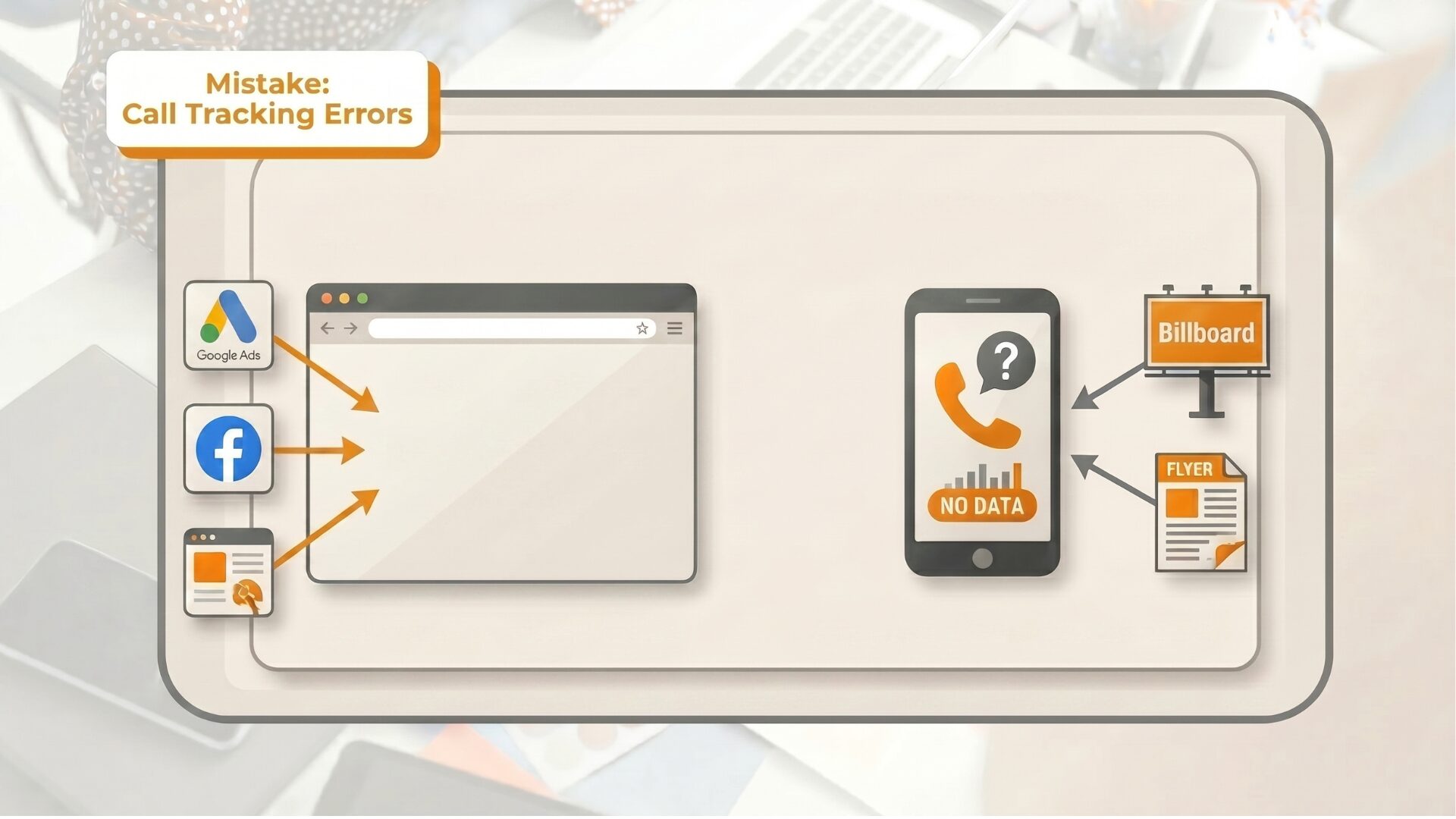
Digital ads can drive strong call volume and still leave the business with weak reporting. That usually happens when teams assume that a phone lead is easy to measure just because the phone rang.
In reality, call attribution breaks down quickly when the setup is loose, the routing is unclear, or the team only looks at total calls instead of call quality and sales outcomes.
That is why this topic matters. Businesses spend heavily on paid search, paid social, display, local campaigns, landing pages, and branded campaigns, yet many still struggle to answer basic questions such as which ad drove the call, whether the call was qualified, and whether that call turned into revenue.
The problem is rarely that calls cannot be tracked. The problem is that they are tracked poorly.
What Are the Most Common Mistakes When Tracking Calls From Digital Ads?
The most common mistakes when tracking calls from digital ads include relying only on total call volume, skipping dynamic number insertion, failing to separate branded and non-branded calls, ignoring missed calls, not linking call data to CRM stages, and failing to review call quality. These issues make ad reporting look cleaner than it really is and often lead to weaker media decisions.
Mistake 1: Tracking total calls and assuming that is enough
This is one of the most common mistakes in digital ad reporting.
Many teams treat total call volume as a sign of campaign success. The problem is that not every call has the same value. One campaign may drive more calls, but include support questions, spam, wrong numbers, or low-intent inquiries. Another may drive fewer calls but more qualified leads.
Why this hurts performance
Budget shifts toward call volume instead of call quality. That leads to weaker optimization decisions.
Better approach
Track:
- qualified calls
- sales inquiry calls
- appointment calls
- quote request calls
- call-to-lead rate
- call-to-sale rate
- revenue from call-driven leads where possible
Raw call volume should not be the only metric used to judge digital ad performance.
Mistake 2: Not Using Dynamic Number Insertion Properly
Dynamic number insertion is one of the most important parts of call tracking for digital ads. It helps match the website visitor to the correct traffic source and session.
When it is missing, weak, or configured badly, many ad-driven calls end up grouped together with general website calls or unattributed traffic.
What often goes wrong
- the website shows one static phone number to everyone
- number swapping only works on some pages
- the number pool is too small for the traffic level
- tracking breaks during higher-volume periods
- the number swap fails on mobile or on certain landing page templates
Why this matters
A paid search campaign may drive the call, but the business sees only “website call” or “direct call.” That hides the real source and makes campaign decisions weaker.
Better approach
Use dynamic number insertion across ad-driven landing pages and key site areas. Make sure the number pool is large enough for traffic levels, especially during peak campaign periods.
Mistake 3: Ignoring Call Quality and Focusing Only on Attribution
A team may get marketing attribution right and still make poor decisions if it does not review call quality.
For example, a Google Ads campaign may look strong at the keyword level, but once calls are reviewed, many may turn out to be poor-fit leads or callers asking about services the business does not offer.
Why this hurts
Attribution shows where the call came from. It does not show whether the call was qualified or useful.
Better approach
Combine attribution with:
- call outcome tagging
- call recordings where appropriate
- AI-powered transcription
- qualified call rules
- CRM outcome tracking
- appointment or quote tracking
This creates a clearer view of which digital ads are driving qualified conversations rather than just call volume.
Mistake 4: Failing to Separate Branded and Non-Branded Ad Calls
Branded and non-branded search calls often perform very differently.
A person who searches for the business by name and then calls may already know the brand. A person who clicks a non-branded service keyword and then calls is often a different type of lead.
Why this matters
If both are reported together, campaign performance can look misleading. Non-branded acquisition may appear stronger than it really is, or weaker than it should be.
Better approach
Break out:
- branded search calls
- non-branded search calls
- competitor campaign calls where relevant
- remarketing-assisted calls where relevant
This helps the team evaluate acquisition quality more accurately.
Mistake 5: Treating Every Call as a Last-Click Conversion
Phone leads often come after several marketing touches. A prospect may first click a paid social ad, return through organic search, and call later after a branded search visit.
If the business only tracks the last ad or last session before the call, the rest of the path disappears.
Why this hurts
Channels that help create demand earlier in the buying process get undervalued. That can lead to weaker budget decisions.
Better approach
Use multi-touch logic where possible. At a minimum, compare first-touch and last-touch behavior for important call paths.
Mistake 6: Not linking Calls Back to CRM or Sales Outcomes
This is one of the biggest reporting gaps in digital ad programs.
A paid ad may generate a phone lead, but if that lead is never matched to a CRM record or closed sale, the team can only prove the call, not the business result.
Why this hurts
Teams keep optimizing for call volume or cost per call instead of qualified leads, appointments, or sales outcomes.
Better approach
Connect call tracking with CRM stages in platforms such as Salesforce, HubSpot, or Zoho CRM, including:
- lead created
- qualified lead
- appointment booked
- opportunity created
- closed sale
This gives a clearer view of which campaigns are driving stronger sales outcomes.
Mistake 7: Ignoring Missed Calls from Digital Campaigns
Many businesses assume that if the ad drove the call, the job is done. That is not true.
A campaign can generate strong call demand, but if the team misses a large share of those calls, the reported media result will look weaker than it should.
Why this matters
The ad account may be blamed for low conversion performance even though the real issue is call handling.
Better approach
Track:
- missed call rate
- answer rate
- voicemail rate
- callback response time
- after-hours call volume
When digital ad calls are missed often, the business is wasting part of its ad spend even if the campaign itself is working.
Mistake 8: Using the Same Call Tracking Setup for Every Ad Channel
Not all digital ad channels behave the same way.
Paid search often drives high-intent phone leads close to purchase. Paid social may influence earlier-stage interest. Display campaigns may support awareness or remarketing. Local service ads and multi-location campaigns may perform differently from national campaigns.
Why this matters
If every channel is measured the same way, reporting becomes too broad and campaign performance is harder to judge properly.
Better approach
Set reporting expectations by channel. For example:
- paid search may be measured by qualified calls, appointments, and sales inquiries
- paid social may be reviewed by assisted conversions, remarketing influence, and branded search lift
- local campaigns may be reviewed by calls by market, answer rate, and location-level call quality
AvidTrak helps businesses track calls across different ad channels so reporting can match how each campaign actually performs.
Mistake 9: Not Reviewing Landing Page Influence on Call Performance
Many teams judge call performance based on the ad alone, but the landing page often shapes whether a visitor calls and what type of call comes in.
What often gets missed
- the phone number is hard to find
- the page pushes forms too heavily and weakens call intent
- the message creates the wrong expectations
- the page brings in support-type calls instead of sales inquiries
- the service area, offer, or location details are unclear
Better approach
Track phone calls by landing page, then compare:
- call volume
- call quality
- appointment rate
- quote request rate
- sales outcome or revenue where possible
A landing page may drive fewer calls and still perform better if those calls are more qualified.
Mistake 10: Forgetting that Call Tracking Should Match the Sales Motion
A local service business, a legal intake team, and a B2B sales team do not handle phone leads the same way.
Why this matters
A good call means something different in each case. For one business, it may be a booked appointment. For another, it may be a qualified consultation. For another, it may be a demo request or sales opportunity.
Better approach
Define what a successful call looks like before building the reporting model. The tracking setup should follow the business goal, the sales process, and the lead qualification rules.
This is where a flexible platform such as AvidTrak becomes useful, especially for businesses with more than one service line, location, or call handling path.
Mistake 11: Failing to Filter Spam and Low-Value Calls
Digital ad campaigns do not only attract good leads. They can also bring in irrelevant calls such as:
- robocalls
- wrong numbers
- customer service calls
- vendor calls
- duplicate calls
- poor-fit inquiries
Why this hurts
If these calls stay inside the main reporting, cost per lead, call quality, and campaign performance become distorted.
Better approach
Use filtering rules, call classifications, and spam controls to ensure the reporting more accurately reflects real lead demand. AvidTrak’s robocall filtering and call tagging features can help teams keep call reporting cleaner.
Mistake 12: Not Auditing the Setup After Launch
Many businesses build a call-tracking setup once and rarely revisit it.
Over time, the setup starts to drift:
- new landing pages are missed
- routing changes but reporting does not
- new campaigns launch without proper tracking
- call outcome rules are outdated
- CRM matching weakens
- reporting no longer matches business goals
Better approach
Audit the setup regularly. Review whether:
- call tracking still works across all ad-driven landing pages
- dynamic number insertion is swapping correctly
- call routing still matches the current sales process
- AI-powered transcription and call outcome rules still reflect what matters
- missed call reporting is being watched
- CRM syncing is complete
This is one of the simplest ways to keep call attribution, call reporting, and campaign analysis accurate over time.
What Does a Reliable Digital Ad Call Tracking Setup Look Like?
A better digital ad call tracking setup connects the call to the right source, filters out low-value activity, and shows what happened after the call. That usually means using dynamic number insertion, campaign and keyword attribution, landing page reporting, qualified call rules, missed call tracking, CRM syncing, and regular audits. The goal is not to make reporting more complicated. The goal is to make campaign decisions more accurate.
A strong setup usually includes:
- dynamic number insertion
- campaign and keyword attribution
- landing page call reporting
- branded and non-branded call separation
- qualified call tracking
- missed call tracking
- CRM or revenue-stage syncing
- call quality review where needed
- ongoing setup audits
For businesses that depend heavily on phone leads, it also helps to review call routing, after-hours handling, and AI-powered transcription so reporting reflects both lead source and lead quality.
AvidTrak supports this kind of setup by combining call tracking, routing, reporting, AI-powered transcription, and conversation outcome extraction in one system.
This does not need to be complex for the sake of complexity. It needs to be precise enough to help the team make better decisions across Google Ads, paid social, landing pages, and sales follow-up.
Practical example
A home services company runs paid search campaigns for plumbing, HVAC, and electrical services. At first, the ad account suggests that plumbing drives the strongest performance because it produces the most phone calls.
Once the business improves its call tracking setup, the picture changes:
- HVAC campaigns drive fewer calls but a better appointment rate
- plumbing campaigns generate more after-hours missed calls
- some electrical keywords bring in many poor-fit calls
- one landing page produces high call volume but weak booked-job outcomes
That changes the media strategy. Budget is no longer judged by total call volume alone. It is judged by call quality, appointment value, missed call loss, and sales outcomes.
Final Thoughts
Tracking calls from digital ads goes wrong when businesses stop at surface-level reporting. The Tracking calls from digital ads break down when businesses rely on surface-level reporting. In most cases, the problem is not the phone number itself. The problem is weak attribution, poor filtering, missed call visibility, or a limited connection between the call and the sales outcome.
A better setup helps the team judge digital ad performance based on qualified calls, appointments, sales progress, and revenue, not just call volume. That is where AvidTrak becomes more useful, especially for businesses that need cleaner attribution, stronger call handling, and better visibility into what happens after the call.
FAQs
1. Is tracking calls from digital ads harder than tracking form leads?
Yes. Tracking calls from digital ads is usually harder than tracking form leads because calls move outside the browser session and often depend on call handling, routing, follow-up, and later sales-stage reporting.
2. What is the biggest mistake businesses make with call tracking from ads?
The biggest mistake is measuring success by total call volume alone. A stronger approach looks at qualified calls, appointments, sales inquiries, missed calls, and downstream outcomes instead of just raw call numbers.
3. Why do missed calls matter in digital ad reporting?
Missed calls matter because the ad campaign still paid to generate that phone lead. If the business does not answer or follow up quickly, part of the advertising spend is effectively lost.
4. Should every business connect call tracking to the CRM?
Not every business needs advanced CRM syncing right away, but businesses that want clearer proof of campaign value should connect call data to lead stages, appointments, opportunities, and closed sales where possible.
5. How often should call tracking from digital ads be reviewed?
Call tracking should be reviewed regularly, especially after campaign launches, landing page updates, routing changes, staffing changes, and seasonal shifts that can affect attribution, call handling, and reporting accuracy.
6. How does AvidTrak help businesses track calls from digital ads more accurately?
AvidTrak helps businesses track calls more accurately through dynamic number insertion, campaign and keyword attribution, AI-powered transcription, conversation outcome extraction, CRM integrations, missed call reporting, and flexible call routing


