


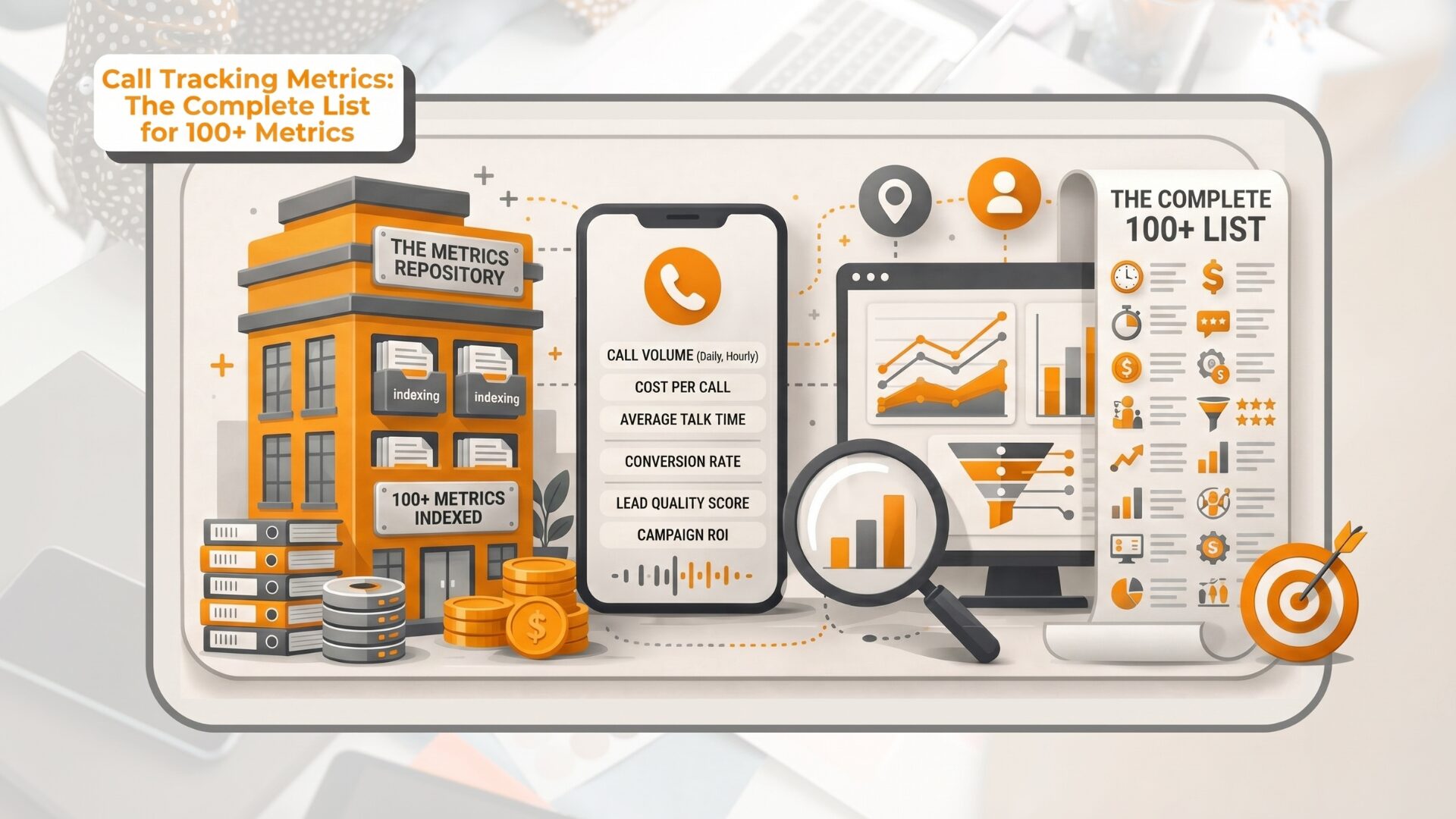
Call tracking metrics are the data points businesses use to measure phone call performance across marketing attribution, lead quality, call handling, and revenue. These call tracking KPIs help teams see which campaigns generate calls, which calls turn into qualified opportunities, and where response gaps hurt results.
Calls can look busy on the surface while missed opportunities, weak follow-up, and incomplete attribution quietly reduce performance. The right call tracking metrics for marketing make it easier to measure demand, identify qualified phone leads, improve response handling, and connect calls to revenue outcomes.
To make this easier to use, the full list below is grouped into the main areas that shape phone lead performance: call demand, attribution, lead quality, call response, conversation data, revenue, and reporting accuracy.
Complete List of Call Tracking Metrics by Category
A. Call Demand
- Total Calls
- Unique Callers
- First-Time Callers
- Repeat Callers
- Answered Calls
- Missed Calls
- Connected Calls
- Voicemail Calls
- After-Hours Calls
- Calls by Day
- Calls by Hour
- Calls by Weekday
- Calls by Date Range
- Peak Call Periods
B. Attribution and Marketing Performance
- Call Source
- Traffic Channel
- Campaign Attribution
- Keyword Attribution
- Landing Page Attribution
- Call Type
- Geographic Call Attribution
- Call Medium
- Ad Group Attribution
- Ad Attribution
- Creative Attribution
- Referring URL
- Referral Source
- Channel Distribution of Calls
- Calls by Campaign
- Calls by Keyword
- Calls by Landing Page
- Calls by Traffic Channel
- Area Code Attribution
- Customer Journey Touchpoints
- First Touch Attribution
- Assist Touch Attribution
- Lead Creation Touch Attribution
- Last Touch Attribution
- Closed-Won Touch Attribution
C. Lead Quality and Validation
- Qualified Calls
- Qualified Call Rate
- Spam Call Rate
- Wrong Number Rate
- Duplicate Lead Rate
- Sales Inquiry Rate
- Appointment Booking Rate
- Quote Rate
- Lead Score
- Intent Detection Rate
- Conversion Outcome by Call
- Quote Value
- Sales Value
D. Call Response and Handling
- Answer Rate
- Missed Call Rate
- Callback Rate
- Callback Response Time
- After-Hours Response Rate
- Routing Success Rate
- Transfer Rate
- Abandonment Rate
- Average Speed of Answer
- Average Waiting Time
- Service Level
- Overflow Routing Rate
- Average Transfers per Call
- Queue Response Time
- Routing Accuracy
E. Conversation Intelligence
- Call Duration
- Average Call Duration
- Talk Time
- Hold Time
- Average Handle Time
- After-Call Work Time
- Call Recording Rate
- Call Recording Capture Rate
- Transcription Coverage Rate
- Sentiment Score
- Script Adherence Rate
- Silence Rate
- Dead Air Rate
- Key Phrase Mention Rate
- Call Outcome Classification Accuracy
F. Revenue and ROI
- Call Conversion Rate
- Call-to-Lead Rate
- Call-to-Appointment Rate
- Call-to-Opportunity Rate
- Call-to-Sale Rate
- Lead Close Rate from Calls
- Revenue per Call
- Revenue per Qualified Call
- Average Order Value from Calls
- Pipeline Value from Calls
- Booked Revenue from Calls
- Customer Lifetime Value from Call Leads
- Repeat Purchase Rate from Call Leads
- Cost per Call
- Cost per Qualified Call
- Cost per Lead from Calls
- Cost per Appointment
- Cost per Sale
- Return on Ad Spend from Calls
- Marketing ROI from Calls
- Revenue by Channel from Calls
- Revenue by Campaign from Calls
- Revenue by Keyword from Calls
- Revenue by Landing Page from Calls
- Revenue per First-Time Caller
- Missed Call Revenue Loss
- Media Efficiency Adjusted by Answer Rate
G. Data and Reporting Integrity
- CRM Match Rate
- Attribution Completeness Rate
- Offline Conversion Import Success Rate
- Tracking Coverage Rate
- Dynamic Number Insertion Success Rate
- Number Pool Utilization
- Duplicate Record Rate
- Spam Detection Accuracy
- Privacy Compliance Rate
- Report Delivery Accuracy
- Client Account Health Score
- White-Label Report Delivery Rate
- Multi-Account Reporting Accuracy
- Campaign-Level Reporting Coverage
- Account-Level Attribution Completeness
- User Access Adoption Rate
- Client Dashboard Usage Rate
A. Call Demand Metrics
1. Total Calls
Total Calls measures the full number of inbound or tracked calls received within a selected period.
Why it matters
It gives the basic demand volume and helps businesses understand whether marketing, seasonality, or operations are increasing or reducing call activity.
How to calculate or measure
Count all tracked calls during the reporting period.
2. Unique Callers
Unique Callers measures how many individual phone numbers were called during a selected period.
Why it matters
It shows reach more clearly than total calls because one person can call multiple times.
How to calculate or measure
Count distinct caller phone numbers.
3. First-Time Callers
First-Time Callers measures how many callers contacted the business for the first time.
Why it matters
It helps measure new demand generation and shows whether campaigns are bringing in fresh prospects.
How to calculate or measure
Count callers whose phone numbers have not appeared before in the system.
4. Repeat Callers
Repeat Callers measures how many callers contacted the business again after a previous call.
Why it matters
It helps identify follow-up behavior, buying intent, service issues, and ongoing customer engagement.
How to calculate or measure
Count callers with prior recorded call history.
5. Answered Calls
Answered Calls measures how many inbound calls were picked up by an agent, rep, or destination line.
Why it matters
It shows how much demand actually reached a human or valid response point.
How to calculate or measure
Count calls marked as answered by the call system.
6. Missed Calls
Missed Calls measures how many inbound calls were not answered.
Why it matters
It points to lost lead risk, wasted ad spend, and service gaps.
How to calculate or measure
Count calls marked as missed or unanswered.
7. Connected Calls
Connected Calls measures calls that successfully connected to the intended destination or conversation point.
Why it matters
It shows whether calls actually reached a usable outcome instead of failing, dropping, or stopping early.
How to calculate or measure
Count calls with successful connection status.
8. Voicemail Calls
Voicemail Calls measures how many calls ended in voicemail.
Why it matters
It helps show how much demand is being diverted away from live response and whether callback workflows are needed.
How to calculate or measure
Count calls routed to voicemail.
9. After-Hours Calls
After-Hours Calls measures calls received outside defined business hours.
Why it matters
It helps businesses plan staffing, automation, AI receptionist usage, and follow-up workflows.
How to calculate or measure
Count calls received outside the configured open hours.
10. Calls by Day
Calls by Day breaks call volume down by calendar day.
Why it matters
It helps identify daily demand patterns and marketing effects.
How to calculate or measure
Group total calls by day.
11. Calls by Hour
Calls by hour break down the call volume by hour of the day.
Why it matters
It helps businesses schedule staff and monitor peak response windows.
How to calculate or measure
Group total calls by hour.
12. Calls by Weekday
Calls by Weekday shows call volume by day of the week.
Why it matters
It helps reveal which weekdays bring the most demand.
How to calculate or measure
Group calls are from Monday through Sunday.
13. Calls by Date Range
Calls by Date Range shows call volume across a selected reporting period.
Why it matters
It supports period comparison, campaign measurement, and trend analysis.
How to calculate or measure
Count calls within the chosen start and end dates.
14. Peak Call Periods
Peak Call Periods identifies the times when call volume is highest.
Why it matters
It helps with staffing, routing setup, queue management, and budget timing.
How to calculate or measure
Identify the highest-volume time blocks by hour, day, or campaign window.
Example
If a business gets its highest call volume between 11 AM and 2 PM on weekdays, that block is the peak call period.
B. Attribution and Marketing Performance Metrics
15. Call Source
Call Source identifies where a call originated, such as a website, Google Business Profile, a paid ad, or an offline asset.
Why it matters
It helps businesses know which sources actually generate call activity.
How to calculate or measure
Track calls by assigned source parameter or number source mapping.
16. Traffic Channel
Traffic Channel classifies calls by marketing channel, such as organic search, paid search, direct, social, referral, or email.
Why it matters
It helps compare channels based on call generation and lead quality.
How to calculate or measure
Assign calls to the channel recorded in attribution data.
17. Campaign Attribution
Campaign Attribution links a call to a specific marketing campaign.
Why it matters
It shows which campaigns are driving response and whether campaign spend is justified.
How to calculate or measure
Match calls to campaign parameters, tracking numbers, or ad platform data.
18. Keyword Attribution
Keyword Attribution identifies the keyword that led to the call.
Why it matters
It helps businesses see which search terms drive real conversations, not just clicks.
How to calculate or measure
Map calls to keyword-level paid search or dynamic number insertion data.
Example
If a Google Ads keyword generated 20 calls in a month, those calls are attributed to that keyword.
19. Landing Page Attribution
Landing Page Attribution identifies the page a caller visited before calling.
Why it matters
It helps show which pages create enough intent to trigger a phone call.
How to calculate or measure
Map the call to the last or relevant landing page session before the call.
20. Call Type
Call Type classifies calls by category, such as sales, support, service, booking, or spam.
Why it matters
It helps businesses separate valuable inquiries from low-value or non-sales calls.
How to calculate or measure
Use manual tagging, AI classification, or IVR selections.
21. Geographic Call Attribution
Geographic Call Attribution identifies the caller’s location or the geographic market tied to the call.
Why it matters
It helps businesses compare performance by region and route calls more effectively.
How to calculate or measure
Track calls using caller geography, campaign geo-targeting, or destination mapping.
22. Call Medium
Call Medium identifies the medium associated with the call path, such as cpc, organic, email, or referral.
Why it matters
It adds a more detailed layer to attribution and supports campaign reporting consistency.
How to calculate or measure
Read the medium field from tracked attribution data.
23. Ad Group Attribution
Ad Group Attribution links a call to a specific ad group.
Why it matters
It helps improve paid search structure and shows which ad group themes lead to real calls.
How to calculate or measure
Map calls to ad group metadata from the ad platform or tracking setup.
24. Ad Attribution
Ad Attribution links a call to the exact ad that drove it.
Why it matters
It helps identify which message, offer, or ad unit is producing response.
How to calculate or measure
Map call data to ad IDs or platform tracking parameters.
25. Creative Attribution
Creative Attribution identifies the specific creative asset tied to the call, such as a video, an image, a headline set, or a copy angle.
Why it matters
It helps marketers compare creative performance based on actual lead activity.
How to calculate or measure
Connect calls to creative IDs or naming conventions in campaign tracking.
26. Referring URL
Referring URL shows the URL that referred the visitor before the call session.
Why it matters
It helps identify traffic paths and external sources influencing calls.
How to calculate or measure
Capture the referring URL tied to the web session.
27. Referral Source
Referral Source identifies the outside source that sent traffic leading to a call.
Why it matters
It helps evaluate partner traffic, listings, and external sites.
How to calculate or measure
Track the referring domain or source tag.
28. Channel Distribution of Calls
Channel Distribution of Calls shows the share of calls coming from each marketing channel.
Why it matters
It gives a channel mix view and helps with budget allocation.
How to calculate or measure
Calls from a channel ÷ Total calls × 100.
Example
If paid search produced 40 out of 100 calls, its call share is 40%.
29. Calls by Campaign
Calls by Campaign shows call volume generated by each campaign.
Why it matters
It helps marketers compare campaigns based on direct response.
How to calculate or measure
Group total calls by campaign name or ID.
30. Calls by Keyword
Calls by Keyword shows the call volume generated by each keyword.
Why it matters
It helps optimize search spend around call-generating terms.
How to calculate or measure
Group calls by keyword attribution.
31. Calls by Landing Page
Calls by Landing Page shows which pages drove calls.
Why it matters
It helps identify pages that create strong call intent.
How to calculate or measure
Group calls by landing page attribution.
32. Calls by Traffic Channel
Calls by Traffic Channel shows the number of calls each channel generated.
Why it matters
It helps compare channel contribution to demand.
How to calculate or measure
Group calls by channel.
33. Area Code Attribution
Area Code Attribution identifies calls by a caller’s area code or a tracked number’s area code.
Why it matters
It helps with market analysis, local routing, and regional campaign review.
How to calculate or measure
Group calls by the area code field.
34. Customer Journey Touchpoints
Customer Journey Touchpoints tracks the number and sequence of interactions before a lead, an opportunity, or a sale.
Why it matters
It shows that calls often happen as part of a wider path, not as a single isolated event.
How to calculate or measure
Track all recorded touches associated with the lead journey.
35. First Touch Attribution
First Touch Attribution assigns the call or lead credit to the first recorded interaction.
Why it matters
It helps measure what originally created awareness.
How to calculate or measure
Assign credit to the earliest tracked touchpoint.
36. Assist Touch Attribution
Assist Touch Attribution credits interactions that influenced the lead before the final conversion step.
Why it matters
It helps businesses see the real contribution of channels that support but do not close the conversion.
How to calculate or measure
Track and count non-final touches in the conversion path.
37. Lead Creation Touch Attribution
Lead Creation Touch Attribution identifies the interaction that directly created the lead record.
Why it matters
It helps show what actually turned interest into a lead.
How to calculate or measure
Assign credit to the touchpoint tied to lead creation.
38. Last Touch Attribution
Last Touch Attribution assigns credit to the final tracked interaction before the call or conversion event.
Why it matters
It helps show which channel or action pushed the prospect to act.
How to calculate or measure
Assign credit to the last touchpoint before the call or conversion.
39. Closed-Won Touch Attribution
Closed-Won Touch Attribution identifies the touchpoint tied to deals that became customers.
Why it matters
It connects marketing and sales activity to actual revenue outcomes.
How to calculate or measure
Assign credit to touches associated with closed-won records.
C. Lead Quality and Validation Metrics
40. Qualified Calls
Qualified Calls measures calls that meet the business’s criteria for being a valid sales or lead opportunity.
Why it matters
It separates useful business calls from low-value noise.
How to calculate or measure
Count calls marked qualified through AI, agent tagging, or business rules.
41. Qualified Call Rate
Qualified Call Rate measures the percentage of calls that are qualified.
Why it matters
It shows the quality of incoming demand, not just volume.
How to calculate or measure
Qualified calls ÷ Total calls × 100.
Example
If 30 out of 100 calls are qualified, the qualified call rate is 30%.
42. Spam Call Rate
Spam Call Rate measures the percentage of calls identified as spam or robocalls.
Why it matters
It helps protect staff time and gives a cleaner view of real lead performance.
How to calculate or measure
Spam calls ÷ Total calls × 100.
43. Wrong Number Rate
Wrong Number Rate measures the percentage of calls that reached the business by mistake.
Why it matters
It highlights wasted call volume and data distortion.
How to calculate or measure
Wrong number calls ÷ Total calls × 100.
44. Duplicate Lead Rate
Duplicate Lead Rate measures how often incoming calls create repeated lead records for the same person.
Why it matters
It affects CRM cleanliness, sales workflow, and reporting quality.
How to calculate or measure
Duplicate leads ÷ Total created leads × 100.
45. Sales Inquiry Rate
Sales Inquiry Rate measures the share of calls that are genuine sales-related inquiries.
Why it matters
It helps businesses separate buying intent from support or low-value calls.
How to calculate or measure
Sales inquiry calls ÷ Total calls × 100.
46. Appointment Booking Rate
Appointment Booking Rate measures the share of calls that result in a booked appointment.
Why it matters
It shows how well calls are turning into a meaningful next step.
How to calculate or measure
Calls that booked appointments ÷ Total calls × 100.
Example
If 12 out of 60 calls lead to appointments, the appointment booking rate is 20%.
47. Quote Rate
Quote Rate measures the percentage of calls that result in a quote or estimate.
Why it matters
It helps measure mid-funnel sales progress.
How to calculate or measure
Quote-producing calls ÷ Total calls × 100.
48. Lead Score
Lead Score measures the assigned value or quality score for a caller or lead.
Why it matters
It helps prioritize follow-up and sales focus.
How to calculate or measure
Apply a scoring model based on fit, intent, need, budget, or outcome signals.
49. Intent Detection Rate
Intent Detection Rate measures how often the system correctly identifies caller intent categories.
Why it matters
It improves automation, reporting, and lead routing.
How to calculate or measure
Calls with detected intent ÷ Eligible calls × 100.
50. Conversion Outcome by Call
Conversion Outcome by Call identifies the specific business result tied to each call, such as a qualified lead, an appointment, a quote, a sale, or no conversion.
Why it matters
It gives a direct outcome view instead of leaving every call as raw activity.
How to calculate or measure
Classify each call by its resulting business outcome.
51. Quote Value
Quote Value measures the monetary value attached to quotes generated from calls.
Why it matters
It helps estimate future revenue and compare call quality across sources.
How to calculate or measure
Sum the value of all quotes linked to calls.
Example
If three call-generated quotes are worth $500, $700, and $800, the total quote value is $2,000.
52. Sales Value
Sales Value measures the total closed revenue that came from call-generated leads.
Why it matters
It helps prove which calls produced real financial outcomes.
How to calculate or measure
Sum all sales amounts tied to call leads.
D. Call Response and Handling Metrics
53. Answer Rate
Answer Rate measures the percentage of calls that were answered.
Why it matters
It shows whether demand is being captured or wasted.
How to calculate or measure
Answered calls ÷ Total calls × 100.
Example
If 90 out of 120 calls are answered, the answer rate is 75%.
54. Missed Call Rate
Missed Call Rate measures the percentage of calls that were not answered.
Why it matters
It helps quantify lost response opportunities.
How to calculate or measure
Missed calls ÷ Total calls × 100.
55. Callback Rate
Callback Rate measures the percentage of missed or voicemail calls that received a callback.
Why it matters
It shows whether the team recovers missed demand.
How to calculate or measure
Calls that received a callback ÷ Eligible missed or voicemail calls × 100.
56. Callback Response Time
Callback Response Time measures how long it takes to return a missed call or voicemail.
Why it matters
Faster callbacks usually improve contact and booking chances.
How to calculate or measure
Average time between a missed call and the first callback attempt.
Example
If three callbacks happen in 5, 10, and 15 minutes, the average callback response time is 10 minutes.
57. After-Hours Response Rate
After-Hours Response Rate measures the percentage of after-hours calls that received a valid follow-up or automation response.
Why it matters
It helps businesses see whether off-hour demand is being handled properly.
How to calculate or measure
Responded after-hours calls ÷ Total after-hours calls × 100.
58. Routing Success Rate
Routing Success Rate measures how often calls reach the correct intended destination.
Why it matters
It affects caller experience, lead capture, and operational efficiency.
How to calculate or measure
Successfully routed calls ÷ Total routed calls × 100.
59. Transfer Rate
Transfer Rate measures the percentage of calls that were transferred.
Why it matters
It helps assess routing design and front-line call resolution.
How to calculate or measure
Transferred calls ÷ Total calls × 100.
60. Abandonment Rate
Abandonment Rate measures the percentage of callers who hang up before being answered or connected.
Why it matters
It shows queue friction and lost opportunities.
How to calculate or measure
Abandoned calls ÷ Total inbound calls × 100.
61. Average Speed of Answer
Average Speed of Answer measures how long callers wait before a call is answered.
Why it matters
It is a core service and conversion indicator.
How to calculate or measure
Total wait time before answer ÷ Answered calls.
62. Average Waiting Time
Average Waiting Time measures the average time callers spend waiting in a queue or before connection.
Why it matters
It affects caller satisfaction and abandonment.
How to calculate or measure
Total waiting time ÷ Calls that entered a waiting state.
63. Service Level
Service Level measures the percentage of calls answered within a defined target time.
Why it matters
It helps teams track response performance against internal standards.
How to calculate or measure
Calls answered within target time ÷ Total eligible calls × 100.
Example
If 80 out of 100 calls are answered within 30 seconds, service level is 80%.
64. Overflow Routing Rate
Overflow Routing Rate measures how often calls are sent to overflow destinations because the primary path was unavailable or full.
Why it matters
It helps identify staffing pressure and routing dependency.
How to calculate or measure
Overflow-routed calls ÷ Total calls × 100.
65. Average Transfers per Call
Average Transfers per Call measures the average number of transfers that occur during calls.
Why it matters
It helps reveal whether callers are being moved too often.
How to calculate or measure
Total transfers ÷ Total calls.
66. Queue Response Time
Queue Response Time measures how long callers spend in a queue before answer, abandonment, or redirect.
Why it matters
It helps diagnose queue performance more precisely.
How to calculate or measure
Average time spent in a queue across queued calls.
67. Routing Accuracy
Routing Accuracy measures how often calls are routed to the right team, location, or person on the first attempt.
Why it matters
It improves the caller experience and reduces internal friction.
How to calculate or measure
Correctly routed calls ÷ Total routed calls × 100.
E. Conversation Intelligence Metrics
68. Call Duration
Call Duration measures the total length of an individual call.
Why it matters
It helps with call review, staffing, and lead analysis.
How to calculate or measure
Track the time from call start to call end.
69. Average Call Duration
Average Call Duration measures the average length of calls across a selected period.
Why it matters
It helps compare engagement across campaigns, teams, or call types.
How to calculate or measure
Total call duration ÷ Total calls.
Example
If five calls total 50 minutes, the average call duration is 10 minutes.
70. Talk Time
Talk Time measures the amount of time people are actively speaking during the call.
Why it matters
It gives a more useful engagement signal than raw call length alone.
How to calculate or measure
Track speaker-active time during the call.
71. Hold Time
Hold Time measures how long callers spend on hold.
Why it matters
It affects experience and can reduce conversion chances.
How to calculate or measure
Track total hold duration per call or across calls.
72. Average Handle Time
Average Handle Time measures the full time required to handle a call, including talk, hold, and related processing.
Why it matters
It helps assess operational efficiency.
How to calculate or measure
(Talk time + Hold time + Related handling time) ÷ Total handled calls.
73. After-Call Work Time
After-Call Work Time measures the time spent on call-related tasks after the call ends.
Why it matters
It affects rep productivity and true handling cost.
How to calculate or measure
Average time spent on notes, dispositioning, CRM entry, or follow-up tasks after each call.
74. Call Recording Rate
Call Recording Rate measures the percentage of calls that were recorded.
Why it matters
It supports quality review, training, compliance, and conversation analysis.
How to calculate or measure
Recorded calls ÷ Eligible calls × 100.
75. Call Recording Capture Rate
Call Recording Capture Rate measures how many calls were successfully recorded out of all calls expected to be recorded.
Why it matters
It ensures data is available for review, QA, and AI-based analysis.
How to calculate or measure
Recorded calls ÷ Total eligible calls × 100.
Example
If 85 out of 100 eligible calls are recorded, the capture rate is 85%.
76. Transcription Coverage Rate
Transcription Coverage Rate measures how many eligible recorded calls were transcribed.
Why it matters
It affects reporting depth, AI analysis, and searchable conversation data.
How to calculate or measure
Transcribed calls ÷ Eligible recorded calls × 100.
77. Sentiment Score
Sentiment Score measures the emotional tone of a call, such as positive, neutral, or negative.
Why it matters
It helps identify caller satisfaction, friction, or sales readiness.
How to calculate or measure
Use AI or scoring models to assign sentiment values to calls.
78. Script Adherence Rate
Script Adherence Rate measures how consistently reps follow required talking points or call scripts.
Why it matters
It supports quality control, training, and compliance.
How to calculate or measure
Calls meeting script requirements ÷ Reviewed calls × 100.
79. Silence Rate
Silence Rate measures the share of a call with no active speech.
Why it matters
It helps identify awkward pauses, weak engagement, or process delay.
How to calculate or measure
Silent time ÷ Total call duration × 100.
80. Dead Air Rate
Dead Air Rate measures periods of inactive audio that create poor call flow.
Why it matters
It can signal poor agent performance, transfer issues, or caller frustration.
How to calculate or measure
Dead air time ÷ Total call duration × 100.
81. Key Phrase Mention Rate
Key Phrase Mention Rate measures how often specific words or phrases appear in calls.
Why it matters
It helps track intent, objections, product interest, and compliance terms.
How to calculate or measure
Calls containing the phrase ÷ Reviewed or transcribed calls × 100.
Example
If 25 out of 100 transcribed calls mention “price,” the key phrase mention rate for that phrase is 25%.
82. Call Outcome Classification Accuracy
Call Outcome Classification Accuracy measures how correctly calls are labeled by AI or automation into outcome categories.
Why it matters
It affects trust in reporting and workflow automation.
How to calculate or measure
Correctly classified calls ÷ Reviewed classified calls × 100.
F. Revenue and ROI Metrics
83. Call Conversion Rate
Call Conversion Rate measures the percentage of calls that result in a defined conversion.
Why it matters
It shows whether calls are producing business outcomes, not just activity.
How to calculate or measure
Converted calls ÷ Total calls × 100.
84. Call-to-Lead Rate
Call-to-Lead Rate measures the percentage of calls that turn into leads.
Why it matters
It helps evaluate lead generation efficiency.
How to calculate or measure
Lead-generating calls ÷ Total calls × 100.
85. Call-to-Appointment Rate
Call-to-Appointment Rate measures the percentage of calls that become appointments.
Why it matters
It shows how well conversations move prospects to the next stage.
How to calculate or measure
Calls that book appointments ÷ Total calls × 100.
86. Call-to-Opportunity Rate
Call-to-Opportunity Rate measures the share of calls that become qualified pipeline opportunities.
Why it matters
It links call activity to sales pipeline creation.
How to calculate or measure
Opportunity-generating calls ÷ Total calls × 100.
87. Call-to-Sale Rate
Call-to-Sale Rate measures the percentage of calls that lead to closed sales.
Why it matters
It is one of the clearest indicators of revenue performance from calls.
How to calculate or measure
Calls resulting in sales ÷ Total calls × 100.
Example
If 8 out of 100 calls become sales, the call-to-sale rate is 8%.
88. Lead Close Rate from Calls
Lead Close Rate from Calls measures the percentage of call-generated leads that become customers.
Why it matters
It shows downstream sales quality, not just front-end lead volume.
How to calculate or measure
Closed sales from call leads ÷ Total call-generated leads × 100.
89. Revenue per Call
Revenue per Call measures the average revenue generated from each call.
Why it matters
It helps compare channels and campaigns using financial output.
How to calculate or measure
Total revenue from calls ÷ Total calls.
Example
If calls generated $10,000 from 200 calls, revenue per call is $50.
90. Revenue per Qualified Call
Revenue per Qualified Call measures average revenue generated from qualified calls.
Why it matters
It helps value high-intent conversations more accurately.
How to calculate or measure
Total revenue from qualified calls ÷ Total qualified calls.
91. Average Order Value from Calls
Average Order Value from Calls measures the average sale amount from call-generated transactions.
Why it matters
It helps compare call-led sales quality across channels.
How to calculate or measure
Total revenue from call sales ÷ Number of call sales.
92. Pipeline Value from Calls
Pipeline Value from Calls measures the total open opportunity value created from calls.
Why it matters
It helps forecast future revenue and campaign potential.
How to calculate or measure
Sum opportunity values tied to call-generated leads.
93. Booked Revenue from Calls
Booked Revenue from Calls measures revenue formally won and recorded from call-generated business.
Why it matters
It shows realized financial return from calls.
How to calculate or measure
Sum closed-won revenue tied to calls.
94. Customer Lifetime Value from Call Leads
Customer Lifetime Value from Call Leads measures the long-term revenue expected from customers first acquired through calls.
Why it matters
It helps businesses understand whether call-driven acquisition creates durable value.
How to calculate or measure
Average lifetime revenue per customer acquired from calls.
95. Repeat Purchase Rate from Call Leads
Repeat Purchase Rate from Call Leads measures how often call-generated customers buy again.
Why it matters
It shows retention quality of call-acquired customers.
How to calculate or measure
Repeat-purchase customers from call leads ÷ Total customers from call leads × 100.
96. Cost per Call
Cost per Call measures how much marketing spend is required to generate one call.
Why it matters
It helps compare efficiency across campaigns and channels.
How to calculate or measure
Total marketing spend ÷ Total calls.
97. Cost per Qualified Call
Cost per Qualified Call measures how much is spent to generate one qualified call.
Why it matters
It is more useful than cost per call when many calls are low-value.
How to calculate or measure
Total marketing spend ÷ Qualified calls.
98. Cost per Lead from Calls
Cost per Lead from Calls measures how much it costs to generate a lead from call activity.
Why it matters
It links ad spend to lead creation rather than raw call volume.
How to calculate or measure
Total marketing spend ÷ Call-generated leads.
99. Cost per Appointment
Cost per Appointment measures how much is required to generate one booked appointment from calls.
Why it matters
It helps evaluate campaign efficiency in appointment-based businesses.
How to calculate or measure
Total marketing spend ÷ Appointments from calls.
100. Cost per Sale
Cost per Sale measures how much is spent to generate one closed sale from calls.
Why it matters
It is a direct acquisition efficiency metric.
How to calculate or measure
Total marketing spend ÷ Sales from calls.
101. Return on Ad Spend from Calls
Return on Ad Spend from Calls measures revenue generated from calls relative to ad spend.
Why it matters
It helps show whether paid media is profitable when calls are part of the conversion path.
How to calculate or measure
Revenue from call-driven ads ÷ Ad spend.
Example
If $5,000 in ad spend produces $20,000 in revenue from call-led sales, ROAS is 4.0.
102. Marketing ROI from Calls
Marketing ROI from Calls measures profit or return generated from marketing spend tied to calls.
Why it matters
It shows whether marketing is creating net business value.
How to calculate or measure
(Revenue from calls – Marketing cost) ÷ Marketing cost × 100.
103. Revenue by Channel from Calls
Revenue by Channel from Calls measures revenue generated from call leads by channel.
Why it matters
It helps allocate budget to channels producing the best financial return.
How to calculate or measure
Group call-generated revenue by channel.
104. Revenue by Campaign from Calls
Revenue by Campaign from Calls measures revenue generated from each campaign.
Why it matters
It helps compare campaign profitability.
How to calculate or measure
Group call-generated revenue by campaign.
105. Revenue by Keyword from Calls
Revenue by Keyword from Calls measures revenue generated from call leads tied to each keyword.
Why it matters
It helps marketers identify the search terms that produce revenue, not just clicks.
How to calculate or measure
Group revenue by keyword attribution.
106. Revenue by Landing Page from Calls
Revenue by Landing Page from Calls measures revenue generated from callers who came through specific landing pages.
Why it matters
It helps identify pages that do not just drive calls but also drive valuable outcomes.
How to calculate or measure
Group call-generated revenue by landing page.
107. Revenue per First-Time Caller
Revenue per First-Time Caller measures the average revenue generated from new callers.
Why it matters
It helps evaluate new demand value more clearly.
How to calculate or measure
Revenue from first-time callers ÷ Number of first-time callers.
108. Missed Call Revenue Loss
Missed Call Revenue Loss estimates the revenue lost because calls were missed.
Why it matters
It helps businesses quantify the cost of poor responsiveness.
How to calculate or measure
Missed calls × Estimated conversion rate × Average revenue per conversion.
Example
If 20 missed calls usually convert at 10% and each sale is worth $500, the estimated missed revenue loss is $1,000.
109. Media Efficiency Adjusted by Answer Rate
Media Efficiency Adjusted by Answer Rate measures media performance after accounting for whether calls were actually answered.
Why it matters
It gives a more realistic view of campaign efficiency because a call that no one answers has less business value.
How to calculate or measure
Use channel or campaign efficiency metrics weighted by answer rate.
G. Data and Reporting Integrity Metrics
110. CRM Match Rate
CRM Match Rate measures the percentage of calls or call leads successfully matched to CRM records.
Why it matters
It shows whether marketing and sales data are connected properly.
How to calculate or measure
Matched call records ÷ Total eligible call records × 100.
111. Attribution Completeness Rate
Attribution Completeness Rate measures how many calls have complete attribution data attached.
Why it matters
It affects how reliably businesses can report on source, campaign, keyword, and page performance.
How to calculate or measure
Calls with complete attribution fields ÷ Total eligible calls × 100.
112. Offline Conversion Import Success Rate
Offline Conversion Import Success Rate measures how often offline call outcomes are successfully sent back to ad platforms.
Why it matters
It supports better ad optimization based on real lead and sales outcomes.
How to calculate or measure
Successful imports ÷ Total intended imports × 100.
113. Tracking Coverage Rate
Tracking Coverage Rate measures the percentage of campaigns, pages, or numbers where call tracking is properly active.
Why it matters
It helps identify blind spots in measurement.
How to calculate or measure
Tracked assets ÷ Total eligible assets × 100.
114. Dynamic Number Insertion Success Rate
Dynamic Number Insertion Success Rate measures how often website visitors are shown the correct tracked number.
Why it matters
It affects attribution accuracy for web-driven calls.
How to calculate or measure
Successful number swaps ÷ Eligible website sessions × 100.
115. Number Pool Utilization
Number Pool Utilization measures how heavily the available tracking number pool is being used.
Why it matters
It helps prevent attribution issues caused by insufficient number availability.
How to calculate or measure
Active numbers in use ÷ Total numbers in the pool × 100.
116. Duplicate Record Rate
Duplicate Record Rate measures how often duplicate records appear in the reporting or CRM system.
Why it matters
It affects data trust and can distort lead and revenue counts.
How to calculate or measure
Duplicate records ÷ Total records × 100.
117. Spam Detection Accuracy
Spam Detection Accuracy measures how accurately the system identifies spam calls.
Why it matters
It keeps reporting clean and protects teams from bad data.
How to calculate or measure
Correctly identified spam and non-spam calls ÷ Reviewed calls × 100.
118. Privacy Compliance Rate
Privacy Compliance Rate measures how consistently call tracking and storage workflows meet privacy requirements.
Why it matters
It reduces regulatory and client risk.
How to calculate or measure
Compliant records or workflows ÷ Total reviewed records or workflows × 100.
119. Report Delivery Accuracy
Report Delivery Accuracy measures whether reports are produced correctly and contain accurate data.
Why it matters
It supports trust in client and internal reporting.
How to calculate or measure
Accurate reports delivered ÷ Total reports delivered × 100.
120. Client Account Health Score
Client Account Health Score measures the overall health of a client setup based on tracking, attribution, usage, integrations, and reporting status.
Why it matters
It helps agencies and account teams catch problems before they affect outcomes.
How to calculate or measure
Use a weighted score across defined health indicators.
121. White-Label Report Delivery Rate
White-Label Report Delivery Rate measures how consistently white-label reports are delivered as expected.
Why it matters
It matters for agency operations, client experience, and reporting discipline.
How to calculate or measure
White-label reports delivered on target ÷ Total scheduled white-label reports × 100.
122. Multi-Account Reporting Accuracy
Multi-Account Reporting Accuracy measures whether reporting stays correct across multiple accounts, clients, or locations.
Why it matters
It is important for agencies, franchise groups, and multi-location businesses.
How to calculate or measure
Accurate multi-account reports ÷ Total reviewed multi-account reports × 100.
123. Campaign-Level Reporting Coverage
Campaign-Level Reporting Coverage measures how much of campaign activity is properly captured in call tracking reports.
Why it matters
It helps marketers know whether campaign decisions are based on complete data.
How to calculate or measure
Campaigns with usable call reporting ÷ Total active campaigns × 100.
124. Account-Level Attribution Completeness
Account-Level Attribution Completeness measures how complete attribution data is across the entire account.
Why it matters
It gives a top-level view of whether the account can be trusted for decision-making.
How to calculate or measure
Accounts or records with complete attribution ÷ Total eligible accounts or records × 100.
125. User Access Adoption Rate
User Access Adoption Rate measures how many intended users actively access the platform or reporting environment.
Why it matters
It helps show whether teams are actually using the system that has been set up.
How to calculate or measure
Active users ÷ Intended users × 100.
126. Client Dashboard Usage Rate
Client Dashboard Usage Rate measures how often clients actively use their dashboard.
Why it matters
It shows engagement, perceived value, and reporting stickiness.
How to calculate or measure
Active dashboard users or active dashboard sessions ÷ Total eligible client users × 100.
Final Thoughts
A strong call tracking strategy should do more than report call volume. The real value comes from measuring which marketing tactics generate calls, which phone leads are qualified, how calls are handled, and which conversations lead to revenue.
When these call tracking metrics are viewed together, businesses get a clearer picture of marketing performance, lead quality, response gaps, and sales outcomes. That is what turns call tracking from basic reporting into a system for better decisions and stronger revenue performance.
Businesses that want to measure call attribution, lead quality, AI-powered conversation outcomes, and revenue impact in one place can use AvidTrak to connect calls back to the marketing tactics, campaigns, keywords, and landing pages that drive them. Start with AvidTrak to track the metrics that matter and turn more phone leads into real business results.


