


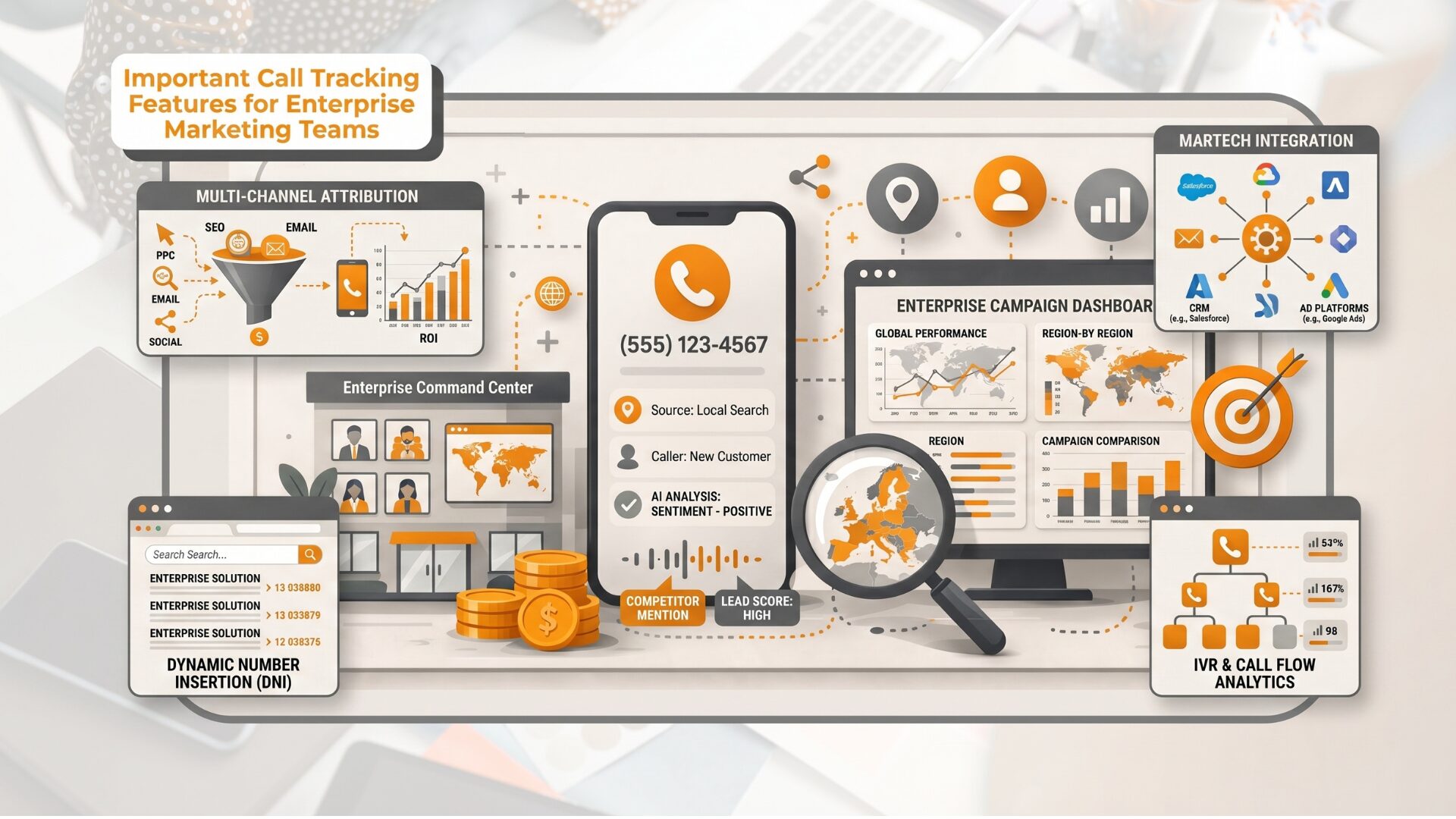
Enterprise marketing teams need more than basic call logs. They need a call tracking platform that shows which campaigns generated calls, how those calls were handled, which ones became qualified opportunities, and how call data connects to the pipeline or revenue.
That is why feature selection matters. The right platform helps enterprise teams improve attribution, reduce response gaps, support multi-location operations, and connect marketing activity to business outcomes. Platforms built for this level of complexity now commonly include dynamic number insertion, AI-powered transcription, conversation outcome extraction, routing controls, CRM integrations, and revenue-focused reporting. AvidTrak combines these capabilities in one system built for tracking, routing, and analyzing calls across campaigns and channels.
Why enterprise teams need a different feature checklist
A small business can often work with a simple call source report. An enterprise team usually cannot.
Enterprise teams often manage:
- large paid media budgets
- many campaigns running at once
- multiple locations, regions, or brands
- internal teams plus outside agencies
- CRM workflows and sales pipelines
- privacy and access requirements
- executive reporting tied to pipeline and revenue
In that environment, missing enterprise call tracking features do not stay isolated. Weak attribution affects budget decisions. Weak routing affects lead handling. Weak integrations affect reporting credibility. Weak governance affects privacy and operational control.
What enterprise marketing teams should look for
Below are the features that matter most, why they matter, and how they affect real marketing performance.
Below are the important call tracking features for enterprise marketing teams, why they matter, and how they affect real marketing performance.
1. Dynamic number insertion
Dynamic number insertion is one of the most important enterprise call tracking features because it changes the phone number shown on a website based on the visitor’s source, session, or tracking rules. Without it, web-driven attribution becomes too broad to trust.
A paid search team does not just need to know that Google Ads drove calls. The team needs to know which campaign, ad group, keyword, and landing page produced those calls.
A healthcare organization running campaigns for “urgent care near me” and “pediatric urgent care” should not have those calls blended into one reporting bucket. The platform should separate them clearly so the team can judge intent and budget efficiency with confidence.
What to look for:
- campaign-, channel-, and keyword-level tracking
- session-based attribution
- number pool controls
- reliable number swapping at scale
- stable performance during traffic spikes
2. Campaign, keyword, and ad attribution
Attribution is one of the most important call tracking features for enterprise marketing teams because enterprise media budgets are not managed at the channel level alone. Teams need to know which campaign drove the call, which keyword drove the session, and which ad or creative pushed the prospect to act.
An enterprise home services brand running paid search across HVAC, plumbing, and electrical services in multiple cities cannot act on “paid search drove 1,200 calls.” The team needs to know whether “emergency AC repair” generated qualified calls while another keyword drove low-value inquiries.
What to look for:
- campaign attribution
- keyword attribution
- ad group attribution
- ad-level reporting
- creative-level reporting
- landing-page attribution
- referring URL capture
3. Multi-touch attribution
Call tracking for enterprise marketing teams should not stop at last-touch reporting. Most enterprise buyers interact with multiple channels before calling, so multi-touch attribution helps teams understand which channels created awareness, which supported the journey, and which drove the final action.
A B2B software company may find that paid search created the first visit, remarketing drove return traffic, and branded search closed the call. Without multi-touch visibility, reporting over-credits one channel and undervalues another.
What to look for:
- first-touch reporting
- assist-touch reporting
- last-touch reporting
- lead-creation touch tracking
- closed-won attribution support
4. CRM integration
CRM integration is one of the most important call tracking features for enterprise marketing teams because enterprise reporting cannot stop at call volume. Teams need to know what happened after the call.
If enterprise marketing call tracking stays disconnected from the CRM, marketing may be able to report calls but still struggle to show which calls turned into qualified opportunities or revenue.
What to look for:
- Salesforce integration
- HubSpot integration
- Microsoft Dynamics or other CRM support
- custom field mapping
- lead and contact matching
- revenue and opportunity syncing
- duplicate handling
5. Offline conversion import
Offline conversion import is a critical part of enterprise call tracking features because many enterprise sales cycles do not end on the first call. The call may create the lead, but the sale happens later.
This helps media teams optimize around real business outcomes instead of raw call volume.
What to look for:
- Google Ads offline conversion import
- Microsoft Ads offline conversion import
- support for multiple conversion stages
- import validation and error handling
- match-rate visibility
6. Enterprise-grade call routing
Enterprise marketing call tracking is not just about attribution. It also affects whether a high-intent caller reaches the right destination.
If a strong campaign generates a valuable call and that call is routed poorly, sent to voicemail, or delayed after hours, marketing performance looks worse than it really is.
What to look for:
- location-based routing
- business-hours routing
- after-hours routing
- IVR support
- sequential forwarding
- simultaneous forwarding
- overflow routing
- zip-code or area-code routing
7. Call recording
Call recording remains one of the most useful enterprise call tracking features because enterprise teams need to review what actually happened on important calls, not just how many calls came in.
What to look for:
- reliable recording coverage
- secure storage
- retention settings
- role-based access
- permission controls
- pause and resume controls where needed
8. AI-powered transcription
AI-powered transcription is essential for call tracking for enterprise marketing teams because searchable transcripts make large-scale call review more practical.
What to look for:
- automatic transcription
- searchable transcripts
- speaker separation
- export options
- strong accuracy across accents and industries
9. Conversation classification and outcome detection
Conversation classification is one of the most important call tracking features for enterprise marketing teams because duration alone does not explain business value. Enterprise teams need to know whether the call was a qualified lead, appointment request, quote inquiry, support call, or spam.
What to look for:
- qualified lead detection
- appointment detection
- quote detection
- spam and wrong-number classification
- custom outcomes
- review and correction workflows
10. Lead scoring from calls
Enterprise marketing call tracking should help teams prioritize quality, not just volume. Lead scoring makes it easier to separate high-fit commercial inquiries from low-value calls.
What to look for:
- rule-based scoring
- CRM score sync
- customizable score logic
- reporting by score band
- source and campaign reporting by lead score
11. Spam and low-value call filtering
Spam and low-value call filtering is one of the enterprise call tracking features that protects reporting quality. Without it, call volume can look stronger than it really is.
What to look for:
- spam detection
- robocall filtering
- wrong-number classification
- duplicate caller recognition
- exclusion rules for reporting
12. Multi-location support
For large organizations, call tracking for enterprise marketing teams must support both local visibility and central oversight. Corporate teams need roll-up reporting, while local teams need their own routing logic and local numbers.
What to look for:
- location-level views
- central roll-up reporting
- local number assignment
- location-based routing
- local dashboard access
13. Role-based access and governance
Enterprise call tracking features should also support governance. Marketing managers, agencies, executives, sales teams, and location managers all need different levels of visibility and control.
What to look for:
- user roles and permissions
- account-level controls
- location-level permissions
- audit trails
- admin activity history
14. Custom dashboards and reporting
Custom dashboards matter because enterprise marketing call tracking serves multiple audiences. A paid media manager, marketing director, regional operator, and executive all need different reporting views.
What to look for:
- custom dashboard creation
- report scheduling
- export options
- multi-filter reporting
- white-label support where agencies are involved
15. Revenue reporting from calls
Revenue reporting is one of the most important call tracking features for enterprise marketing teams because this is where the platform moves beyond activity reporting and into business performance.
What to look for:
- revenue by channel
- revenue by campaign
- revenue by keyword
- revenue by landing page
- revenue per call
- revenue per qualified call
- pipeline value from calls
16. API and data flexibility
Enterprise call tracking features should fit into larger reporting environments, not stay locked inside a single dashboard. API access and export flexibility matter when teams use BI tools, warehouses, and custom apps.
What to look for:
- API access
- webhook support
- export flexibility
- custom fields
- compatibility with BI and warehouse tools
17. Privacy, consent, and compliance controls
Call tracking for enterprise marketing teams should include strong privacy and governance controls, especially in regulated industries such as healthcare, legal, education, and financial services.
What to look for:
- recording controls
- retention rules
- user access controls
- deletion workflows
- regional compliance support
- consent-related controls where required
18. Reliability and support
One of the most overlooked enterprise call tracking features is dependable support. Enterprise teams do not just buy software. They buy confidence in implementation, troubleshooting, and long-term use.
What to look for:
- implementation support
- account management
- issue-resolution process
- support for routing and integration work
- platform stability history
19. Agency and cross-team collaboration
Many enterprise programs involve internal teams, outside agencies, analytics teams, and local operators. Enterprise marketing call tracking should support collaboration without creating reporting confusion.
What to look for:
- shared dashboards
- permission-based access
- collaboration-friendly reporting
- export options for agencies
- structured note or tagging workflows where available
20. Scalability
Scalability is one of the most important call tracking features for enterprise marketing teams because enterprise environments rarely stay static. More locations, more campaigns, more users, and more complex attribution models all put pressure on the platform.
What to look for:
- large number-pool support
- high-traffic handling
- multi-brand or multi-region support
- flexible account structure
- long-term setup flexibility
Real-world signs that a feature is actually useful
A feature matters when it helps an enterprise team answer an important business question clearly and quickly.
For example:
A paid search manager asks, which keywords are driving qualified calls, not just call volume?
That requires keyword-level attribution plus conversation outcome tracking.
A marketing director asks, which locations are missing the most high-intent calls?
That requires location-level reporting, answer rate visibility, and routing performance data.
A CMO asks, which campaigns are contributing to pipeline or revenue?
That requires CRM integration, offline conversion import, and revenue reporting tied back to the original marketing source.
A regional operations lead asks, why are calls in one market converting worse than others?
That may require call recordings, AI-powered transcription, conversation classification, and routing review.
That is how enterprise teams should evaluate enterprise call tracking features. The goal is not to collect the longest feature list. The goal is to choose a platform that helps marketing, sales, and operations answer important performance questions with confidence.
Common mistakes enterprise teams make
One common mistake is treating call tracking as a paid media tool only. In reality, enterprise marketing call tracking also affects sales visibility, routing performance, lead quality, and revenue reporting.
Another mistake is focusing on call volume too early. High call volume can hide weak lead quality, poor routing, missed opportunities, or low-value calls.
A third mistake is choosing a platform based on price alone. At the enterprise level, weak support, incomplete integrations, and limited reporting often create higher costs over time.
A fourth mistake is skipping CRM integration and offline conversion planning. That usually leaves the team with activity reporting but weak visibility into qualified leads, pipeline, and revenue outcomes.
Final thoughts
The most important call tracking features for enterprise marketing teams are the ones that help teams answer real business questions clearly. Enterprise call tracking features should not only show that a call happened. They should show what drove the call, how it was handled, whether it was qualified, where it went next, and whether it contributed to revenue.
That is what makes call tracking for enterprise marketing teams useful at scale. AvidTrak helps enterprise teams combine attribution, routing, AI-powered transcription, conversation outcome extraction, integrations, and reporting in one platform, so enterprise marketing call tracking supports better decisions, stronger lead handling, and clearer revenue visibility.
FAQs
What are the most important call tracking features for enterprise marketing teams?
The most important call tracking features for enterprise marketing teams usually include dynamic number insertion, CRM integration, offline conversion import, routing, AI-powered transcription, conversation outcome detection, and revenue reporting.
Why is CRM integration important for call tracking for enterprise marketing teams?
CRM integration helps enterprise marketing teams connect calls to qualified leads, opportunities, and revenue instead of stopping at call counts alone.
Why does enterprise marketing call tracking need routing features?
Because routing affects whether high-intent calls reach the right team quickly. Poor routing can reduce conversion performance even when campaigns are generating strong demand.
Do enterprise call tracking features need AI-powered transcription and outcome detection?
Yes. These features help enterprise teams review call quality, identify qualified leads, detect patterns, and measure business outcomes at scale.
What should teams avoid when choosing enterprise call tracking features?
They should avoid choosing based only on call volume reporting, price, or surface-level integrations. Strong enterprise marketing call tracking needs attribution, routing, CRM alignment, reporting, and revenue visibility together.


