


Struggling to understand which marketing calls generate qualified leads and actual conversions?
Marchex offers call tracking and conversation analytics, but its features, complexity, or pricing may not suit every business.
Here are the 10 best Marchex Alternatives in 2027 worth comparing for call attribution, analytics, integrations, and pricing.
Marchex Alternatives at a glance
| Alternative | Best fit | Main analytics use | Pricing basis |
| AvidTrak | Agencies and campaign-focused marketing teams | Source attribution, conversation outcomes, and CRM reporting | Starter: $15/month with usage allowances; overages apply |
| Invoca | Enterprise teams needing custom conversion signals | Business-specific AI models and agent analysis | Custom quote; Signal AI is an optional add-on |
| CallTrackingMetrics | Teams connecting call data with automated actions | Qualification, custom fields, routing, and follow-up workflows | Marketing Lite: $79/month; Marketing Pro: $179/month; usage extra |
| CallRail | Local businesses and agencies adding conversation insights | Call and text attribution, with deeper analysis on premium plans | Lead Tracking advertised from $50/month; confirm billing term; usage extra |
| Convirza | Managers measuring lead quality and phone skills | Call indicators, sentiment, and agent scoring | Starter: $29/month; numbers, minutes, and AI services extra |
| Infinity | Marketing teams investigating conversion barriers | Visitor attribution, call outcomes, and conversation themes | Regional platform fee plus call charges; quote the required analytics scope |
| WhatConverts | Agencies reporting across calls, forms, and chats | Lead qualification, source reporting, and lead value | Call Tracking: $30/month; Plus: $60/month; included usage credit |
| Nimbata | Paid-media teams defining their own qualification fields | AI notes, tags, ratings, and marketing automation | Pro: $39/month; answered-call charges, numbers, and transcription extra |
| Ringba | Lead generators distributing calls to buyers | Publisher, buyer, routing, and call-revenue performance | Business: $147/month; Professional: $297/month; usage extra |
| CallScaler | Small agencies reviewing calls and preparing client reports | Call logs, source reporting, and AI summaries | $95/month, or $65/month billed annually; usage and account expansion extra |
1. AvidTrak
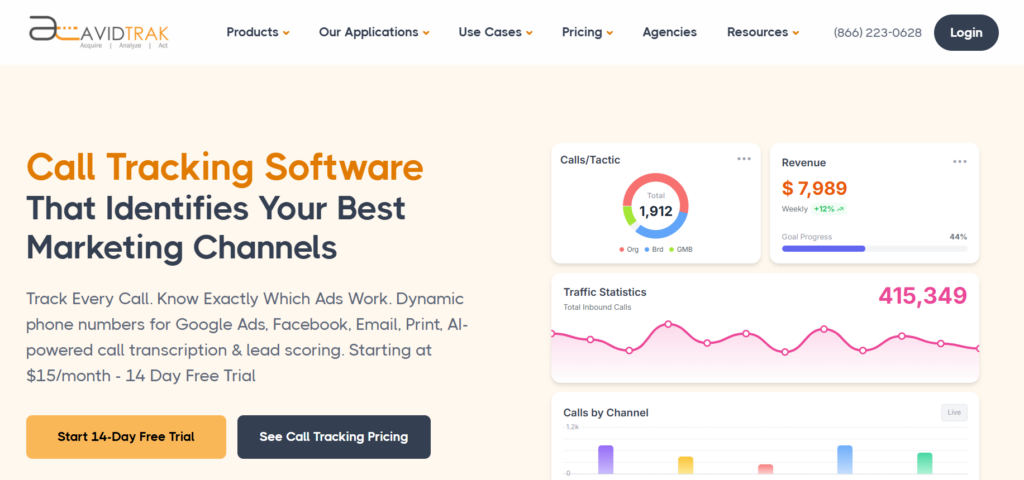 Best for: Marketing teams and agencies that need campaign attribution, routing, and conversation outcomes together.
AvidTrak connects calls to marketing sources through dynamic number insertion and supports IVR and location-based routing. Its AI call transcription and outcome analysis provides summaries, caller-intent analysis, and sentiment alongside the call record.
That combination is useful when the decision involves both advertising and call handling: which campaign generated the inquiry, what the caller wanted, and which team should receive the call.
Pricing: The US and Canada Starter plan is $15/month, including five local numbers, 500 local minutes, and 500 recording minutes. Overages apply. Paid activation includes a default $20 account deposit, refundable upon request after cancellation. The trial lasts 14 days or until its $20 credit is spent. Ask for AI-processing costs separately; recording minutes are not a stated transcription allowance.
2. Invoca
 Best for: Enterprise teams that need business-specific AI signals for marketing and agent performance.
Invoca’s Signal AI Studio supports custom models for intent, product interest, and conversion outcomes. Its analytics also address agent scoring, sentiment, and conversation topics, with findings used in advertising and CRM workflows.
The appeal is the ability to define a valuable call in terms that match the business. An insurance inquiry, vehicle-sales opportunity, and home-service booking should not necessarily share the same qualification rules.
For a Marchex replacement, evaluate how those custom signals appear in campaign reports, agent reviews, and the systems where teams take action.
Pricing: Brand and agency packages require a custom quote. Signal AI is an optional add-on, and premium integration requirements can affect package scope. Include the required models, integrations, and tracking-number volume in the proposal.
3. CallTrackingMetrics
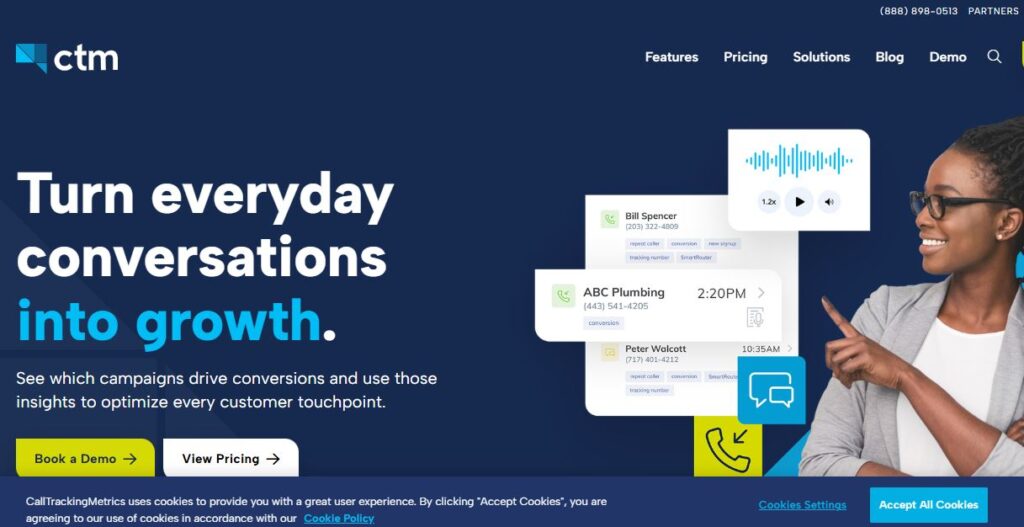 Best for: Teams that want call findings to trigger routing, qualification, and follow-up workflows.
Both CallTrackingMetrics and Marchex connect call-source data with conversation analysis. CallTrackingMetrics, also known as CTM, is particularly worth evaluating when those findings should trigger a business action.
Marketing Pro offers custom fields, API access, conditional workflows, and AI questions for analyzing conversations. A team could use a qualification result to send a conversion signal, notify sales, or trigger follow-up.
Pricing: Marketing Lite is $79/month on monthly billing. Marketing Pro is $179/month, or $149/month billed annually, plus usage. Marketing Pro includes an initial 3,000 transcription minutes per subaccount; this allowance does not renew monthly. AI questions and additional analysis have their own listed charges.
4. CallRail
 Best for: Local businesses and agencies that want attribution with a defined path into premium conversation reporting.
CallRail’s Lead Tracking package combines call and text attribution with recording, routing, transcription, and analysis. Lead Tracking Complete adds forms. Lead Conversion adds premium features such as summaries, sentiment, conversation trends, and automatic conversion tagging.
This gives a local-service team a way to separate two buying decisions: obtaining reliable source reporting and purchasing deeper conversation analysis. The relevant package depends on which findings the team will actually use.
Pricing: Lead Tracking is advertised from $50/month, plus usage. Confirm the billing term and checkout offer. The entry allowance lists five local numbers and 250 minutes; premium conversation features require the appropriate package.
5. Convirza
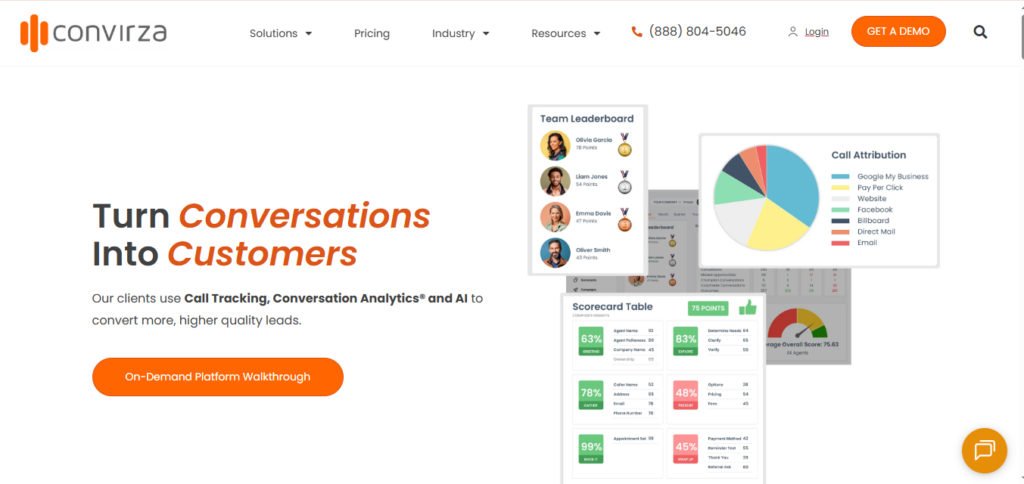 Best for: Managers evaluating lead quality, conversion behavior, and agent phone skills.
Convirza’s Conversation Analytics uses predefined and custom indicators to assess calls. It examines intent, sentiment, lead quality, and agent behavior. Indicators can cover actions such as identifying needs, asking for contact information, and setting appointments.
This makes Convirza relevant when managers need to explain a gap between qualified inquiries and booked business. The useful output is a finding that links to a conversation and supports a specific coaching action.
Pricing: Starter is $29/month. Local numbers are listed at $3/month and call minutes at $0.08. AI services are priced separately: the page lists summary/transcription, standard scoring, sentiment, and advanced QA scoring as distinct services.
6. Infinity
 Best for: Marketing teams that want to understand why attributed callers convert or stop short of buying.
Infinity combines visitor-level call tracking with Conversation Analytics. It analyzes questions, objections, conversation topics, and conversion barriers, and connects call findings with marketing and CRM systems.
The practical value is turning conversation patterns into a marketing decision. Repeated questions about pricing or service availability may suggest a landing-page change; recurring objections may affect campaign messaging.
For a Marchex comparison, ask how Infinity reports those findings alongside the source, outcome, and relevant business location.
Pricing: Infinity uses regional platform fees and call charges. Its US tracking page lists $0.20 per call for Essentials and $0.15 for Pro; Enterprise pricing is quoted. Request a proposal that explicitly covers the required Conversation Analytics functions.
7. WhatConverts
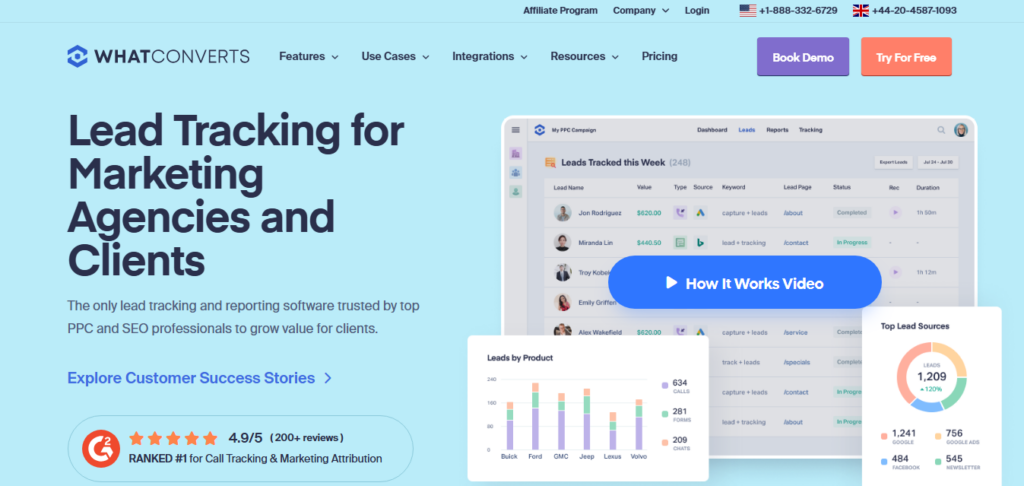 Best for: Agencies that need to judge campaign performance across calls, forms, and chats.
WhatConverts brings multiple lead types into marketing reporting. Its Plus plan combines call, form, and chat tracking, while its qualification tools help teams distinguish relevant inquiries and connect them with their sources. Higher tiers add reporting and marketing-intelligence tools.
This matters when phone calls account for only part of a campaign’s contribution. An agency can review call quality alongside form and chat leads instead of presenting a call count as the entire result.
Pricing: Single-account Call Tracking is $30/month; Plus is $60/month and adds forms and chats. Both include $30 in usage credit, with charges beyond that credit. Pro is $100/month and adds report-building and scheduled-report tools. Agency packages are separate.
8. Nimbata
 Best for: Paid-media teams that want to define call qualification and structure the resulting data.
Nimbata offers AI notes, summaries, tags, ratings, and custom fields alongside attribution. Teams can organize conversations using their own qualification criteria and send resulting data into marketing workflows.
This fits a marketer who needs consistent answers from calls: which service was requested, whether the inquiry met qualification rules, and what follow-up was needed. Structured fields can make those findings easier to report than a collection of recordings.
Pricing: Pro is $39/month on monthly billing or $35/month billed annually. Marketing is $89/month on monthly billing and adds automation and CRM capabilities. Phone usage uses answered-call charges, with tracking numbers additional. Transcription is separately listed at $0.02/minute.
9. Ringba
 Best for: Lead generators and call buyers measuring the performance of distributed inbound calls.
Ringba’s call tracking, ring trees, and routing features support operations that send calls to buyers. Its analytics are relevant when the business needs to assess publishers, buyer performance, routing decisions, and call revenue.
That is a specific type of Marchex alternative. A network distributing leads needs different decision support from a regional manager evaluating appointment handling at company-owned branches.
Pricing: Business is $147/month on monthly billing; Professional is $297/month. Their annual-billing equivalents are $127 and $197/month. Professional includes ring-tree, predictive-routing, and revenue-recovery features. Phone usage, recording, and transcription carry separate charges.
10. CallScaler
 Best for: Small agencies that need source reporting, call review, and recurring client reports.
CallScaler combines call logs and analytics with report filters, exports, and scheduled delivery. Its reporting can include recording links, transcripts, and AI summaries, helping an agency review campaign calls and prepare client updates.
During evaluation, check whether the exported fields and conversation details answer the client’s actual questions. A useful report should make it possible to distinguish relevant inquiries, poor-fit calls, and calls needing follow-up.
Pricing: Call Tracking is $95/month or $65/month billed annually. The plan includes three businesses; removing business and user limits costs an additional $95/month. Phone usage is extra. AI Transcription & Intelligence is listed at $0.006 per 15 seconds. A 14-day trial is available.
How to choose the right Marchex alternative
Reduce the shortlist by the decision your team needs to make:
- Campaign spending and lead quality: Prioritize attribution, qualification, and conversion reporting.
- Agent coaching and branch performance: Prioritize score definitions, location hierarchy, permissions, and comparable operational reports.
- Automated follow-up: Prioritize triggers, routing rules, integration fields, and workflow ownership.
- Call distribution and monetization: Prioritize buyer, publisher, routing, and revenue reporting.
Then evaluate the same reporting requirements across the remaining providers.
Verify the result, not just the feature
Use representative calls to test the outputs you need. Include a poor-fit inquiry, a qualified call that did not book, and a conversation involving a confirmed appointment.
These cases expose a common reporting problem: “appointment discussed,” “appointment requested,” and “appointment booked” are different outcomes.
| Requirement | What to demonstrate | What a useful result should show |
| Attribution | A test call from a known campaign | The correct source attached to the call record and reporting output |
| AI qualification | Calls with different intents and outcomes | Labels that match your definitions, with the conversation available for review |
| Location reporting | Results for different branches and agents | Correct assignment, consistent metrics, and appropriate access |
| CRM reporting | A call associated with a contact or deal | The required fields and business outcome linked to the right record |
| Workflow action | A qualification or missed-call event | The intended notification, follow-up, or conversion event |
Website attribution depends on a working dynamic number insertion setup and sufficient tracking numbers for the traffic being measured. Test the source-to-call connection before evaluating campaign results.
For CRM call tracking, inspect field mapping, contact association, and how later outcome changes are handled. A conversation label should not silently become confirmed revenue.
Preserve the meaning of location reports
An agency subaccount separates client data. A location hierarchy supports comparisons within one organization. They are different requirements.
For multi-location reporting, agree on the definitions of answered calls, qualified inquiries, missed opportunities, and appointments. Apply those definitions consistently across branches before judging comparative performance.
Also verify what a branch manager can see, what a regional manager can aggregate, and whether callers routed between teams remain associated with the correct location.
Compare the required package and billing units
Give each provider the same requirements: active numbers, monthly call volume and duration, recordings, AI services, users, locations, integrations, and billing commitment.
Separate four cost categories:
- Subscription: The package containing the required features.
- Phone usage: Number rentals, calls, minutes, and relevant messaging.
- Analytics: Transcription, scoring, summaries, and other processing.
- Account scope: Additional businesses, users, branding, and service requirements.
Keep refundable deposits and one-time charges separate from recurring fees. A lower advertised subscription does not establish a lower cost for the required deployment.
FAQs about Marchex alternatives
Can I keep existing tracking numbers when switching from Marchex?
Often, but confirm each number’s eligibility and the transfer process with both providers. Document its campaign, routing destination, and business owner before scheduling the move.
AvidTrak offers a number migration process. Keep the existing service active until the agreed transfer and routing checks are complete.
Will historical recordings and reports transfer automatically?
Do not assume they will. Ask what the existing provider can export and what the replacement can import, including recordings, source fields, outcomes, and timestamps.
Moving phone numbers and moving historical data are separate tasks. Export essential records before ending the old subscription and retain an accessible copy for reporting continuity.
Do I need to replace my phone system to change analytics providers?
Not necessarily. Call tracking may forward calls to existing destination numbers. An analytics deployment may instead analyze recordings from another communications platform.
Marchex’s Bring Your Own Conversations product supports analysis of existing conversation data. Ask alternatives how they ingest recordings, retain source information, and return findings to your current systems.
Can one platform support locations in different countries?
Possibly, but check phone-number availability, regional usage rates, and the languages your analytics must handle as separate requirements.
Ask about local-number requirements and test recordings from the relevant teams. Availability of international numbers does not establish that conversation analysis will work equally well for every language, accent, or mixed-language call.
Can call tracking prove ROI without CRM revenue data?
Call tracking can show attributed calls and, depending on the setup, qualified leads or reported lead values. Revenue-based ROI also needs reliable sales outcomes and the relevant costs.
Keep estimated lead value separate from confirmed revenue. Measuring call tracking ROI should account for marketing and tracking costs as well as the business generated.
Choose the reports your team will actually use
The right Marchex alternative should help a team make its next decision: adjust campaign spending, improve call handling, follow up on a qualified inquiry, or compare branch performance.
Build a shortlist around those decisions, then validate attribution, outcome definitions, reporting access, and actual billing scope in a pilot.
If campaign attribution, routing, and conversation analysis fit your requirements, try AvidTrak on a limited campaign before moving a wider set of numbers.


