


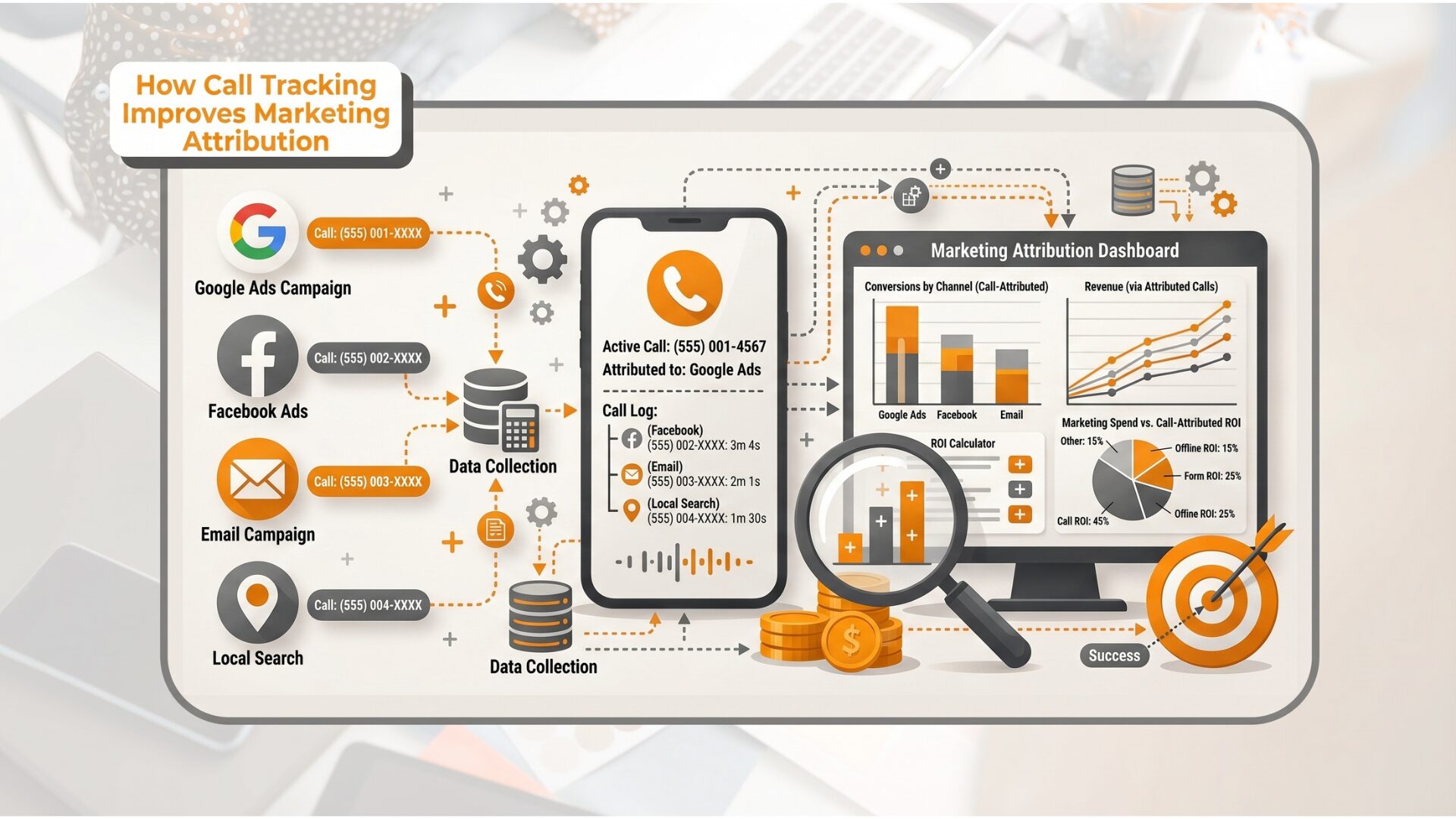
Call attribution is a key part of marketing attribution because it connects phone calls to the channels, campaigns, keywords, and pages that drive them. It helps businesses track not just where calls come from, but whether those calls show real intent, progress into opportunities, and contribute to revenue.
Marketing attribution gets weaker the moment the customer journey leaves the browser. A click is easy to record.
A phone call is different because the buyer may arrive through a paid ad, return through organic search, visit a location page, and then call after comparing options.
If that call is not tied back to the right touchpoints, the business ends up judging marketing with only part of the story.
That is why call tracking matters in attribution. It helps teams connect phone conversations to channels, campaigns, keywords, landing pages, locations, and downstream outcomes.
Instead of seeing only traffic and form submissions, marketing leaders can see which efforts influenced real sales conversations.
Why Attribution Often Breaks When Calls are Involved
Most attribution systems work well for web-based actions such as clicks, form fills, and purchases. The gap starts when a lead chooses to call instead of converting online.
That gap creates problems such as:
- paid search driving high-intent phone leads but getting under-credited
- SEO appearing weaker because callers bypass forms
- branded traffic absorbing too much final-click credit
- location pages influencing calls without being properly recognized
- offline sales teams closing deals that never get tied back to the original source
Another layer often missed is call handling. If calls are not tracked properly, routed incorrectly, or missed altogether, attribution becomes even less reliable because those interactions never get recorded or analyzed.
When this happens, the business ends up funding the wrong campaigns and undervaluing the channels that actually create demand and drive real conversations.
What Better Attribution Looks like When Call Tracking is in Place
Better attribution means every phone call is tied back to its exact source, intent, and outcome. Instead of just tracking that a call happened, businesses can see which campaign drove it, what the caller wanted, and whether it turned into a real opportunity or sale.
A stronger attribution model does not stop at “the phone rang.”
It connects each call back to the channel, campaign, keyword, and page that influenced it, while also capturing what happened during the conversation.
This includes:
- identifying the marketing source that drove the call
- understanding which campaigns and keywords influence call behavior
- recognizing which pages create enough intent for a visitor to call
- capturing whether the caller was serious, comparing options, or ready to act
- tracking whether the call moved into an appointment, quote, opportunity, or sale
This is where attribution becomes more reliable. It starts to reflect actual buying behavior rather than just online activity.
When call data includes both source and outcome, teams can make clearer decisions about where to invest, which campaigns to adjust, and which channels are consistently driving qualified conversations.
How Attribution Changes When Call Data Is Fully Tracked
The difference becomes clearer when you compare how marketing performance is evaluated with and without call tracking in place. What looks like incomplete or misleading data often becomes much more actionable once call activity is properly connected to attribution.
| Without call tracking | With call tracking |
| Paid search is evaluated mainly on clicks and form submissions, missing a large share of phone-driven leads | Paid search is evaluated on total call volume, qualified calls, and how those calls progress into opportunities or sales |
| SEO appears inconsistent because many users prefer calling instead of submitting forms | SEO performance reflects both online and phone-driven conversions, giving a more accurate view of demand generation |
| Branded campaigns receive most of the credit due to last-click attribution | Attribution shows how non-branded campaigns and earlier touchpoints contribute to calls before branded searches close them |
| Landing pages are judged by surface metrics such as bounce rate or form fills | Landing pages are evaluated based on whether they create enough intent to drive calls and meaningful conversations |
| Call activity is treated as general inbound volume with limited context | Each call is tied to a specific source, campaign, page, and intent, making reporting more precise |
| Leadership sees fragmented reporting across marketing and sales | Leadership sees a connected view from marketing activity to conversations, opportunities, and revenue |
Where Call Tracking Improves Attribution the Most
1. Connecting calls to the original marketing source
This is the most direct improvement.
Without call tracking, many phone leads fall into loose categories such as direct traffic, website calls, or general inbound volume. That makes source-level attribution too broad to trust.
With proper tracking, teams can connect calls to:
- paid search
- organic search
- local SEO
- social ads
- display campaigns
- referral traffic
- landing page campaigns
- offline campaigns with dedicated numbers
This is typically enabled through dynamic number insertion and call tracking numbers, which allow each source to be clearly identified for a more accurate view of channel contribution.
2. Strengthening campaign-level attribution
Attribution should not stop at the channel level. Strong marketing decisions are often made at campaign level.
Call tracking helps answer:
- Which campaign is driving the most calls?
- Which campaign is driving the best calls?
- Which campaign brings call volume but weak lead quality?
- Which campaigns are driving calls that actually progress in sales?
When paired with advanced call tracking reporting dashboards and Google Ads call tracking integration, teams can move beyond cost-per-click and evaluate actual performance.
This matters because the campaign with the lowest cost per click is not always the one that delivers the strongest business results.
3. Improving keyword-level attribution in high-intent search
Keyword-level attribution improves when call tracking connects phone calls directly to the search terms that triggered them. This allows businesses to see which keywords drive high-intent calls, qualified leads, and booked appointments, instead of relying only on clicks or form data.
As a result, teams can optimize campaigns based on real call behavior and lead quality.
4. Measuring landing page influence on call behavior
Many landing pages do more than collect forms. They create the confidence, urgency, or clarity that makes the visitor call.
If the team only tracks online conversions, those pages can look weaker than they really are.
Call tracking helps reveal:
- which pages generate call intent
- which pages create stronger qualified calls
- which service pages influence more phone-led conversions
- which location pages perform best by market
That helps content and paid media teams make better landing page decisions.
5. Separating branded and non-branded contribution
One of the most common attribution distortions happens when branded traffic gets too much final credit.
A prospect may first discover the business through a non-branded ad or organic content, then return later through a branded search and call. If the business only looks at last touch, branded search appears to do more of the work than it really did.
Call tracking helps teams see that difference more clearly, especially when paired with multi-touch logic.
6. Improving attribution across locations and service areas
Attribution becomes more complex when several locations, branches, or service areas are involved.
Call tracking helps businesses understand:
- which market generated the call
- which location answered it
- which branch converted it
- which local campaign influenced it
- where missed calls are hurting market-level performance
Capabilities such as zip code-based call routing and [multi-location call tracking] make this possible. This is especially valuable for franchise systems, healthcare groups, and home service businesses.
7. Connecting attribution to revenue outcomes
Attribution becomes more useful when it is tied to actual business outcomes instead of just call volume.
When call tracking is connected to CRM and sales workflows, teams can track:
- qualified calls by source
- appointments by campaign
- opportunities by keyword
- sales by channel
- revenue from call-driven leads
This is where AI-powered transcription and conversation outcome extraction make a clear difference. Instead of reviewing calls manually, teams can identify pricing requests, booking intent, and other key signals automatically.
That makes it easier to understand which marketing tactics are generating real opportunities and where to adjust spend. Attribution moves from basic reporting to a more reliable way to support business decisions.
The Real Business Value of Stronger Attribution
When call tracking improves attribution, decisions become more grounded in actual performance instead of assumptions.
Teams start to see clear improvements in how marketing is evaluated and managed:
- budget allocation becomes more accurate
- high-intent channels receive proper credit
- weak campaigns are identified and adjusted faster
- lead quality becomes easier to compare across sources
This also improves alignment across teams. Sales and marketing work from the same data, and leadership gets a clearer view of how marketing activity connects to conversations, opportunities, and revenue.
This is especially important for businesses where a large share of leads convert through phone calls rather than forms.
A practical example
Consider a regional legal practice running paid search campaigns, local SEO pages, branded campaigns, and remarketing ads.
Without call tracking, reporting is limited to traffic, form submissions, and last-click conversions. Branded search appears to perform the strongest, so it continues to receive most of the credit.
Once call tracking is in place, the picture becomes more accurate. Non-branded accident-related terms are driving more first-touch calls than expected. Location pages are influencing a significant share of serious phone inquiries. Some campaigns generate high call volume but low consultation quality, while branded search closes many calls but is not responsible for creating all of the demand.
With this clarity, the team can adjust budget allocation, refine targeting, and focus on the marketing tactics that are consistently driving qualified conversations.
Signs your Attribution Likely Needs Stronger Call Tracking
Use this checklist as a quick diagnostic.
Attribution gap checklist
- Digital campaigns drive phone leads, but reporting focuses mostly on forms.
- Branded traffic seems to get too much credit.
- Leadership asks which campaigns created real conversations, and the answer is unclear.
- Local or multi-location performance is hard to compare.
- Sales says some sources are stronger, but marketing cannot prove it clearly.
- Revenue gets reported later, but the original call source is missing.
- Paid search looks busy, but call quality is inconsistent.
- Landing pages may influence calls, but the reporting does not show it.
If several of these are true, attribution is likely undercounting the role of phone-driven conversions.
Key Attribution Data Points to Track for Call-Driven Leads
To make attribution useful, teams need to track more than just call volume. The focus should be on connecting each call to its source, intent, and outcome.
| Data point | Why it matters |
| Call source | Shows the original marketing origin |
| Traffic channel | Helps compare search, social, local, and other channels |
| Campaign attribution | Supports better budget decisions |
| Keyword attribution | Improves search optimization |
| Landing page attribution | Shows which pages create call intent |
| First-touch attribution | Reveals demand creation |
| Last-touch attribution | Shows closing influence |
| Qualified call status | Separates useful calls from noise |
| Appointment or opportunity outcome | Connects attribution to sales movement |
| Revenue from calls | Gives leadership a stronger business view |
How Advanced Call Tracking Platforms Improve Attribution Accuracy
Better attribution depends on more than just tracking where a call came from. It requires understanding what happened during the call and how that interaction progressed.
Modern call tracking platforms such as AvidTrak make this possible by combining source tracking with conversation data and call handling.
This includes:
- connecting calls to campaigns, keywords, and landing pages
- capturing caller intent through AI-powered transcription
- identifying outcomes such as pricing requests, bookings, or service inquiries
- ensuring calls are properly routed and not missed, so attribution data remains complete
- linking call activity with CRM and sales stages
When these elements are combined, attribution becomes more reliable because it reflects both how leads are generated and how they are handled.
AvidTrak brings these capabilities together in one system. Instead of relying solely on call volume, teams can track which marketing tactics generate qualified conversations and how those conversations progress toward revenue.
AvidTrak allows marketing and sales teams to make decisions based on actual performance rather than partial data.
Final Thoughts
Call tracking improves marketing attribution by filling one of the biggest gaps in conversion reporting: what happens when a buyer chooses to call instead of convert fully online.
It helps teams understand which channels, campaigns, keywords, and pages are influencing real conversations and which of those conversations turn into sales progress or revenue.
That is what makes it so useful. Better attribution is not only about giving credit more accurately. It is about making better decisions with the budget, the campaigns, and the growth plan.
Frequently Asked Questions
What is call tracking in marketing attribution?
Call tracking in marketing attribution connects phone calls to the channels, campaigns, keywords, and pages that drive them. It helps businesses understand which marketing tactics generate calls and how those calls contribute to leads, opportunities, and revenue.
How does call tracking improve marketing attribution accuracy?
Call tracking improves attribution accuracy by linking each phone call to its original source and capturing what happens during the conversation. This allows teams to measure call intent, lead quality, and outcomes instead of relying only on clicks or form submissions.
Why is call attribution important for businesses?
Call attribution is important because many high-intent leads prefer calling over filling out forms. Without tracking these interactions, businesses miss a large portion of conversion data and may misjudge which campaigns or channels are actually driving demand.
Can call tracking show which keywords drive phone calls?
Yes, call tracking can connect phone calls directly to the keywords and ads that triggered them. This helps businesses identify which search terms drive high-intent calls, qualified leads, and conversions, making keyword optimization more effective.
How does call tracking help measure lead quality?
Call tracking helps measure lead quality by capturing conversation data and identifying signals such as pricing inquiries, booking intent, or service requests. This allows teams to separate qualified calls from low-value interactions and prioritize follow-ups more effectively.
How does AvidTrak improve call attribution and lead tracking?
AvidTrak improves call attribution by connecting calls to campaigns, keywords, and landing pages while also capturing conversation data. With AI-powered transcription and conversation outcome extraction, teams can identify caller intent, track qualified leads, and link calls directly to sales outcomes.


