


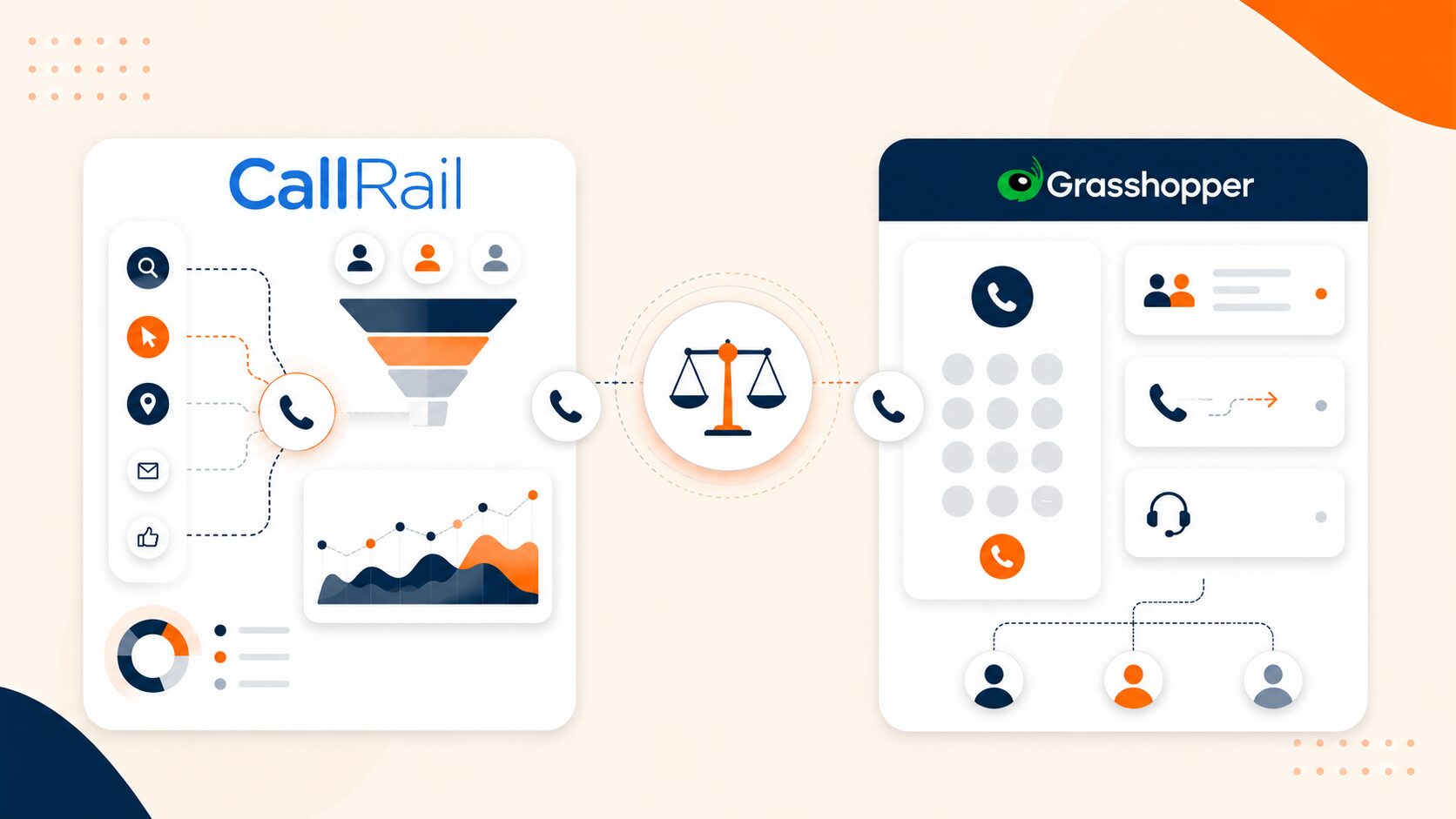
A CallRail vs Grasshopper comparison helps businesses decide whether they need marketing-focused call tracking or a virtual business phone system.
Suppose a potential customer clicks a Google ad, visits a website, and calls the business.
One company may simply need the call sent to the right person through a professional business number. Another company may need to know which campaign, keyword, advertisement, or landing page generated the call.
That difference explains much of the distinction between CallRail and Grasshopper.
CallRail vs Grasshopper: The short answer
CallRail is generally the stronger choice when marketing attribution, call tracking, and conversation analysis are the main requirements.
Grasshopper is generally better suited to entrepreneurs and small teams that primarily need a professional virtual phone system for calling, texting, extensions, voicemail, and forwarding.
The platforms overlap in areas such as business numbers, call recording, routing, and texting. However, they are designed around different primary use cases.
CallRail helps businesses understand where phone leads originate and what happens during those conversations. Grasshopper focuses more heavily on helping businesses manage customer communications.
CallRail vs Grasshopper at a glance
| Comparison area | CallRail | Grasshopper |
| Best for | Marketing teams, agencies, and lead-driven businesses | Entrepreneurs and small business teams |
| Primary purpose | Marketing call tracking and lead attribution | Virtual business phone system |
| Marketing attribution | Strong | Limited |
| Dynamic number insertion | Yes | Not a core capability |
| Keyword-level tracking | Available | Not a core capability |
| Call recording | Yes | Yes |
| Call transcription | Yes | Yes |
| AI call analysis | Stronger marketing and conversion focus | Summaries and sentiment focused on customer communication |
| Call routing | Yes | Yes |
| Extensions | Not a central proposition | Core feature |
| Business texting | Yes | Yes |
| Mobile and desktop calling | Available | Core feature |
| Form tracking | Available on relevant plans | Not a core capability |
| Starting published price | $50/month plus usage | $14/month |
| Main reason to choose | Measure marketing-generated phone leads | Run business communications |
The table compares publicly documented capabilities rather than results from a controlled hands-on test. Features can depend on the selected plan, usage, account configuration, or add-ons.
How we compared CallRail and Grasshopper
A useful comparison should not treat every similarly named phone feature as equivalent.
Instead, CallRail and Grasshopper should be evaluated around the questions a buyer is actually trying to answer:
- Does the business need to know which marketing activity produced each call?
- Does the business mainly need a professional phone system?
- How much call routing and team communication control is required?
- Does the business need call transcription and conversation analysis?
- How important are extensions, mobile calling, and shared customer communications?
- How does the expected usage affect the final cost?
These questions expose the main difference between the platforms more clearly than a long feature checklist.
What is CallRail?
CallRail is a call tracking and lead intelligence platform built primarily for businesses that want to connect customer conversations with marketing activity.
The platform can track calls and texts, associate leads with marketing sources, record conversations, route calls, transcribe conversations, and analyze lead interactions.
CallRail also supports dynamic number insertion, which allows different tracking numbers to appear according to visitor or traffic-source information. Businesses unfamiliar with the process can review how dynamic number insertion works before comparing individual platforms.
This makes CallRail particularly relevant for businesses investing in paid search, SEO, digital advertising, landing pages, or agency-managed campaigns.
Rather than simply showing that a phone call occurred, CallRail is designed to help marketers understand what produced that call and what happened afterward.
What is Grasshopper?
Grasshopper is a virtual phone system designed mainly for entrepreneurs and small businesses.
The platform provides business phone numbers, extensions, call forwarding, texting, voicemail, mobile and desktop applications, recording, and other tools used to manage customer communication.
According to Grasshopper’s business phone features, businesses can use local, toll-free, or vanity numbers while keeping business calls separate from personal communications.
Grasshopper also supports call recording, transcripts, a shared inbox, AI sentiment, and related features that make reviewing customer conversations easier.
The key distinction is that Grasshopper primarily helps businesses manage calls and communications. Marketing attribution is not the central reason to use the platform.
The biggest differences between CallRail and Grasshopper
Call tracking and marketing attribution
Marketing attribution is the clearest difference between CallRail and Grasshopper.
CallRail is designed to connect incoming phone leads with marketing sources. A business can use tracking numbers and dynamic number insertion to understand whether calls originate from paid search, organic traffic, particular campaigns, or other sources.
For businesses running paid campaigns, this type of tracking can also complement a broader Google Ads call tracking strategy that connects phone conversions with PPC activity.
Grasshopper provides call records and reporting, but its primary purpose is not to attribute phone calls to marketing campaigns or keywords.
CallRail therefore has the stronger fit when the business needs to answer questions about campaign performance rather than simply manage incoming calls.
Business phone system and everyday calling
Grasshopper has the stronger position when the main requirement is a straightforward professional business phone system.
The platform provides business numbers, extensions, forwarding, texting, voicemail, mobile applications, desktop applications, and unlimited calling minutes within its current plans.
This setup can suit a consultant, contractor, small agency, or growing service company that wants customers to call a professional business number without installing a traditional office phone system.
This distinction is particularly important for smaller organizations. A business evaluating whether phone attribution is necessary can also review when call tracking makes sense for a small business before paying for a more marketing-focused platform.
Dynamic number insertion and source tracking
Dynamic number insertion is important when a business wants different website visitors to see tracking numbers based on their source or session.
CallRail supports DNI as part of its call attribution capabilities.
Grasshopper is not primarily designed around dynamic website number replacement or keyword-level marketing attribution.
A business that receives significant phone leads from PPC, organic search, landing pages, or other digital campaigns should therefore treat DNI as an important distinction rather than simply comparing the number of phone features available.
Call routing and forwarding
Both platforms can route incoming calls, but the surrounding use case differs.
Grasshopper emphasizes straightforward forwarding to employees, departments, mobile phones, or voicemail. Extensions also make it easier for small teams to organize incoming calls.
CallRail combines call routing with lead-tracking data, which can make the platform more relevant when the business wants routing activity to remain connected with marketing attribution.
Businesses with more complex workflows may also need capabilities beyond standard forwarding. These can include IVR, after-hours handling, simultaneous forwarding, sequential routing, or geographic rules. AvidTrak’s advanced call routing options provide examples of how these routing models differ.
The better platform therefore depends on the routing problem. A simple small-business phone system and a multi-location lead-routing workflow are not the same requirement.
Call recording and transcription
CallRail and Grasshopper both provide recording and transcription capabilities.
CallRail includes recording, transcription, and analysis within its lead-tracking environment. Higher plans add deeper conversation intelligence features.
Grasshopper also provides automatic call recording and transcription. Its communication features include shared conversation history and AI-supported information that helps teams review customer interactions.
The distinction is therefore not simply whether a transcript exists.
CallRail is more focused on using the conversation as marketing and lead intelligence. Grasshopper uses conversation data primarily to make customer communication and follow-up easier.
AI and conversation analysis
AI capabilities have become less useful as a simple yes-or-no comparison because both products now provide them.
CallRail’s higher-tier offerings include call summaries, sentiment analysis, keyword analysis, conversation trend reporting, automatic conversion tagging, and related conversation intelligence features.
Grasshopper provides AI-supported call sentiment and call summaries within its business communication environment through features such as business call sentiment analysis.
The more useful buying question is what the business intends to do with the output.
A marketing team may care about conversion signals, qualification, campaign performance, and lead outcomes. A small business owner may simply want to understand a call quickly and decide who needs a follow-up.
Extensions and team communication
Grasshopper has a clearer advantage when extensions form an important part of the phone setup.
Employees and departments can receive their own extensions and forwarding configurations, while higher Grasshopper plans provide additional extension capacity.
That structure suits businesses looking for a virtual replacement for a traditional office phone system.
CallRail provides call flows and routing, but extensions and general team communications are not the center of its proposition.
Integrations and reporting
CallRail’s reporting and integrations support its marketing-focused position.
The platform is designed to connect calls and lead activity with the systems marketers use to evaluate campaign performance.
A business considering this type of workflow should also look beyond the number of integrations listed on a vendor page. The more important question is whether call data can move into the CRM, advertising, analytics, and reporting systems the team already uses.
For example, AvidTrak’s call tracking integrations connect call data with platforms including Google Ads, Microsoft Advertising, GA4, HubSpot, Salesforce, Zoho, and Looker Studio.
Grasshopper’s reporting is more closely aligned with phone activity and customer communications than detailed marketing attribution.
CallRail vs Grasshopper pricing
Price is one of the largest visible differences between CallRail and Grasshopper, but the lower-priced product is not automatically the better value.
The platforms are selling different types of software.
CallRail pricing
According to CallRail’s pricing plans, the published monthly packages include:
| Plan | Published starting price |
| Lead Tracking | $50/month plus additional usage |
| Lead Tracking Complete | $95/month plus additional usage |
| Lead Conversion | $150/month plus additional usage |
| Lead Conversion Complete | $195/month plus additional usage |
The entry Lead Tracking package includes five numbers and 250 minutes. Additional usage can increase the final cost.
Businesses needing form attribution or deeper conversation intelligence move into higher packages.
Grasshopper pricing
According to Grasshopper’s pricing information, its plans start from $14 per month.
| Plan | Published starting price |
| True Solo | $14/month |
| Solo Plus | $25/month |
| Small Business | $55/month |
True Solo includes one user, one phone number, and one extension. Solo Plus supports unlimited users with one number and three extensions, while Small Business provides more numbers and extension capacity.
Grasshopper therefore has a much lower entry price.
However, that difference makes sense because Grasshopper is primarily selling a virtual business phone system, while CallRail is selling marketing attribution and lead intelligence.
A business that only needs professional calling may have little reason to pay for advanced attribution.
A business spending heavily on advertising may consider campaign-level call data considerably more valuable than a lower base subscription.
Which platform is better for different use cases?
| Business requirement | Better fit |
| Marketing attribution | CallRail |
| PPC and campaign call tracking | CallRail |
| Keyword-level phone attribution | CallRail |
| Virtual business phone system | Grasshopper |
| Professional number for a solo business | Grasshopper |
| Extensions and straightforward team calling | Grasshopper |
| Marketing-oriented conversation intelligence | CallRail |
| Mobile and desktop business communications | Grasshopper |
| Form attribution alongside calls | CallRail |
| Low-cost professional phone setup | Grasshopper |
This is why a single overall winner would be misleading.
The better option depends on whether the phone system is primarily a communications tool or part of the marketing measurement system.
When should you choose CallRail?
CallRail is the stronger fit when incoming calls need to become measurable marketing conversions.
The platform makes more sense when paid advertising generates a meaningful share of leads, marketing teams need campaign attribution, DNI is required, phone leads need to appear in reporting, or conversation intelligence contributes to lead qualification.
CallRail may also suit agencies that need to connect client campaigns with call and form activity.
When should you choose Grasshopper?
Grasshopper makes more sense when the business primarily needs a professional phone presence.
A small company may need a separate business number, customer texting, extensions, voicemail, forwarding, and the ability for team members to answer through mobile or desktop applications.
If detailed campaign attribution is not an important requirement, Grasshopper can provide the communication features without requiring the business to buy a marketing-focused tracking platform.
What if you need call tracking without CallRail’s starting price?
CallRail and Grasshopper are not the only two choices.
A business may need more marketing attribution than Grasshopper provides while still preferring a lower-cost call tracking platform.
AvidTrak is designed specifically around phone attribution, call routing, reporting, conversation analysis, and marketing integrations.
AvidTrak currently lists a Starter plan at $15 per month with five local numbers and 500 local minutes. Professional starts at $30 per month, while the Agency plan starts at $55 per month.
Businesses can review the current AvidTrak call tracking plans and pricing for the latest package details.
AvidTrak also supports tracking numbers and dynamic number insertion for website call attribution, along with keyword tracking, call recording, transcription, routing, reporting, and CRM and advertising integrations.
The positioning is therefore different across all three products:
| Platform | Strongest fit |
| Grasshopper | Businesses primarily needing a virtual phone system |
| CallRail | Businesses wanting an established marketing attribution and conversation intelligence platform |
| AvidTrak | Call-heavy businesses wanting attribution, routing, and reporting with lower published entry pricing |
AvidTrak should not be treated as a direct Grasshopper replacement for every business-phone requirement.
However, when the buyer is comparing CallRail and Grasshopper because the real requirement is marketing call tracking, AvidTrak becomes a more directly comparable alternative.
CallRail vs Grasshopper: Which should you choose?
CallRail and Grasshopper solve different primary problems.
Choose CallRail when the business needs to understand which marketing activity generated phone leads and wants those calls connected with campaign, source, and conversation data.
Choose Grasshopper when the priority is a professional virtual phone system with business numbers, extensions, calling, texting, voicemail, and straightforward forwarding.
Consider AvidTrak when the requirement is specifically call tracking and attribution but the business also places significant weight on published starting price, included minutes, routing flexibility, and phone-focused reporting.
The easiest way to make the decision is to answer one question:
Does the business mainly need to manage calls, or does the business need to measure what generated those calls?
That answer usually makes the CallRail vs Grasshopper decision much clearer.
Frequently asked questions
1. Is Grasshopper a call tracking platform?
Grasshopper provides call reporting, recording, transcripts, phone numbers, forwarding, extensions, and other communication capabilities.
However, Grasshopper is primarily a virtual business phone system rather than a marketing attribution platform. Businesses that need to connect calls with campaigns, keywords, or digital traffic sources should compare dedicated call tracking platforms.
2. Is CallRail a business phone system?
CallRail provides tracking numbers, call routing, texting, recording, and other phone-related capabilities, but its primary proposition is lead tracking and marketing attribution.
A business that only needs a professional number, extensions, and straightforward calling may find Grasshopper more closely aligned with its requirements.
3. Which is cheaper, CallRail or Grasshopper?
Grasshopper has the lower published starting subscription. Grasshopper starts at $14 per month, while CallRail’s Lead Tracking package starts at $50 per month plus additional usage.
The platforms offer different types of functionality, so the starting subscription should not be used as the only measure of value.
4. Does Grasshopper offer call recording?
Yes. Grasshopper supports automatic recording for incoming and outgoing business calls, with controls available at the extension level through its call recording features.
Businesses should still follow applicable call-recording and consent laws.
5. Does CallRail support dynamic number insertion?
Yes. CallRail supports dynamic number insertion for tracking website-generated calls and connecting those calls with available marketing-source information.
DNI is particularly relevant for businesses that want to attribute phone leads from channels such as paid search and organic traffic.
6. Which platform is better for marketing attribution?
CallRail is the stronger choice between the two for marketing attribution.
CallRail is specifically designed to connect calls and other lead activity with marketing sources, whereas Grasshopper primarily manages business communications.
7. Which platform is better for a small business?
Grasshopper may be the better choice for a small business that primarily needs a professional number, calling, texting, extensions, and forwarding.
CallRail may be more appropriate when the same business spends significantly on marketing and needs to identify which campaigns generate phone leads.
8. What are the alternatives to CallRail and Grasshopper?
The right alternative depends on the requirement.
Businesses primarily looking for marketing call tracking can compare products in AvidTrak’s guide to call tracking software platforms.
Businesses primarily seeking a virtual phone system should instead compare business communication and VoIP platforms.
Track the marketing behind every call
AvidTrak connects inbound calls with campaigns, keywords, channels, landing pages, routing activity, and call outcomes.
Plans start at $15 per month with a 14-day free trial and no credit card required.


